

Motmot

オオフラミンゴ 対 アンデスフラミンゴ

Phoenicopterus ruber 対 Phoenicoparrus andinus

オオフラミンゴとアンデスフラミンゴのクイズ
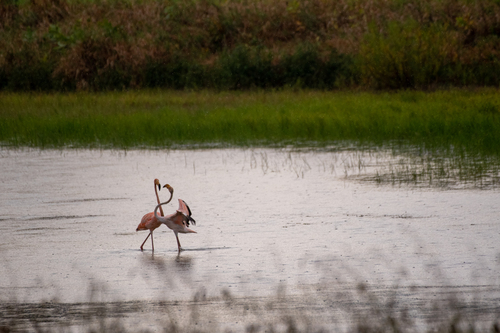
オオフラミンゴ (Phoenicopterus ruber) オオフラミンゴ
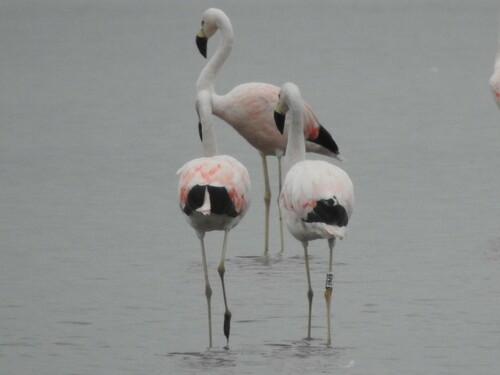
アンデスフラミンゴ (Phoenicoparrus andinus) アンデスフラミンゴ

メディア

読み込み中…

要点

アメリカフラミンゴとアンデスフラミンゴを区別する最も信頼できるフィールドマークは脚の色です:アメリカフラミンゴは常に完全にピンクの脚を示し、アンデスフラミンゴは独特に黄色の脚と三本指の足を持っています。この特徴は他のフラミンゴには共有されていません。飛行中または静止中、両種は黒い一次羽と二次羽を示しますが、アンデスフラミンゴの黒は翼が折りたたまれているときでも見える大胆な三角形を形成します。成鳥のアメリカフラミンゴは全体的に非常に深く、豊かなピンク色をしており、成鳥のアンデスフラミンゴはより淡い色合いで、下の首と胸だけが明るいピンクを示しています。幼鳥のアンデスフラミンゴは均一に淡い灰色で、ピンクは全くなく、アメリカフラミンゴの幼鳥はすでにいくつかのピンクのトーンを示しています。くちばしの色と構造も異なります:アメリカフラミンゴは大きな黒い先端を持つピンクと白のくちばしを持ち、アンデスフラミンゴのくちばしは主に黒で、基部に黄色があり、より深く、特徴的な下向きの曲がりがあります。両種は大きいですが、アメリカフラミンゴは平均して重いですが、重なりがあります。

識別のコツ

  1. 脚の色は診断的です:アメリカフラミンゴは常に完全にピンクの脚を持っています;アンデスフラミンゴは独特に黄色の脚と三本指の足を持っています。これは年齢や季節に関係なく最も信頼できるマークです。
  2. 幼鳥の羽毛:幼鳥のアンデスフラミンゴは均一に淡い灰色で、ピンクはなく、時々頭/首がより暗い色合いで、覆羽/肩羽にはより暗い茶色の中心があります。幼鳥のアメリカフラミンゴは成熟するにつれていくつかのピンクがかったトーンを示します。
  3. 成鳥の体色:成鳥のアメリカフラミンゴは全体的に深く、豊かなピンクで、特に明るい赤の翼覆羽を持っています。成鳥のアンデスフラミンゴははるかに淡く、体はほぼ白く、下の首、胸、翼覆羽だけが明るいワイン色のピンクを示します。
  4. 静止時の翼のパターン:両種は黒い一次羽と二次羽を持っていますが、アンデスフラミンゴでは黒が大胆な三角形を形成し、止まっているときでも見えます。アメリカフラミンゴでは、翼が折りたたまれているときに黒が通常より隠されています。
  5. くちばしの色と形:アメリカフラミンゴは大きな黒い先端を持つピンクと白のくちばしを持っています;くちばしはかなり厚いですが、非常に深くはありません。アンデスフラミンゴのくちばしは主に黒で、基部に黄色があり、より深く(垂直に高い)、より顕著な下向きの曲がりがあります。
  6. 足:アンデスフラミンゴは三本指の足を持っています(遠くからは見えませんが、フラミンゴの中では独特です);アメリカフラミンゴは通常のフラミンゴの足の構造を持っています。
  7. サイズ:アメリカフラミンゴは一般的に重くて高いですが、重なりがあります;鳥が並んでいない限り、サイズに頼らないでください。
  8. 生息地と場所:アメリカフラミンゴはカリブ海、ユカタン、南アメリカ北部の低地沿岸地域に見られます。アンデスフラミンゴは高地のアンデス湖に制限されています。もしあなたが3000メートル以上のアンデスにいるなら、ほぼ確実にアンデスフラミンゴを見ているでしょう。
  9. 飛行時の特徴:両種は飛行中に黒い一次羽と二次羽を示しますが、アンデスフラミンゴの黒い三角形は翼が折りたたまれているときでもより顕著です。
  10. 頭と首の色:アンデスフラミンゴでは、頭と上の首が体の他の部分より明るいピンクであることがありますが、下の首と胸ほど明るくはありません。アメリカフラミンゴはより均一に深いピンクです。
  11. 横から見たくちばしの構造:アンデスフラミンゴのくちばしはより深く、より鋭く下向きに曲がっており、アメリカフラミンゴに比べて下顎が目立たなくなっています。
  12. 他のフラミンゴとの関連:アンデスフラミンゴはしばしばアンデスでジェームズフラミンゴやチリーフラミンゴと混ざり、時には彼らの採餌行動を採用します。アメリカフラミンゴは通常、その範囲内で単一種の群れにいます。
  13. 声:アメリカフラミンゴは大きなガチョウのような鳴き声を出します。アンデスフラミンゴの声はフィールドでの区別には特異ではありません。
  14. 性別と季節:どちらの種にも強い性的または季節的二形性はありません;上記のすべてのフィールドマークは年間を通じて両性に適用されます。
  15. 迷子や飼育された鳥に注意:範囲外のフラミンゴは動物園で見られることがあるか、逃げたものとして現れることがあります;常に最初に脚とくちばしの色を確認し、その後生息地と場所を確認してください。

大きさ

成鳥のアメリカフラミンゴは平均して約3052gの質量を持ち、オスは最大2.8kg、メスは約2.2kgに達し、高さは120〜145cmです。アンデスフラミンゴは質量にばらつきがあり(1.5〜4.9kgが報告されています)、平均してやや軽い傾向がありますが、最大の個体はアメリカフラミンゴの重量に近づくか、超えることがあります。高さでは、アンデスフラミンゴは100〜140cmの範囲であり、したがって重なりがあります。フィールドでは、サイズだけでは鳥を区別するのは信頼できませんが、アメリカフラミンゴは一般的にアメリカ大陸でより大きく、アンデスでは最大のフラミンゴです。

羽色

幼鳥のアンデスフラミンゴは均一に淡い灰色で、時には頭と首がより暗い色合いで、覆羽と肩羽にはより暗い茶色の中心があります;彼らはピンクのトーンを全く持っていません。対照的に、幼鳥のアメリカフラミンゴは成熟するにつれていくつかのピンクがかった色合いを示します。成鳥のアメリカフラミンゴは全体的に深いピンクで、赤い翼覆羽と黒い一次羽と二次羽を持っています;彼らのピンクはアンデスフラミンゴと比較して特に鮮やかです。成鳥のアンデスフラミンゴは体が淡いピンクからほぼ白で、下の首、胸、翼覆羽がより明るいワイン色のピンクです。頭と上の首は体の他の部分より明るいピンクであることがありますが、下の首と胸ほど深くはありません。両種では、飛行中に黒い一次羽と二次羽が見えますが、アンデスフラミンゴでは黒が止まっているときでも大胆な三角形を形成します。くちばしの色は診断的です:アメリカフラミンゴは大きな黒い先端を持つピンクと白のくちばしを持ち、アンデスフラミンゴのくちばしは主に黒で、基部に黄色があり、より深く、より下向きに曲がっています。脚の色は最も特徴的です:アメリカフラミンゴは完全にピンクの脚を持ち、アンデスフラミンゴは黄色の脚と三本指の足を持っています(フラミンゴの中では独特です)。

行動

両種は浅い塩水またはアルカリ性の湖で濾過摂食者ですが、アンデスフラミンゴは柔軟な採餌戦略で知られており、時には彼らが関連する他のフラミンゴ種の採餌パターンを採用します。アメリカフラミンゴは低地の沿岸ラグーンや河口で大きく目立つ群れで見られる可能性が高いです。対照的に、アンデスフラミンゴは通常、アンデスの高地で見られ、より警戒心が強く、近づきにくいかもしれません。両種は頭を下げて歩き、餌を食べますが、生息地の文脈がしばしば同定の手がかりを与えます。

生息環境

アメリカフラミンゴは西インド諸島、南アメリカ北部(ガラパゴスを含む)、ユカタン半島に自生し、低地の塩水ラグーン、沿岸の干潟、河口を好みます。アンデスフラミンゴは南アメリカの高地のアンデス湖に制限されており、しばしば3000メートル以上の塩水またはアルカリ性の環境に生息しています。したがって、場所と標高は強い文脈の手がかりです:低地のカリブ海やユカタンにいるフラミンゴはほぼ確実にアメリカフラミンゴであり、高いアンデスにいるものはアンデスフラミンゴです。重なりは、飼育下や迷子の場合を除いて非常に稀です。

声

アメリカフラミンゴは大きなガチョウのような鳴き声を出します。提供されたメモにはアンデスフラミンゴの特定の鳴き声は記載されていませんが、他のフラミンゴと区別するために特異ではないとされています。声はこれらの二種を区別するための信頼できるフィールドマークではありません。

より良い説明を送る

比較と同じ項目を使ってください。文章はすぐに公開されます。

The most reliable field mark to separate American Flamingo from Andean Flamingo is leg color: American Flamingo always shows entirely pink legs, while Andean Flamingo uniquely has yellow legs and three-toed feet, a feature not shared by any other flamingo. In flight or at rest, both species show black primaries and secondaries, but Andean Flamingo’s black forms a bold triangle visible even when the wing is folded. Adult American Flamingos are a much deeper, richer pink overall, while adult Andean Flamingos are paler with only the lower neck and breast showing bright pink. Juvenile Andean Flamingos are uniformly pale gray, lacking any pink, while American Flamingo immatures already show some pink tones. Bill color and structure also differ: American Flamingo has a pink and white bill with a large black tip, while Andean Flamingo’s bill is mostly black with yellow at the base and is deeper, with a distinctive downward curve. Both species are large, but American Flamingo is heavier on average, though there is overlap.

  1. Leg color is diagnostic: American Flamingo always has entirely pink legs; Andean Flamingo uniquely has yellow legs and three-toed feet. This is the most reliable mark at any age or season.
  2. Juvenile plumage: Juvenile Andean Flamingos are uniformly pale gray with no pink, sometimes duskier on the head/neck and with darker brown centers to coverts/scapulars. Juvenile American Flamingos show some pinkish tones as they mature.
  3. Adult body color: Adult American Flamingos are deep, rich pink overall, with especially bright red wing coverts. Adult Andean Flamingos are much paler, almost white on the body, with only the lower neck, breast, and wing coverts showing bright vinaceous-pink.
  4. Wing pattern at rest: Both species have black primaries and secondaries, but on Andean Flamingo, the black forms a bold triangle visible even when perched due to less overlap from coverts. On American Flamingo, black is usually more concealed when wings are folded.
  5. Bill color and shape: American Flamingo has a pink and white bill with a large black tip; the bill is fairly thick but not extremely deep. Andean Flamingo’s bill is mostly black with yellow at the base, is deeper (taller vertically), and has a more pronounced downward curve.
  6. Feet: Andean Flamingo has three-toed feet (not visible at long range, but unique among flamingos); American Flamingo has the usual flamingo foot structure.
  7. Size: American Flamingo is generally heavier and taller, but there is overlap; do not rely on size unless birds are side by side.
  8. Habitat and location: American Flamingo is found in lowland coastal areas of the Caribbean, Yucatán, and northern South America. Andean Flamingo is restricted to high-altitude Andean lakes. If you are in the Andes above 3,000 m, you are almost certainly seeing Andean Flamingo.
  9. Flight jizz: Both species show black primaries and secondaries in flight, but Andean Flamingo’s black triangle is more prominent even when wings are folded.
  10. Head and neck color: On Andean Flamingo, the head and upper neck may be brighter pink than the rest of the body, but never as bright as the lower neck and breast. American Flamingo is more uniformly deep pink.
  11. Bill structure in profile: Andean Flamingo’s bill is deeper and more sharply downcurved, with a less prominent lower mandible compared to American Flamingo.
  12. Association with other flamingos: Andean Flamingo often mixes with James's and Chilean Flamingos in the Andes, sometimes adopting their foraging behaviors. American Flamingo is usually in single-species flocks in its range.
  13. Voice: American Flamingo gives a loud, goose-like honk. Andean Flamingo’s voice is not distinctive for field separation.
  14. Sex and season: No strong sexual or seasonal dimorphism in either species; all field marks above apply year-round and to both sexes.
  15. Beware of vagrants and captive birds: Out-of-range flamingos may occur in zoos or as escapees; always check leg and bill color first, then habitat and location.

Adult American Flamingos average about 3052 g in mass [wikidata], with males reaching up to 2.8 kg and females around 2.2 kg, and stand 120–145 cm tall [wikipedia]. Andean Flamingos are variable in mass (1.5–4.9 kg reported), but tend to be slightly lighter on average, though the largest individuals can approach or exceed American Flamingo weights. In height, Andean Flamingos range from 100–140 cm, so there is substantial overlap. In the field, size alone is unreliable for separation unless birds are side by side, but American Flamingo is generally bulkier and taller in the Americas, while Andean is the largest flamingo in the Andes.

Juvenile Andean Flamingos are uniformly pale gray, sometimes duskier on the head and neck, with coverts and scapulars showing darker brown centers; they lack any pink tones. Juvenile American Flamingos, by contrast, show some pinkish hues as they mature. Adult American Flamingos are deep pink overall, with red wing coverts and black primaries and secondaries; their pink is especially vivid compared to the Andean. Adult Andean Flamingos are pale pink to nearly white on the body, with the lower neck, breast, and wing coverts a brighter vinaceous-pink. The head and upper neck can be brighter pink than the rest of the body but never as deep as the lower neck and breast. In both species, the black primaries and secondaries are visible in flight, but on Andean Flamingo, the black forms a bold triangle even when perched, due to less overlap from coverts. Bill color is diagnostic: American Flamingo has a pink and white bill with a large black tip, while Andean Flamingo’s bill is mostly black with yellow at the base and is deeper and more downcurved. Leg color is the most distinctive: American Flamingo has all-pink legs, while Andean Flamingo has yellow legs and three-toed feet (unique among flamingos).

Both species are filter feeders in shallow saline or alkaline lakes, but Andean Flamingo is noted for its flexible foraging strategies, sometimes adopting the feeding patterns of other flamingo species it associates with. American Flamingo is more likely to be seen in large, conspicuous flocks in lowland coastal lagoons and estuaries. Andean Flamingo, by contrast, is typically found at high elevations in the Andes and may be more wary and less approachable. Both species wade and feed with their heads down, but habitat context often gives clues to identity.

American Flamingo is native to the West Indies, northern South America (including the Galápagos), and the Yucatán Peninsula, favoring lowland saline lagoons, coastal mudflats, and estuaries. Andean Flamingo is restricted to high-altitude Andean lakes in South America, often above 3,000 meters, in saline or alkaline environments. Thus, location and elevation are strong context clues: a flamingo in the lowland Caribbean or Yucatán is almost certainly American, while one in the high Andes is Andean. Overlap is extremely rare except in captivity or vagrancy.

American Flamingo gives a loud, goose-like honking. No specific vocalization is described for Andean Flamingo in the provided notes, but it is not noted as distinctive from other flamingos. Voice is not a reliable field mark for separation between these two species.

変更を破棄しますか?

保存していない編集があります。今離れると失われます。

オオフラミンゴ · アンデスフラミンゴ · 苦手な鳥