

American Coot vs Purple Gallinule
Fulica americana versus Porphyrio martinica
Play a quiz with American Coot and Purple Gallinule
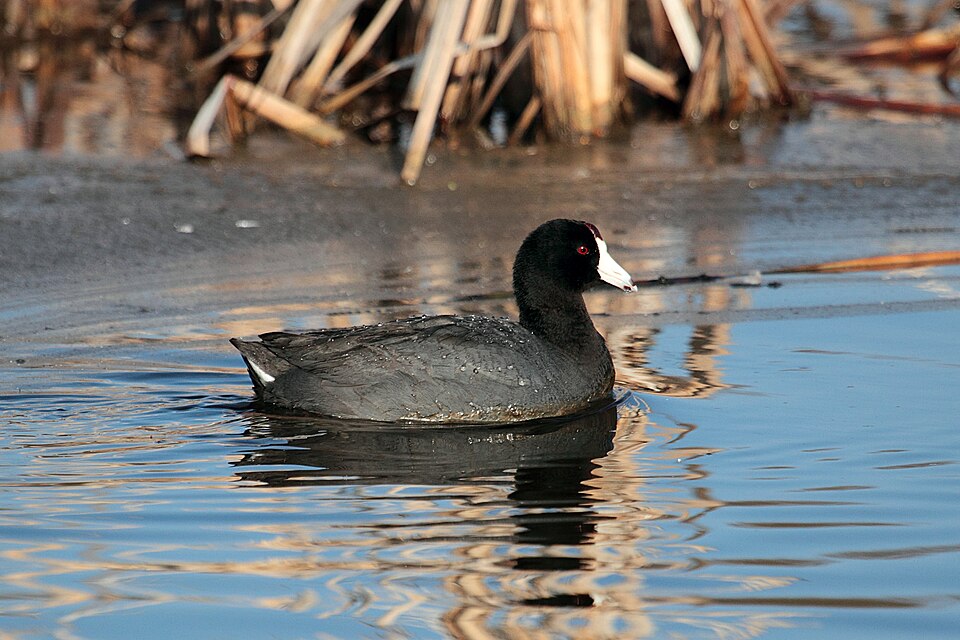 American Coot
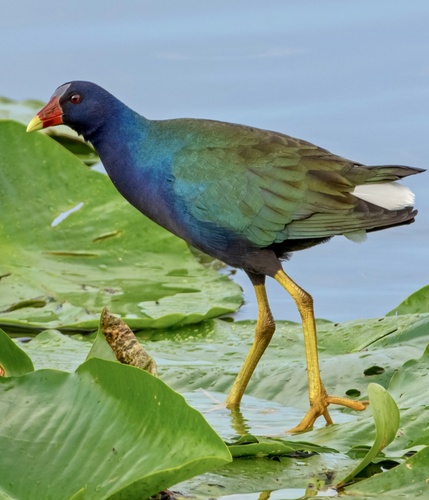 Purple Gallinule
In short
The most reliable field mark between American Coot and Purple Gallinule is the bill and shield color: coots have a white bill and shield with a reddish-brown spot, while adult gallinules show a red and yellow bill with a pale blue shield. Juvenile and immature birds can be tricky, but gallinules are browner and show white undertail coverts, while coots are grayish with olive-brown crowns. In flight, gallinules dangle bright yellow legs, whereas coots have more compact, dark legs and a steadier flight. Structure and leg color, especially when birds are walking or climbing, are also key. Both species can occur in marshes, but coots are bulkier and more aggressive, while gallinules are lighter and more agile.
Identification tips
- Bill and shield color (all ages): Adult coots have a white bill and shield with a reddish-brown spot; adult gallinules have a red and yellow bill with a pale blue shield. Immature gallinules have a pale bill and shield, but never white like coot.
- Leg and foot color (all ages): Adult gallinules have bright yellow legs and feet, visible even at a distance or in flight. Coots have grayish or greenish legs with lobed toes, never bright yellow.
- Juvenile/immature plumage: Juvenile coots are gray with olive-brown crowns and lack white undertail coverts. Juvenile gallinules are light brown with green-bronze hints and always show white undertail coverts; immatures are brown-bronze with some purple on chest.
- Adult body color: Adult coots are dark gray to black overall; adult gallinules are purple-blue with iridescent green and turquoise, though they may look dusky in poor light.
- Undertail pattern: Gallinules (all ages) show white undertail coverts, especially when climbing or flicking the tail. Coots do not have contrasting undertail coverts.
- Flight jizz: Gallinules fly weakly with legs dangling and often drop quickly into cover; coots have steadier, more direct flight and keep legs tucked.
- Size and bulk: Coots are much heavier and bulkier, with a more duck-like silhouette. Gallinules are more slender and delicate.
- Behavior on vegetation: Gallinules often walk on floating plants or climb among reeds, using long toes. Coots rarely climb and are more likely to swim or walk on solid ground.
- Aggression and flocking: Coots are often aggressive and seen in larger groups; gallinules are less aggressive and more solitary or in small family groups.
- Habitat preference: Coots use open water and are more tolerant of disturbed or urban wetlands. Gallinules stick to dense, vegetated margins and avoid open water.
- Sex differences: Both species are sexually monomorphic in plumage, but coot females are smaller than males; gallinule males are slightly larger than females.
- Seasonal context: In winter, gallinules are rare north of the southern U.S., while coots can be found farther north if water is open.
- Bill shape: Both have thick bills, but coot's is shorter and blunter; gallinule's is slightly longer and more pointed at the tip.
- Feet structure: Coots have lobed toes (not webbed), visible when walking; gallinules have long, slender toes for climbing.
- Lighting pitfalls: In poor light, gallinules can appear dull or brownish, but the bill and shield color remain diagnostic if seen well.
Size
American Coots are significantly heavier and bulkier than Purple Gallinules. Coots measure 34–43 cm in length with a wingspan of 58–71 cm, and males can weigh up to 848 g, with females starting at 427 g. In contrast, Purple Gallinules are smaller and lighter, at 26–37 cm long, wingspan 50–61 cm, and average adult body mass around 236 g (males ~257 g, females ~215 g). In the field, coots appear more robust and duck-like, while gallinules are more slender and delicate.
Plumage
Juvenile and immature birds are the most likely to be confused. Juvenile American Coots are gray-bodied with olive-brown crowns and lack any bright color on the bill or legs; they transition to adult plumage by about 4 months. Juvenile Purple Gallinules are light brown with hints of green-bronze on the wings and back, white undertail coverts, and brown legs and feet. Immature gallinules show a brown-bronze body with some purple on the chest and a pale bill and shield. Adult coots are uniformly dark gray to black with a white bill and shield (with a reddish-brown spot), while adult gallinules are strikingly purple-blue with iridescent green and turquoise, a red and yellow bill, pale blue shield, and bright yellow legs and feet. In poor light, gallinules can look dusky or brownish, but the bill and shield color remain distinctive. In flight, gallinules' yellow legs trail and are obvious; coots' legs are less visible and darker.
Behaviour
American Coots are aggressive, often seen in groups, and swim like ducks with a steady, direct movement. They walk with a waddling gait on land, thanks to their lobed toes, and rarely climb. Purple Gallinules are more solitary or in small family groups, and are agile climbers, often seen walking on floating vegetation or clambering among reeds and stems using their long toes. In flight, gallinules are weak fliers, usually flying short distances with legs dangling, while coots have a more direct, steady flight and rarely dangle their legs.
Habitat
Both species are found in marshes, ponds, and lakes with dense vegetation, but American Coots are more widespread and can be found in open water, even on larger lakes and sluggish rivers. Purple Gallinules prefer dense, floating vegetation along shallow margins and are less likely to be seen on open water. Coots are more likely to be present year-round in northern areas where water stays open, while gallinules are more restricted to warmer, southern wetlands and are more prone to vagrancy.