

American Black Duck vs Northern Pintail
Anas rubripes versus Anas acuta
Play a quiz with American Black Duck and Northern Pintail
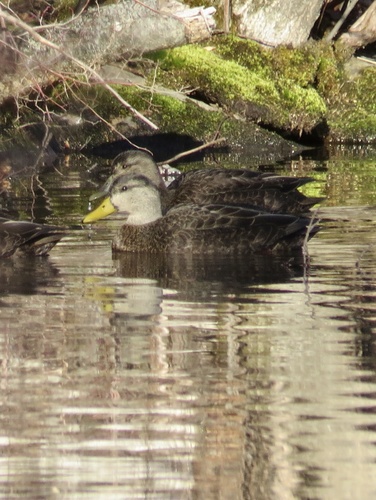 American Black Duck
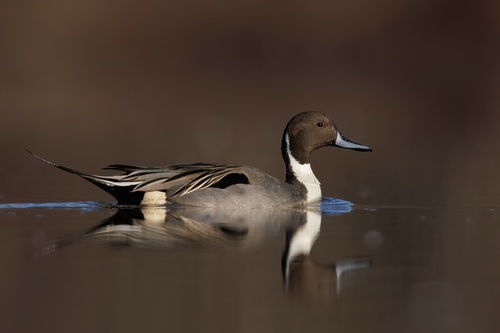 Northern Pintail
In short
The most reliable field mark to separate American Black Duck from Northern Pintail—especially in flight or among immatures—is the speculum and wing pattern: American Black Duck shows a violet-blue speculum with mostly black borders and little or no white, while Northern Pintail has a darker speculum with a prominent white trailing edge (especially in females and juveniles). Pintails are also notably more slender, with a longer neck and, in males, a distinctive pointed tail. Black Ducks look bulkier and darker overall, with both sexes showing a dusky, uniform brown body and a slightly lighter brown head. Careful attention to bill color, body shape, and flight style will help clinch the ID, especially when plumage is ambiguous.
Identification tips
- Speculum and wing pattern (all ages): American Black Duck shows a violet-blue speculum with mostly black borders and little or no white; Northern Pintail (especially females and juveniles) has a darker speculum with a prominent white trailing edge, visible in flight and sometimes at rest.
- Juvenile underparts: Juvenile Black Ducks have broken, pale feather edges below, giving a streaked look; juvenile Pintails are less scalloped and more uniform below.
- Tail shape (adult males): Male Pintail has extremely long, pointed central tail feathers, giving a sharp, pin-like tail; Black Duck tail is short and rounded in all ages and sexes.
- Body shape and jizz: Pintails are slender, long-necked, and graceful, with a forward-leaning swimming posture and fast, swept-back wingbeats in flight. Black Ducks are bulkier, with a thicker neck and a more horizontal, heavy look.
- Bill color: Black Duck males have yellow bills; females have dull green with dark marks. Pintails of both sexes have blue-grey bills.
- Leg and foot color: Black Ducks have orange feet with dark webbing; Pintails have blue-grey legs and feet.
- Head pattern: Black Ducks have a uniformly dark brown head, slightly paler than the body, with a dark eye and crown streak. Pintail males have a chocolate-brown head with a white neck stripe in breeding plumage; females have a more uniform, grey-brown head.
- Underwing in flight: Black Duck shows white underwing linings contrasting with a dark underbody; Pintail underwing is less contrasting.
- Plumage tone: Black Ducks are overall darker and more uniform brown; Pintails are lighter, with more contrast and (in males) striking white and brown patterning.
- Size impression: Black Ducks appear heavier and more robust; Pintails are slimmer and longer-necked.
- Voice: If heard, Black Duck female gives loud, descending quacks; Pintail drake gives a flute-like whistle, and female a rougher quack.
- Habitat context: In wooded or densely vegetated eastern wetlands, Black Duck is more likely; in open marshes, flooded fields, or large lakes, Pintail is more likely, especially outside the eastern US.
- Pitfall—female/juvenile confusion: Female and juvenile Pintails can look superficially similar to Black Ducks, but always check for the white-bordered speculum and more mottled, lighter body.
- Pitfall—hybrids: Black Duck can hybridize with Mallard, but not with Pintail; Pintail hybrids are rare and usually show obvious structural differences.
- Seasonal variation: Pintail males in eclipse resemble females but retain the long tail and wing pattern; Black Ducks show little seasonal change.
Size
American Black Duck is heavier and bulkier (mean mass ~1181.5g) compared to Northern Pintail (~945.5g). While both are large dabbling ducks, Black Ducks appear more robust and thickset, whereas Pintails are more elongated and graceful, with a longer neck and, in males, a much longer tail. In the field, Pintails often look slimmer and more streamlined, especially in flight. Length and wingspan overlap, but the overall impression is of a heavier, darker duck (Black Duck) versus a lighter, more elegant one (Pintail).
Plumage
- Juvenile/immature birds in flight: American Black Duck juveniles resemble adult females but have paler, broken feather edges below, giving a streaked look; their speculum is violet-blue with mostly black borders and rarely any white trailing edge. Juvenile Pintails are less neatly scalloped than adults, with a dull brown speculum and a narrow but distinct white trailing edge—this white is often visible even at a distance.
- Adult males: Black Duck males are dark brown overall with a slightly paler brown head and yellow bill; their speculum is violet-blue with black borders, lacking white. Pintail drakes in breeding plumage are unmistakable: chocolate-brown head, white neck stripe, white underparts, long pointed central tail feathers, and a black speculum with a white trailing edge.
- Adult females: Black Duck females are dark and uniform, with a dull greenish bill and dark marks; their speculum is as above. Female Pintails are lighter brown, more mottled and scalloped, with a grey-brown head, blue-grey bill, and a pointed but shorter tail. Their speculum is dark brown with a prominent white rear border.
- Feet and bill: Black Ducks have orange feet with dark webbing; Pintails have blue-grey legs and feet. Black Duck males have yellow bills, females dull green; Pintails of both sexes have blue-grey bills.
Behaviour
Northern Pintail is more graceful and elongated in posture, both on water and in flight, often holding its neck outstretched and its body low to the water. Pintails swim with a forward-leaning, streamlined profile and fly with fast, slightly swept-back wings. Black Ducks are bulkier and sit higher in the water, with a more horizontal, less elongated profile. In flight, Black Ducks appear heavier and less agile than Pintails, with deeper, slower wingbeats.
Habitat
Both species can overlap in freshwater and coastal wetlands, but American Black Duck is more tied to eastern North America, especially in coastal and wooded wetlands. Northern Pintail has a much broader range across the Northern Hemisphere and is more likely in open wetlands, marshes, and flooded fields. In migration and winter, Pintails may be found in larger, more open bodies of water, while Black Ducks favor more sheltered, vegetated wetlands.
Voice
Both species have quacking calls, but Black Duck females give a loud, descending series of quacks similar to Mallard, while Pintail females have a rougher quack and drakes give a flute-like whistle. Voice is rarely diagnostic at a distance, but the male Pintail's whistle is distinctive if heard.