

American Barn Owl vs Red Owl
Tyto furcata versus Tyto soumagnei
Play a quiz with American Barn Owl and Red Owl
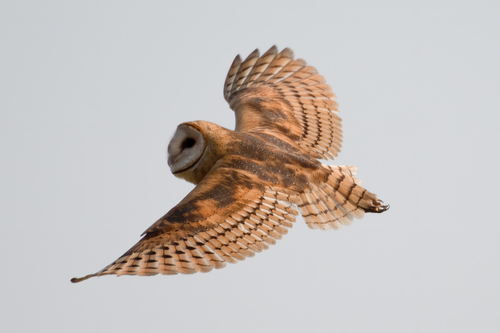 American Barn Owl
 Red Owl
In short
The most reliable field mark to separate American Barn Owl from Red Owl is overall plumage color: American Barn Owl is pale, with whitish or buff underparts and a white or pale heart-shaped face, while Red Owl is distinctly orange-red overall with small black spots and a sooty-black facial disk. Both have the classic barn owl shape and heart-shaped face, but the Red Owl is smaller and richer in color. In flight or perched, the American Barn Owl appears paler and longer-winged, while the Red Owl’s compact, richly colored appearance stands out. Juvenile and immature-specific wing patterns are not described for either species, so focus on overall color and structure.
Identification tips
- Overall color: American Barn Owl is pale (white to buff below, pale brown to gray above); Red Owl is deep orange-red with small black spots. This is the most immediate field mark.
- Facial disk: American Barn Owl has a bright white or pale heart-shaped face; Red Owl’s face is sooty-black or dusky, blending more with the rest of the plumage.
- Size and shape: American Barn Owl is larger and longer-winged, especially noticeable in flight. Red Owl is smaller, more compact, and shorter-winged.
- Underpart spotting: American Barn Owl males are usually plain below; females may be more spotted, but never as richly colored as Red Owl. Red Owl always shows small black spots on a rich rufous background.
- Bill and feet: American Barn Owl’s bill varies from pale horn to dark buff; Red Owl’s is pale grey with a flesh-colored cere. Red Owl’s feet are smoke-grey, while American Barn Owl’s are pink to pinkish-grey.
- Eye color: Both have dark eyes, but Red Owl’s are described as sooty-black, which may appear more striking against its rufous face.
- Tail shape: American Barn Owl has a short, squarish tail, which helps separate it from typical owls but is similar to Red Owl; tail is not a strong separator between these two.
- Flight jizz: American Barn Owl’s undulating, buoyant flight and long wings are more pronounced; Red Owl’s smaller size may make its flight appear more compact and less elongated.
- Legs: Both have feathered legs, but American Barn Owl’s are paler and more visible in flight.
- Habitat and range: Red Owl is only in Madagascar forests; American Barn Owl is widespread in the Americas. If seen outside Madagascar, it is not Red Owl.
- Sex and age: American Barn Owl females are larger and more spotted than males, but both sexes are still much paler than Red Owl. No age-specific marks are described for Red Owl.
- Juvenile plumage: American Barn Owl nestlings are white and downy; no juvenile description for Red Owl, but likely similar in basic structure.
- Diet context: Red Owl preys mostly on native Malagasy mammals; American Barn Owl often eats introduced rodents. Prey remains can be a supporting clue in roosts.
- Vocalizations: Not described for either species in these notes; do not use as a separator.
- Pitfalls: In poor light, American Barn Owl can look buffy, but never truly orange-red. Red Owl’s rich color is unique among barn owls.
Size
Red Owl is smaller and lighter than the American Barn Owl. Red Owl’s body mass averages around 380 g [wikidata], with a measured body length of 27–30 cm and a wing length of about 209 mm. American Barn Owl is generally larger (females of large subspecies can exceed 550 g, with males about 10% lighter) [wikipedia], and appears more elongated in both body and wings. In the field, the American Barn Owl will look noticeably bigger and longer-winged, especially in flight.
Plumage
No age-specific upperwing or flight pattern differences are described for either species, so rely on overall coloration. Adult American Barn Owl is pale above (pale brown to gray, sometimes richer brown) with fine black-and-white speckling, and has a white or pale heart-shaped face. Underparts are white to reddish buff, usually with few or no spots (males paler, females more spotted). Red Owl, by contrast, is orange-red overall with small black spots, a sooty-black eye, and a pale grey beak. Its face is less bright white, appearing more dusky or sooty, and the overall impression is much richer and darker than any American Barn Owl. Juvenile plumage is not detailed for Red Owl, but American Barn Owl nestlings are white-downy with the facial disk visible early. Both species have feathered legs, but American Barn Owl’s are paler. In all ages and seasons, Red Owl’s deep rufous tones and smaller size are distinctive.
Behaviour
Both species share similar barn owl family behaviors: nocturnal, silent flight, and roosting in cavities or dense cover. American Barn Owl is noted for its undulating flight and dangling, feathered legs, which can be a helpful jizz mark. There is no specific behavioral trait described for Red Owl that would separate it in the field, though its smaller size may make its flight appear more compact. Both hunt small mammals, but Red Owl’s prey is mostly native Malagasy species, while American Barn Owl often takes introduced rodents.
Habitat
Habitat is a strong contextual clue. Red Owl is endemic to Madagascar, found in humid evergreen and dry deciduous forests, both primary and disturbed, and sometimes near forest edges. It is rare and local. American Barn Owl is widespread in the Americas, often in open country, farmland, grasslands, and sometimes near human habitation. If you are not in Madagascar, you are almost certainly seeing American Barn Owl. Even within Madagascar, American Barn Owl is not expected (unless introduced), so location is highly diagnostic.