

Amazonian Pygmy-Owl vs Ferruginous Pygmy-Owl
Glaucidium hardyi versus Glaucidium brasilianum
Play a quiz with Amazonian Pygmy-Owl and Ferruginous Pygmy-Owl
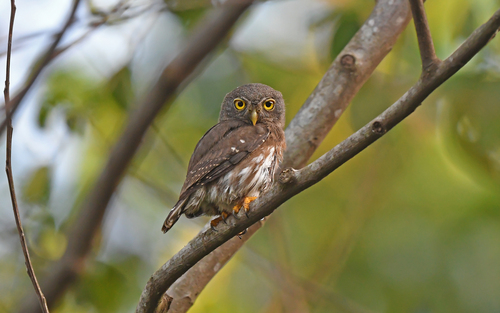 Amazonian Pygmy-Owl
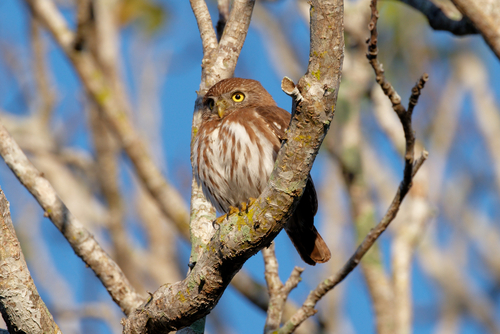 Ferruginous Pygmy-Owl
In short
The most reliable field mark to separate Amazonian Pygmy-Owl from Ferruginous Pygmy-Owl is the crown pattern: Amazonian shows a gray-brown crown with fine white dots (adults) or plain (juveniles), while Ferruginous has a crown with elongated white or buff streaks. Both species have 'false eyes' on the nape and similar overall shape, but Ferruginous Pygmy-Owl is slightly heavier and more variable in color, sometimes appearing rufous. Amazonian Pygmy-Owl is a strict canopy specialist of humid Amazonian forests, while Ferruginous Pygmy-Owl prefers semi-open woodlands and is much more widespread. Juvenile plumage is subtly different, especially on the crown and underpart streaking. Vocalizations are similar but not reliably separable in the field.
Identification tips
- Crown pattern (adults): Amazonian Pygmy-Owl has a gray-brown crown with fine white dots; Ferruginous Pygmy-Owl has elongated white or buff streaks on the crown. This is the most consistent field mark for adults.
- Crown pattern (juveniles): Juvenile Amazonian Pygmy-Owls have a plain, unspotted crown, while juvenile Ferruginous Pygmy-Owls retain crown streaks. Use this for young birds.
- Underpart streaking: Amazonian shows broad brown or rufous-brown streaks on otherwise white underparts; Ferruginous is more heavily and extensively streaked white, sometimes with a messier appearance.
- Tail pattern: Both have dark tails with pale bars, but Ferruginous can be more rufous overall and may show a more uniform rufous tail in some morphs. Amazonian's tail is always dark brown with large white spots/bars.
- Supercilia: Ferruginous Pygmy-Owl shows prominent white supercilia above the facial disc, which can be more obvious than in Amazonian.
- Nape 'false eyes': Both species have two dark nape spots; this is not a separator.
- Bill and cere color: Amazonian has a greenish yellow bill and pale yellow cere; Ferruginous details not specified, so not diagnostic.
- Size and structure: Ferruginous is slightly heavier and may appear stockier with larger feet and talons, but this is subtle and unreliable unless seen side-by-side.
- Color morphs: Ferruginous Pygmy-Owl is highly variable, with gray-brown to rich rufous morphs. Amazonian is more consistently gray-brown above.
- Flight style: Ferruginous often uses undulating flight, similar to woodpeckers; Amazonian's flight style is not described as distinctive.
- Habitat: Amazonian is restricted to tall, humid Amazonian forests (canopy/subcanopy); Ferruginous is found in a wide range of semi-open and edge habitats, including dry forests and urban areas.
- Geographic range: Amazonian is limited to the Amazon Basin and adjacent regions; Ferruginous is widespread from the southern US to Argentina. If outside the Amazon, Ferruginous is far more likely.
- Behavior: Amazonian perches quietly and is rarely seen; Ferruginous is often conspicuous and bold.
- Vocalizations: Both species have similar high-pitched calls; do not rely on voice alone unless well-studied.
- Sexual dimorphism: Both sexes look alike, but Ferruginous females may be slightly more reddish. This is not a reliable field mark.
Size
Both species are very small owls, but Ferruginous Pygmy-Owl is slightly heavier (average adult mass ~69.7 g [wikidata]) compared to Amazonian Pygmy-Owl (~60 g [wikipedia]). Both are about 14–15 cm in length. In the hand or with a direct comparison, Ferruginous may appear a bit stockier with larger feet and talons, but this is subtle and not usually diagnostic at a distance.
Plumage
For adults, Amazonian Pygmy-Owl has a gray-brown crown with small white dots, while Ferruginous Pygmy-Owl shows elongated white or buff streaks on the crown. Both have dark nape spots ('false eyes'), white-spotted wing coverts, and heavily streaked white underparts, but Amazonian's underpart streaks are broad and brown or rufous-brown, while Ferruginous tends to have heavier, more extensive streaking. Tail pattern is similar: both have dark tails with pale bars, though Ferruginous can show more rufous, and its tail may be more uniformly rufous in some morphs. Juvenile Amazonian Pygmy-Owls have a plain (unspotted) crown and less distinct underpart streaking, while juvenile Ferruginous Pygmy-Owls retain crown streaks. Both species lack sexual dimorphism in plumage, though Ferruginous females may be slightly more reddish overall.
Behaviour
Amazonian Pygmy-Owl is strictly diurnal and perches quietly in the canopy or subcanopy, often remaining motionless for long periods. Ferruginous Pygmy-Owl is primarily crepuscular but often active by day, hunting in more open or edge habitats and sometimes using undulating flight reminiscent of woodpeckers. Both species are subject to mobbing by small birds. Amazonian is more secretive and rarely seen, while Ferruginous is bold and often conspicuous.
Habitat
Amazonian Pygmy-Owl is a canopy and subcanopy specialist of tall, humid, tropical evergreen forests in the Amazon Basin, rarely venturing into open or edge habitats. Ferruginous Pygmy-Owl is much more adaptable, occupying a wide range of semi-open wooded habitats from southern Texas and Arizona through much of Central and South America, including dry forests, gallery woodlands, and even urban parks. If seen in dense, continuous Amazonian canopy, Amazonian is far more likely; in open or fragmented woodland, Ferruginous is expected.
Voice
Both species give repeated, high-pitched, short notes or trills. Amazonian Pygmy-Owl's main call is a soft, descending, high-pitched trill, while Ferruginous Pygmy-Owl gives a series of short, high-pitched tweets. In practice, their calls are very similar and not reliably separable in the field without experience or recording analysis.
Amazonian Pygmy-Owl · Ferruginous Pygmy-Owl · My Tricky Birds