

Allen's Gallinule vs Western Swamphen
Porphyrio alleni versus Porphyrio porphyrio
Play a quiz with Allen's Gallinule and Western Swamphen
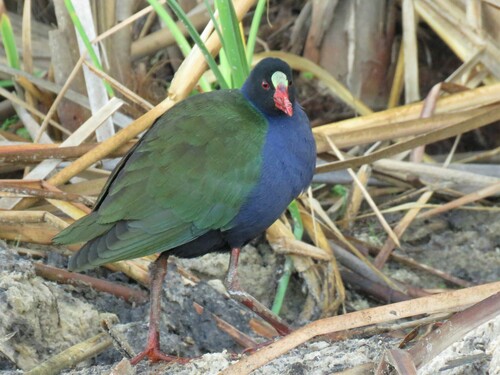 Allen's Gallinule
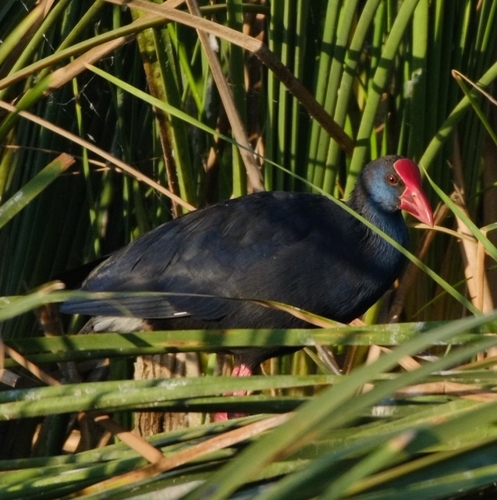 Western Swamphen
In short
The most reliable way to separate Allen's Gallinule from Western Swamphen is by size and structure: Allen's Gallinule is a much smaller, more delicate bird, while Western Swamphen is chicken-sized and robust. In all plumages, Allen's Gallinule shows a short red bill, greenish back, and purple upperparts, with a blue (male) or green (female) frontal shield in breeding adults, and a white undertail with a dark central bar. Juvenile Allen's Gallinule is sandy brown with a buff undertail, contrasting with the consistently bright, all-over blue-purple plumage of Western Swamphen. Swamphens have massive feet, a thick red bill, and a prominent red frontal shield in all ages and sexes. If you see a small, rail-like bird with a nodding swimming motion, it's Allen's Gallinule; a large, strutting, purple-blue bird with huge feet is Western Swamphen.
Identification tips
- Size is the fastest check: Allen's Gallinule is small and rail-like; Western Swamphen is as large as a domestic chicken. If the bird looks big and robust, it's a Swamphen.
- Bill and frontal shield: Allen's Gallinule has a short, fine red bill with a blue (male) or green (female) frontal shield in breeding adults; Swamphen has a massive, thick red bill and a prominent red frontal shield in all ages and sexes.
- Plumage brightness: Swamphen is always bright blue-purple all over, with no brown or sandy tones. Allen's Gallinule is never as bright or as uniformly colored, showing greenish back and purple upperparts, but not the deep blue of Swamphen.
- Juvenile/immature plumage: Young Allen's Gallinule is sandy brown with a buff undertail—never blue or purple. Juvenile Swamphen is still blue-purple, lacking any sandy or brown tones.
- Undertail pattern: Allen's Gallinule shows a short white tail with a dark central bar underneath; Swamphen's undertail is all white and the tail is proportionally shorter and more squared.
- Legs and feet: Both have long toes, but Swamphen's feet are extremely large and thick, often looking oversized for the body. Allen's Gallinule's legs are red and long-toed but more delicate.
- Head shape and jizz: Allen's Gallinule has a small, rounded head and compact body, often with a nervous, quick movement. Swamphen has a large, blocky head and a heavy, upright posture.
- Behavior: Allen's Gallinule is secretive, swimming with a nodding motion and rarely venturing far from cover. Swamphen is bold, often seen strutting or feeding in the open.
- Habitat context: If the bird is in a dense, reedy swamp and skulking, Allen's Gallinule is more likely. If it is striding in open marsh or rice fields, Swamphen is more probable.
- Sex differences: Only Allen's Gallinule shows a difference in frontal shield color between sexes (blue in males, green in females) in breeding plumage; Swamphen does not.
- Seasonal context: Allen's Gallinule is more likely to be seen during migration or winter, as it is very secretive in the breeding season. Swamphen can be seen year-round in its range.
- Swimming style: Allen's Gallinule nods its head as it swims; Swamphen swims more steadily, often walking rather than swimming.
- Vocalizations: Allen's Gallinule gives a sharp, nasal 'pruk' call, mostly from cover; Swamphen is generally louder and more varied, but this is not always diagnostic.
- Mixed flocks: Rare, but if seen together, the size and color difference is unmistakable.
- Common pitfalls: Immature Allen's Gallinule can be mistaken for other small rails, but never shows the blue-purple of Swamphen. Swamphen is unlikely to be confused with any small, brownish rail.
Size
Allen's Gallinule is similar in size to a Water Rail—small and slight, with a short bill and tail. In contrast, Western Swamphen is chicken-sized, much larger and bulkier, with a thick, heavy bill and very large feet. This size gap is obvious in the field, especially if both species are seen near each other or with familiar waterbirds for scale. Allen's Gallinule looks delicate and compact; Western Swamphen is robust and imposing. [wikipedia]
Plumage
Juvenile and immature Allen's Gallinule are sandy brown above with a buff undertail, lacking the bright colors of adults; their undertail is diagnostic if seen well. Adults have a greenish back, purple upperparts, and a short white tail with a dark central bar underneath. Breeding males show a blue frontal shield, females a green one. In contrast, Western Swamphen of all ages is strikingly blue-purple overall, with no brown or sandy tones, and always has a thick red bill and red frontal shield. Swamphen's tail is short and white but lacks the dark central bar; the undertail is usually all white. Allen's Gallinule's legs are red with long toes, but Swamphen's feet are even larger and more exaggerated. The difference in brightness and extent of blue-purple is marked: Allen's Gallinule is never as saturated or as uniformly colored as Western Swamphen. [wikipedia]
Behaviour
Allen's Gallinule is secretive, often skulking in dense vegetation and swimming with a characteristic head-nodding motion. It probes for insects and aquatic animals, and is more likely to be seen on migration or in winter. Western Swamphen is bolder, often strutting in the open, walking with slow, deliberate steps, and sometimes feeding in paddy fields or open marshes. Swamphens are more likely to be seen out of cover, using their massive feet to grasp vegetation. Allen's Gallinule is rarely seen out in the open for long. [wikipedia]
Habitat
Both species are wetland birds, but Allen's Gallinule prefers dense swamps and marshes, staying hidden in thick vegetation. Western Swamphen also inhabits wetlands but is more adaptable, often found in human-modified habitats like rice fields and open marshes, especially in its European and North African range. Swamphens are more likely to be seen in open areas, while Allen's Gallinule is typically glimpsed at the edge of dense cover or during migration. [wikipedia]
Voice
Allen's Gallinule is mostly heard during the breeding season, giving sharp, nasal 'pruk' calls from cover. Western Swamphen is generally noisy, with a variety of loud, harsh calls, but the notes do not specify a diagnostic difference in voice between these two species. [wikipedia]