

Allen's Gallinule vs Black Crake
Porphyrio alleni versus Zapornia flavirostra
Play a quiz with Allen's Gallinule and Black Crake
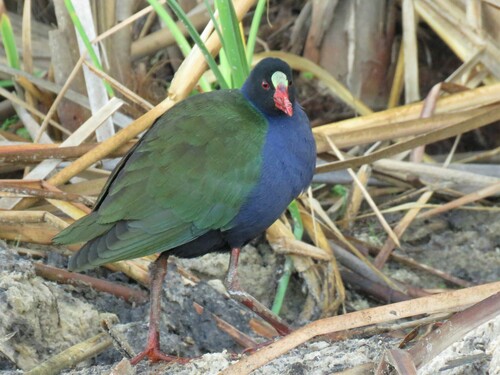 Allen's Gallinule
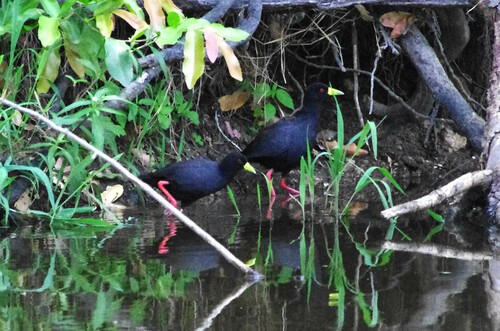 Black Crake
In short
The most reliable field mark is overall body color: adult Black Crake is entirely black with a bright yellow bill and red legs, while Allen's Gallinule shows a greenish back, purple upperparts, and a red bill. Immature birds of both species are brownish, but Allen's Gallinule immatures are sandy brown with a buff undertail, while Black Crake immatures are brown above and dark grey below. In flight or when swimming, Allen's Gallinule shows a short white tail with a dark central bar underneath, a feature not present in Black Crake. Bill color is also key: Allen's Gallinule has a short red bill (blue or green shield by sex in breeding adults), while Black Crake's bill is always yellow or greenish-yellow in immatures. Both have long red legs, but Black Crake's are duller outside breeding. Watch for head-nodding in Allen's Gallinule when swimming, and listen for their distinct calls if you can't get a clear view.
Identification tips
- Bill color is often the quickest check: Allen's Gallinule always has a short red bill (with a blue or green shield in breeding adults), while Black Crake's bill is bright yellow in adults and greenish-yellow in immatures. If you see yellow, it's not Allen's Gallinule.
- Overall body color: Adult Black Crake is entirely black, sometimes with a faint olive-brown tinge on the upperparts, but this is rarely visible. Allen's Gallinule is never all-black; look for greenish back and purple upperparts.
- Tail pattern: Allen's Gallinule has a short white tail with a dark bar underneath, which is often flicked and visible in flight or when swimming. Black Crake's tail is short and lacks any white or barring underneath.
- Leg color: Both have red legs, but Black Crake's are duller outside the breeding season. This is not a reliable separation, but can support other marks.
- Immature/juvenile separation: Immature Allen's Gallinule is sandy brown with a buff undertail, lacking strong contrast between head and body. Immature Black Crake is brown above but has a much darker grey head and underparts, and a greenish-yellow bill. If the underparts are dark and the bill is not red, suspect Black Crake.
- Frontal shield: In breeding Allen's Gallinule, males have a blue shield and females a green one above the bill. Black Crake lacks any such shield.
- Behavior: Allen's Gallinule often nods its head while swimming, a behavior not noted for Black Crake. If you see this, it's a strong pointer to Allen's Gallinule.
- Habitat context: If the bird is skulking in dense floating vegetation and rarely seen, Allen's Gallinule is more likely. Black Crake is more likely to be seen foraging openly at the water's edge.
- Voice: A sharp, nasal 'pruk' call is Allen's Gallinule; a chattering duet or dove-like cooing is Black Crake.
- Sex differences: Only Allen's Gallinule shows sexual dimorphism in the frontal shield (blue in males, green in females) during breeding. Black Crake sexes are similar, though males are slightly larger and may have a hooked upper mandible.
- Head and underparts in immatures: Allen's Gallinule immatures are uniformly sandy brown; Black Crake immatures have a dark grey head and underparts, contrasting with brown upperparts.
- Downy chicks: Both species' chicks are black and indistinguishable at this stage; do not rely on chick plumage.
- Flight views: No distinctive upperwing or flight marks are described for either species, but Allen's Gallinule's white undertail with a dark bar may be visible in flight.
- Seasonal context: Allen's Gallinule is most secretive during breeding and easier to see on migration or in winter. Black Crake is present year-round in suitable wetlands.
- Jizz: Both have long toes and short tails, but Allen's Gallinule may appear more compact and is more likely to be seen swimming with head-nodding, while Black Crake is often seen walking at the water's edge.
Size
Both species are similar in size, with Black Crake slightly larger (19–23 cm) and Allen's Gallinule just smaller than a Water Rail. Both have long toes and short tails, so size alone is rarely diagnostic in the field. Structural differences are subtle and best used in combination with plumage and bill color.
Plumage
- Immature/juvenile plumage: Immature Allen's Gallinule is sandy brown overall with a buff undertail, lacking strong contrast on the head or underparts. Immature Black Crake is brown above but has a noticeably darker grey head and underparts, and its bill is greenish-yellow, not red. Both species' downy chicks are black and indistinguishable at that stage.
- Adult plumage: Adult Allen's Gallinule has a greenish back, purple upperparts, and a short white tail with a dark central bar underneath. The bill is red, and breeding males have a blue frontal shield (green in females). Adult Black Crake is entirely black with only a faint brown-olive tone on the wings and upperparts (rarely visible), a bright yellow bill, and red legs.
- Tail pattern: Allen's Gallinule shows a white undertail with a dark central bar, especially obvious when flicking the tail or in flight. Black Crake lacks this pattern; its tail is short and does not show white underneath.
- Wing pattern: No distinctive upperwing or flight marks are described for either species, so rely on body and tail coloration.
Behaviour
Allen's Gallinule is more secretive, especially during breeding, and is often hidden in dense swamps. It nods its head as it swims, a behavior not noted for Black Crake. Black Crake is more likely to be seen openly foraging at the water's edge. Both probe mud and shallow water for food, but Allen's Gallinule is more likely to be heard than seen in the breeding season.
Habitat
Both species inhabit wetlands, marshes, and swamps, but Allen's Gallinule is especially tied to dense, floating vegetation and is often very secretive, especially in the breeding season. Black Crake is widespread in sub-Saharan Africa (except very arid areas) and is more likely to be seen in open wetland areas, sometimes away from dense cover. Both may undertake seasonal movements, but Allen's Gallinule is more likely to be seen on migration or in winter when it is less secretive.
Voice
Allen's Gallinule gives a sharp, nasal 'pruk' call, especially when breeding. Black Crake's main call is a duet: a throaty chattering 'krrrok-kraaaa' followed by a dove-like 'coo-crr-COO.' If you hear a nasal, single-note call, suspect Allen's Gallinule; a chattering duet points to Black Crake.