

Alder Flycatcher vs Willow Flycatcher
Empidonax alnorum versus Empidonax traillii
Play a quiz with Alder Flycatcher and Willow Flycatcher
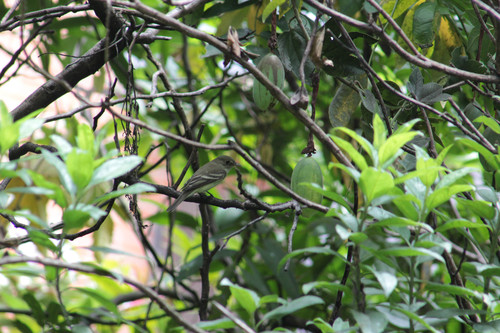 Alder Flycatcher
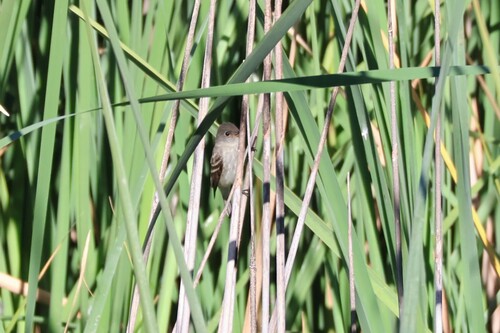 Willow Flycatcher
In short
Alder and Willow Flycatchers are nearly identical in the field, especially in adult plumage, but careful attention to subtle differences in bill color, breast contrast, and juvenile wingbars can help. Juvenile Alder Flycatchers show browner upperparts and more yellowish underparts than Willow, with buffier wingbars. On perched adults, Alder often shows a slightly darker olive crown, a more distinct breast band, and a pinkish or yellow-orange lower mandible, while Willow’s bill is more orangish below and gray above. Both species are best separated by voice, but in silent birds, these fine points—especially in fresh juveniles—may offer clues. Expect overlap and uncertainty, as even experts struggle with silent Empidonax.
Identification tips
- Juvenile plumage: Look for brownish upperparts and yellowish underparts with buffy wingbars in juvenile Alder Flycatchers; this is less pronounced in Willow, which tends to be duller and less contrasting. This mark is most useful in late summer and early fall.
- Breast band: Alder Flycatcher often shows a more distinct, darker breast band against a white throat, while Willow’s breast is more evenly washed olive-gray with less contrast.
- Crown color: Alder’s crown is slightly darker olive-green than the back, sometimes giving a capped appearance; Willow’s crown is not as distinct from the back.
- Bill color: On close views, Alder’s lower mandible is pinkish or yellow-orange with a black upper mandible; Willow’s lower mandible is more orangish and the upper is gray. This is subtle and may be affected by light.
- Eye ring: Both have thin white eye rings, but Willow’s is less distinct, sometimes appearing almost absent in worn birds.
- Wingbars: Both species have white wingbars and pale tertial edges; in fresh juveniles, Alder’s wingbars are buffier and more contrasting.
- Tail flicking: Alder Flycatcher often flicks its tail upward, especially when singing or agitated. Willow does this less frequently.
- Primary projection/wing formula: Not described in detail here, but the ratio of primary feather lengths can separate these species in the hand or in high-quality photos. Not practical in the field with binoculars.
- Overall jizz: Both are small, upright flycatchers with similar posture and foraging behavior; structure is not a reliable separator.
- Habitat: Both use wet thickets, but Alder is more closely tied to alder, birch, and maple stands. Willow is more flexible but this is not a strong field mark in overlap zones.
- Vocalizations: If the bird is singing, use song as your primary field mark—Alder’s 'fee-bee-o' is distinctive. Calls are less reliable unless well known.
- Season: Juvenile plumage marks are most useful in late summer and early fall. Adults in breeding plumage are extremely similar.
- Sex: No reliable sexual dimorphism in either species.
- Pitfalls: Beware of overlap and individual variation; silent Empidonax are often best left unidentified unless vocalizing or in the hand.
- Confidence: If you cannot hear the bird, treat any identification as tentative unless multiple field marks align.
Size
Both species are very similar in size, with Willow Flycatcher averaging about 12.6 g in mass [wikidata]. Alder Flycatcher is noted as one of the larger Empidonax, with a mass range of 12–14 g and a length of 13–17 cm [wikipedia], but this difference is not reliable in the field. Expect them to look and feel the same size through binoculars.
Plumage
Juvenile Alder Flycatchers have brownish upperparts, yellow underparts, and yellowish-brown or buff wingbars, which can be slightly warmer and more contrasting than the juvenile Willow’s, though Willow juveniles are not described in detail here. In adults, Alder’s upperparts are dull greenish-olive with a slightly darker olive-green crown, a white throat, and a darker breast band that stands out more than on Willow. Willow Flycatchers have brown-olive upperparts, a less distinct white eye ring, and a breast washed with olive-gray, lacking the sharp breast band. Both show white wingbars and pale tertial edges, but Alder’s wingbars may be crisper, especially in fresh juveniles. Bill color is subtly different: Alder shows a pinkish or yellow-orange lower mandible with a black upper mandible, while Willow’s lower mandible is more orangish and the upper is gray. Eye rings are thin and white in both, but Willow’s is less distinct.
Behaviour
Alder Flycatcher is noted for frequent upward tail flicking, especially when singing or agitated, which is less pronounced in Willow Flycatcher. Both species use similar sit-and-wait foraging strategies, sallying from exposed perches to catch insects. Flight style and general jizz are otherwise very similar and not reliably separable.
Habitat
Alder Flycatcher breeds in wet thickets, especially those dominated by alder, birch, and maple, often near water. Willow Flycatcher also favors shrubby, wet habitats but is more flexible, occupying a range of riparian thickets and brushy areas. In overlap zones, habitat is not a reliable separator, but pure stands of alder or birch may favor Alder Flycatcher.
Voice
Vocalizations are the most reliable way to separate these species. Alder Flycatcher’s song is a distinct 'fee-bee-o,' often delivered with a head throw and tail shake. Willow Flycatcher’s song is not described here, but is well known to differ and is the main field separation. Calls also differ, but these are subtle and not described in detail for Willow. If the bird is singing, identification is straightforward.