

African Woolly-necked Stork vs White Stork
Ciconia microscelis versus Ciconia ciconia
Play a quiz with African Woolly-necked Stork and White Stork
 African Woolly-necked Stork
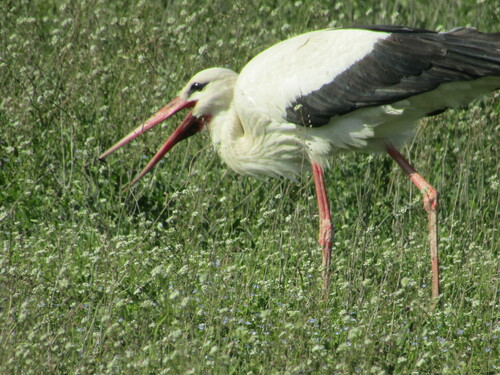 White Stork
In short
The most reliable field mark to separate African Woolly-necked Stork from White Stork is the color pattern of the neck and head: woolly-necked shows a distinctive downy white neck with a black cap, while White Stork has an all-white head and neck. In flight, White Stork is much larger and shows a classic white body with black flight feathers, whereas woolly-necked is overall darker with white only on the neck, lower belly, and under-tail. Juvenile woolly-necked storks can show a white forehead spot, which never occurs in White Stork. Bill color is also key: woolly-necked has a mostly dark bill, while White Stork's is bright red. Both have long red legs, but the overall jizz and plumage contrast are strikingly different with careful viewing.
Identification tips
- Neck and head pattern (all ages): African Woolly-necked Stork always shows a downy white neck with a contrasting black cap; White Stork's head and neck are entirely white with no cap or woolly texture.
- Bill color (adults): Woolly-necked has a mostly blackish bill (sometimes dark red at base); White Stork's bill is bright red and slender. This is visible at moderate range.
- Body and wing color (adults): Woolly-necked is glistening black overall except for the white neck, lower belly, and under-tail; White Stork is white-bodied with black only on the wings (flight feathers).
- Flight profile (all ages): In flight, White Stork shows a classic white body and forewing with sharply contrasting black primaries and secondaries, and a long, straight neck. Woolly-necked appears darker overall, with white restricted to the neck and vent area.
- Juvenile marks: Juvenile woolly-necked storks may show a white spot on the forehead and a streaked black-and-white feathered forehead, never seen in White Stork. Young White Storks are simply duller versions of adults, lacking any forehead spot.
- Size: White Stork is much larger and bulkier than woolly-necked, but beware of lone birds or distant views where size is hard to judge.
- Leg color: Both have long red legs, but this is not diagnostic between the two.
- Tail: Woolly-necked has a deeply forked white tail, usually hidden by long black under-tail coverts; White Stork's tail is short and square, but this is rarely a useful field mark.
- Forearm skin (close views): Woolly-necked shows a narrow, bright orange-red unfeathered skin band along the underside of the forearm when wings are open—unique to this species, but only visible at close range or in certain postures.
- Behavior: Woolly-necked is more likely to be solitary or in small groups and may show acrobatic flight maneuvers; White Stork is often seen in larger, more organized flocks, especially on migration.
- Habitat: Woolly-necked is more flexible in habitat choice, including forested wetlands and agricultural areas; White Stork prefers open country and is more likely to nest on buildings.
- Iridescence: Woolly-necked's black feathers can show coppery-purple iridescence, especially on the fore-neck; White Stork lacks any iridescence.
- Voice: Both are mostly silent, but woolly-necked may whistle or hiss at the nest; not a reliable field mark.
- Sexes: Both species are sexually monomorphic in plumage; do not use sex to separate them.
- Pitfalls: Do not rely on leg color alone; both can show red legs. Beware of distant or backlit views where the woolly neck or black cap may be hard to see—use bill color and overall body contrast as backup marks.
Size
White Stork is significantly larger, averaging 100–115 cm in length with a 155–215 cm wingspan [wikipedia]. African Woolly-necked Stork is medium-sized for a stork, at 75–92 cm tall [wikipedia]. This size difference is obvious when both are seen together, but less so at a distance or alone. Both species have long legs and necks typical of storks, but White Stork has a bulkier, longer-bodied appearance.
Plumage
- Juveniles and immatures: Juvenile African Woolly-necked Stork is a duller version of the adult, with a feathered forehead (sometimes streaked black-and-white) and a prominent white mark in the center of the forehead in newly fledged birds. Immatures have less iridescence and longer, fluffier neck feathers. White Stork juveniles are similar to adults but with duller, less vivid red on the bill and legs, and lack any forehead spot or woolly neck texture.
- Adults: African Woolly-necked Stork has a striking downy white neck, black cap, glistening black body, white lower belly and under-tail, and a deeply forked white tail (usually hidden). The bill is heavy and mostly blackish, sometimes with a dark red base. White Stork is white overall with black on the wings (flight feathers), long red legs, and a long, pointed red bill. The head and neck are entirely white, lacking any black cap or woolly texture. In flight, White Stork shows a classic white body and forewing with sharply contrasting black primaries and secondaries; woolly-necked is much darker overall, with only the neck and ventral area white.
- Special mark: When woolly-necked stork opens its wings, a narrow, bright orange-red unfeathered skin band is visible along the underside of the forearm—unique to this species.
Behaviour
Both are broad-winged soaring birds, but White Stork is more likely to be seen in larger, more organized flocks, especially on migration, while African Woolly-necked Stork is usually solitary or in small, loose groups. Woolly-necked stork can perform acrobatic flight maneuvers such as rolling and diving, and has been described as having a 'bat-like' abrupt flight when leaving the nest. Both species fly with necks outstretched, but White Stork's flight is more stately and direct.
Habitat
African Woolly-necked Stork uses a wide range of habitats, including marshes in forests, agricultural areas, and freshwater wetlands across Africa, and is not an obligate wetland species. It nests singly or in small loose colonies, often in trees, and occasionally on artificial structures. White Stork is more associated with open country, wetlands, and agricultural landscapes, and is famous for nesting on buildings and other human-made structures in its range. Both can be found near people, but White Stork is more likely to be seen in large numbers in open areas.
Voice
Both species are generally silent, as is typical for storks. African Woolly-necked Stork can give bisyllabic whistles during displays and a fierce hissing sound when threatened. No distinctive field-call is noted for White Stork; both may bill-clatter at nests, but this is not a reliable separation mark.