

African Houbara vs Asian Houbara
Chlamydotis undulata versus Chlamydotis macqueenii
Play a quiz with African Houbara and Asian Houbara
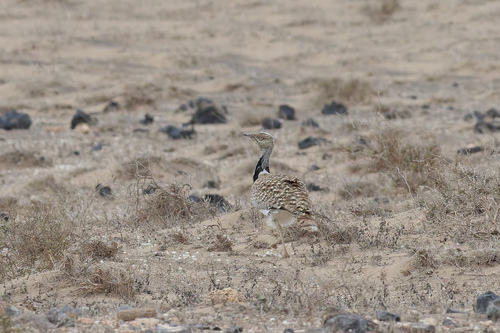 African Houbara
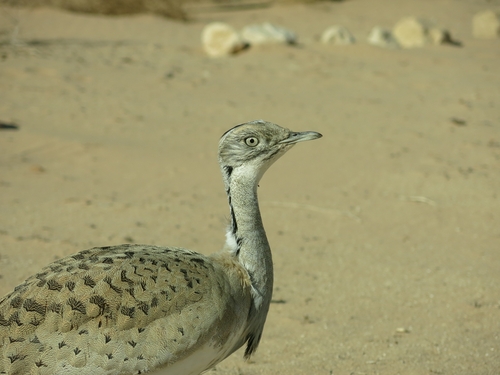 Asian Houbara
In short
The most reliable field mark between African Houbara and Asian Houbara is the pattern of the upperwing in flight: Asian Houbara shows a distinct white patch at the base of the primaries, visible from below as a mostly white wing with a black trailing edge, while African Houbara lacks this feature and shows more extensive black and brown on the flight feathers. Both species are brown above and white below with black neck stripes, but African Houbara is generally smaller and duller, with females especially appearing greyer above. Structure and display behavior are similar, but subtle differences in size and upperpart tone can help in good views. Habitat is a strong clue: African Houbara is restricted to North Africa and the Canary Islands, while Asian Houbara occurs from the Middle East eastwards across Central Asia.
Identification tips
- Underwing pattern in flight (all ages): Asian Houbara shows a bold white patch at the base of the primaries, making the underwing mostly white with a black trailing edge. African Houbara lacks this, showing more extensive black and brown on the flight feathers, so the underwing is less contrasting.
- Upperwing pattern (all ages): From above, both species show large areas of black and brown on the flight feathers, but the white base of the primaries is more apparent in Asian Houbara, especially in good light.
- Size and bulk: Asian Houbara is generally larger and bulkier, but there is overlap. Use this only as a supporting mark, especially for lone birds.
- Female plumage: African Houbara females are greyer above than males, while Asian Houbara females are only slightly paler. This is subtle and best used with other marks.
- Neck stripes: Both species have black stripes down the sides of the neck; this is not a useful separator.
- Crown and upperpart tone: African Houbara tends to be duller overall, especially on the upperparts, but this is variable and not always reliable.
- Display behavior: Both species have flamboyant courtship displays with erected neck feathers and head withdrawal; field separation by display is not practical.
- Habitat and range: African Houbara is confined to North Africa and the Canary Islands; Asian Houbara is found from the Middle East eastwards. Use location as a strong clue, especially outside the narrow zone of potential vagrancy.
- Perched birds: Separation is very difficult when birds are not in flight; rely on subtle size and upperpart tone, but expect uncertainty.
- Sexual dimorphism: Both species show similar sex differences—males are larger and heavier, but plumage is nearly identical between sexes.
- Juvenile/immature birds: The underwing pattern remains diagnostic in flight for all ages; there are no described juvenile-specific upperwing marks that override the adult pattern.
- Vocalizations: Not a useful field mark—both species are largely silent, with only low booming notes from displaying males.
- Pitfalls: Do not rely on neck stripes or general brown-and-white coloration; these are shared. Focus on underwing pattern in flight and range.
- Seasonal variation: No major seasonal plumage changes described for either species; marks are stable year-round.
- When in doubt: If you cannot see the underwing in flight or are outside the known range, identification may remain uncertain. Use a combination of range, size, and subtle plumage tone, but expect overlap.
Size
African Houbara is slightly smaller and lighter than Asian Houbara. African Houbara measures 55–75 cm in length with a wingspan of 135–170 cm, and an average body mass around 1.5 kg (females lighter, males heavier) [wikidata]. Asian Houbara averages about 65 cm in length and a 140 cm wingspan, with males 9–15% larger than females. In the field, size overlap is substantial, but Asian Houbara tends to look bulkier, especially in direct comparison or with experience.
Plumage
The key age-related difference is in the wing pattern seen in flight: Asian Houbara (all ages) shows a prominent white patch at the base of the primaries, resulting in a mostly white underwing with a black trailing edge. African Houbara lacks this white patch, instead showing more extensive black and brown on the flight feathers, so the underwing is less contrasting. Both species are brown above and white below, with black stripes down the sides of the neck. Females of both are smaller and paler, but African Houbara females are distinctly greyer above than males, while Asian Houbara females are only slightly paler. In perched birds, the difference is subtle, but in flight, the underwing pattern is diagnostic.
Behaviour
Both species display similar bustard behaviors: elaborate courtship displays with neck feather erection and head withdrawal, and ground-nesting habits. Males of both species perform flamboyant displays, but the details of the display are not reliably separable in the field. Both are omnivorous and forage on the ground, often in arid open landscapes. There is no strong behavioral separation for field identification.
Habitat
African Houbara is found in arid habitats of North Africa and the Canary Islands, never ranging into Asia. Asian Houbara occupies desert and steppe regions from the Sinai Peninsula, across Iran, to Central Asia and Mongolia. Range is a strong clue: any houbara in North Africa is African Houbara, while birds from the Middle East eastward are Asian Houbara. Overlap is extremely rare and only possible with vagrants.
Voice
Both species are largely silent, but males may give low booming notes during breeding displays. These vocalizations are not typically useful for field separation, as they are infrequent and subtle, and the notes do not describe diagnostic differences.