Motmot

Bird course · Lesson 8 · 12 minutes

Ducks: the males

Five ducks, each with one striking feature

Today it's the ducks' turn. In winter, drakes wear their smartest plumage, and they are easy to tell apart. The females look much more alike, and we leave those to a later course. Look for the males.

Each of these five has one thing that gives it away: a hanging crest, a green eye stripe, a yellow forehead, a black rear end, a huge spoon-shaped bill. If you have the habit of looking at the shape first, as in week 4, you will get these quickly.

At the end there's a quiz of eight questions, with birds from the last two weeks mixed in.

Today: 5 birds

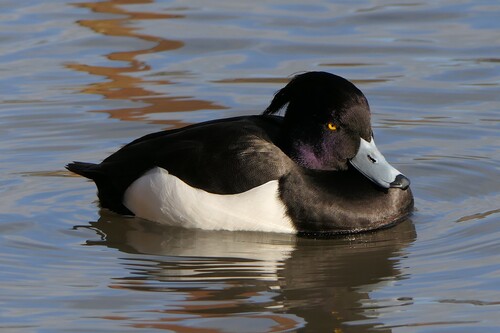
Tufted Duck, adult male adult male
Photo: Ranscombe Lodge · CC BY-NC

Bird 1 of 5

Tufted Duck

Aythya fuligula

How to recognise it

  • Black, with bright white flanks
  • A hanging crest at the back of the head
  • Bright yellow eye
crest Long feathers on the head that stand up or hang down.

Where and when

Park lakes, reservoirs and gravel pits, all year. Dives for food and bobs up like a cork.

Call Not very vocal; a soft, whistled "wheeoo" in the breeding season. Recording: David Darrell-Lambert · xeno-canto
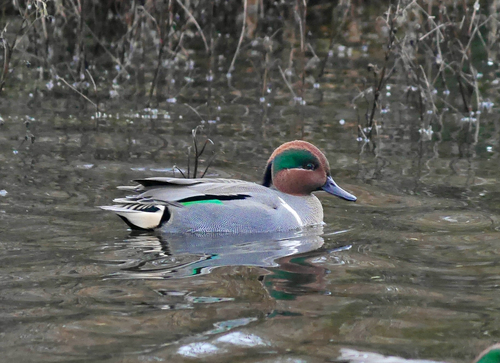
Teal, adult male adult male
Photo: Nola Wilken · CC BY-NC

Bird 2 of 5

Teal

Anas crecca

How to recognise it

  • Small: much smaller than a Mallard
  • Chestnut head with a green eye stripe
  • A yellow triangle by the tail
eye stripe A stripe through or behind the eye.

Where and when

Shallow pools and marshes, mostly in winter. Hides at the edge of the reeds, and takes off straight up when disturbed.

Call A short, clear "krrit" or "pip", like a whistle on a squeaky toy. Recording: Jack Berteau · xeno-canto

Bird 3 of 5

Wigeon

Mareca penelope

How to recognise it

  • Chestnut head with a yellow forehead
  • Pinkish-grey breast
  • Short, blue-grey bill

Where and when

Estuaries, wet grassland and flooded fields in winter, in big flocks. Grazes on grass, like a small goose.

Call A clear, whistled "whee-oo" from a flock, one of the great sounds of winter wetlands. Recording: David Darrell-Lambert · xeno-canto

Teal or Wigeon?

TealTeal
Wigeon

Both have a chestnut head. The Teal is small, with a green stripe through the eye and a yellow triangle by the tail. The Wigeon is bigger, with a yellow forehead and a pinkish breast.

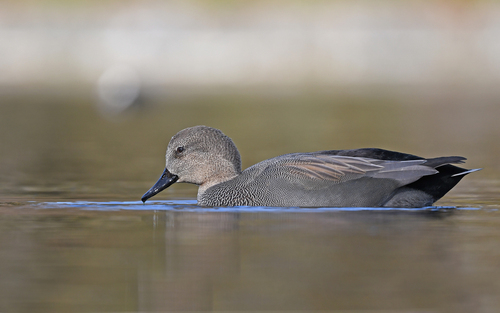
Gadwall, adult male adult male
Photo: christoph_moning · CC BY

Bird 4 of 5

Gadwall

Mareca strepera

How to recognise it

  • Grey, with fine wavy lines up close
  • Black rump and undertail
  • Small white patch on the wing
rump The area between the back and the tail.

Where and when

Lakes and gravel pits, mostly in the south and east. Easy to overlook; a plain grey duck with a smart black rear end.

Call A low, rasping "reb" or "kaak", a bit like a Mallard. Recording: David Darrell-Lambert · xeno-canto
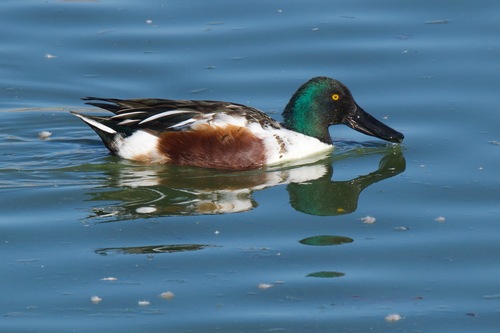
Shoveler, adult male adult male
Photo: Ari Rice · CC BY-NC

Bird 5 of 5

Shoveler

Spatula clypeata

How to recognise it

  • Enormous bill, as broad as a spade
  • Green head, with a yellow eye
  • White breast, chestnut flanks

Where and when

Shallow lakes, flooded fields and marshes. Swims low, with the bill held down, sweeping it through the water.

Call A soft, hollow "took-took" in the breeding season. Recording: Joost van Bruggen · xeno-canto

Quiz

8 questions, with a few birds from earlier lessons mixed in. Your answers stay in this browser.

Out and about this week

Go to a lake, a reservoir or a nature reserve in winter and look through the ducks. Which of the five can you find? Take a good look at the head and the bill first.