Today we're doing something different: you close your eyes. On an early spring morning, Britain is full of singing birds, and most of them stay hidden in the trees. If you can recognise their songs, a walk to the shops turns into a tour of the neighbourhood.
Six birds you have already met, and one new one, the Chiffchaff, which arrives in March. Each bird has a recording, and a description of what to listen for. Play each one a few times.
The quiz at the end has no photos. You hear a song, and you choose the bird: eight questions.
Sounds relaxed, as if it has all the time in the world
phrase One song from start to finish, until the bird stops for a moment.
Where and when
From a rooftop, a TV aerial or a treetop, mostly at dawn and dusk, from February.
Song Slow, relaxed, fluting phrases, never quite repeated.
Recording: Marc Anderson · xeno-canto
adult
Photo: larib-bonvier · CC BY-NC
Bird 2 of 6
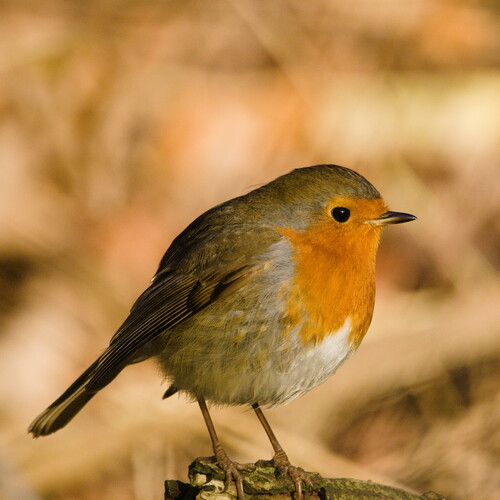
Robin
Erithacus rubecula
How to recognise it
High, thin and wistful
Ripples up and down, with short pauses
Sings in autumn and winter too
Where and when
Alone, from a low branch or a fence post. It sings all year, and at night under street lights.
adult
Photo: Elio Giacone · CC BY-NC
Bird 3 of 6
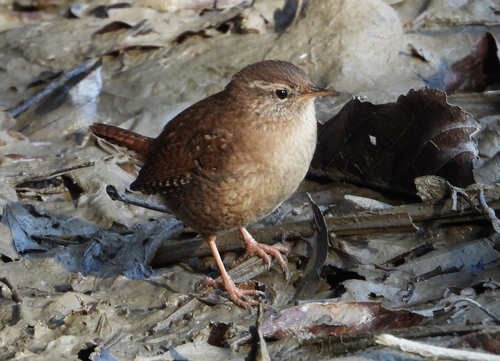
Wren
Troglodytes troglodytes
How to recognise it
Amazingly loud for such a tiny bird
Fast and clear, around five seconds
With a rattling trill in it
trill A series of very fast, identical notes, like a rolling r.
Where and when
From low in a bush or a bramble patch, all year but mostly in spring.
Song A loud, fast burst with a rattling trill, over in a few seconds.
Recording: François Guibert · xeno-canto
adult
Photo: sylvainm_53 · CC BY
Bird 4 of 6
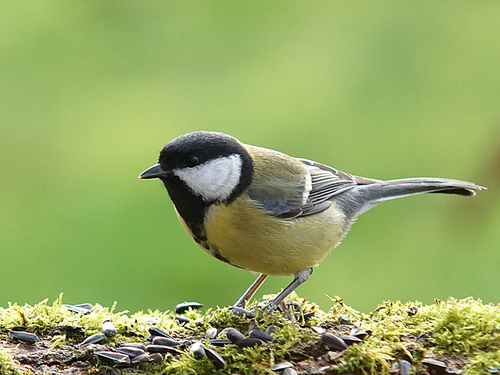
Great Tit
Parus major
How to recognise it
The song: two notes, "tea-cher"
Repeated again and again, like a squeaky bicycle pump
Loud and sawing, from as early as January
song The tune of a bird, especially in spring. It is usually the male singing, to claim a territory and attract a female.
Where and when
From a treetop or a branch near a feeder. The first spring song you will hear every year.
Song "Tea-cher, tea-cher, tea-cher": two notes, repeated, with a sawing sound.
Recording: Joost van Bruggen · xeno-canto
adult
Photo: outandabout68 · CC BY-NC
Bird 5 of 6
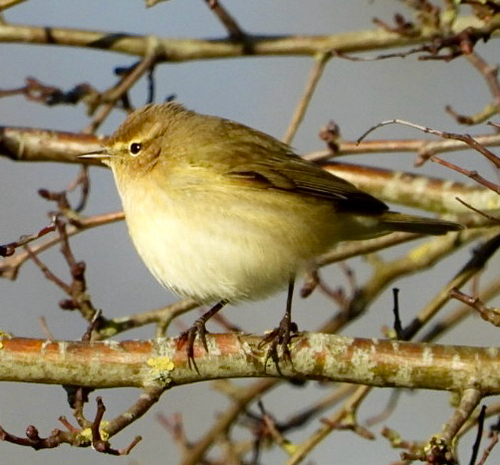
Chiffchaff
Phylloscopus collybita
How to recognise it
Small and greenish-brown, with no striking markings
Dark legs, a short pale eyebrow stripe
Keeps bobbing its tail
Where and when
Woods, parks and hedges with some trees, from March. One of the first summer visitors to arrive. A few stay for the winter.
Song Its name is its song: "chiff-chaff-chiff-chiff-chaff", with the notes jumping up and down at random.
Recording: Abe Bakker · xeno-canto
If you hear this in March, spring is here.
Great Tit or Chiffchaff?
Great Tit
Chiffchaff
Both repeat two notes, but not in the same way. The Great Tit is loud and sawing, in a steady rhythm: "tea-cher, tea-cher, tea-cher". The Chiffchaff is softer and irregular: "chiff-chaff-chiff-chiff-chaff", the notes jump up and down at random.
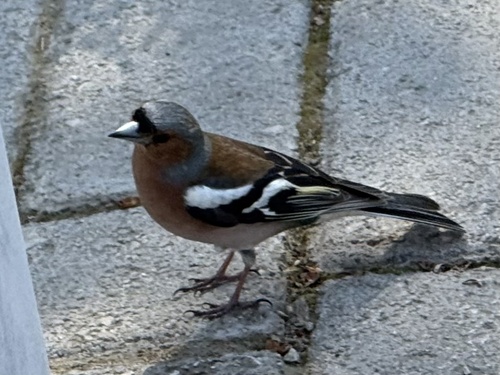
adult male
Photo: aurora_993 · CC BY
Bird 6 of 6
Chaffinch
Fringilla coelebs
How to recognise it
A cheerful rattle that runs downhill
Ends with a flourish
Its call: a clear "pink"
call A short sound used to keep in touch or to warn. Birds call all year round.
Where and when
From a tree in a wood, park or large garden, from February.
Song A rattle that runs downhill and finishes with a flourish.
Recording: Romuald Mikusek · xeno-canto
Quiz
8 questions, sound only. Your answers stay in this browser.
Out and about this week
Go outside early in the morning this week, with the window open or a coat on, and listen. How many of the six can you hear? Bonus: record the singing and try to pick out each bird.