Motmot

Bird course · Lesson 6 · 12 minutes

Gulls made simple

The four gulls you will meet almost everywhere

"Seagull" is not a bird. Britain has a dozen or more regular species of gull, and many of the ones you see in a car park are far from the sea. Today we learn the four that cover most of what you will meet: two big ones and two smaller ones.

Gulls are hard because they change plumage as they grow up: a young Herring Gull is brown and speckled, and takes four years to turn white and grey. To keep things easy we only look at adults today. Whenever you see a brown gull, just say "young" and move on.

At the end there's a quiz of eight questions, with birds from the last two weeks mixed in.

Today: 4 birds

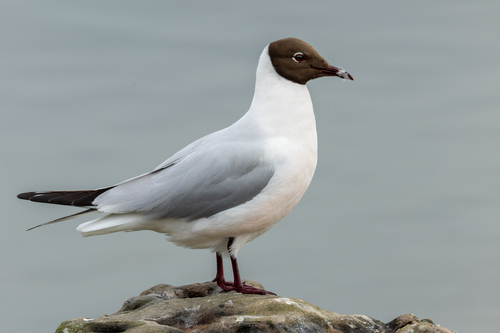
Black-headed Gull, adult, summer and winter adult, summer and winter
Photo: alexislours · CC BY

Bird 1 of 4

Black-headed Gull

Chroicocephalus ridibundus

How to recognise it

  • Summer: chocolate-brown hood
  • Winter: white head with a dark ear spot
  • Small and slim, red bill and legs
hood A dark head, like a hood over a white body.
ear spot A dark spot behind the eye, where the ear is.

Where and when

Parks, fields, reservoirs and rubbish tips, far from the sea too. In winter it is the gull on the park pond, begging for bread.

Call A harsh, grating "kree-ar", and a lot of squabbling. Recording: Kelle Moreau · xeno-canto

The hood is chocolate-brown, not black. It is only worn from spring to late summer.

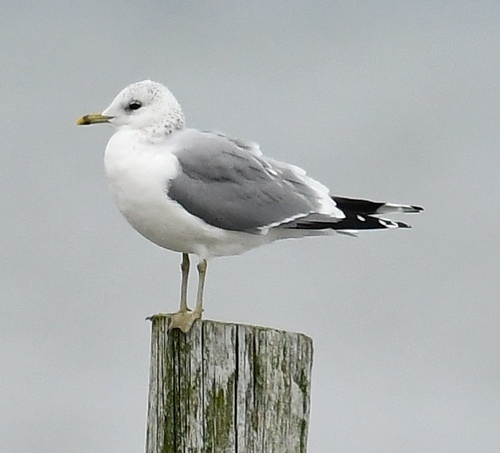
Common Gull, adult adult
Photo: Lorenzo Vinciguerra · CC BY-NC

Bird 2 of 4

Common Gull

Larus canus

How to recognise it

  • Medium-sized, with a round head and a dark eye
  • Thin yellow-green bill, with no red spot
  • Black wing tip with big white spots
wing tip The end of the wing. On a resting gull it sticks out past the tail.

Where and when

Playing fields, farmland and coasts, mostly in winter in the south. In Scotland it also breeds on moors and lochs.

Call A high, laughing "kee-ya, kee-ya", higher than a Herring Gull. Recording: guus van duin · xeno-canto

Despite its name, it is not the most common gull. That's the Black-headed Gull.

Bird 3 of 4

Herring Gull

Larus argentatus

How to recognise it

  • Big and bulky, with a pale grey back
  • Yellow bill with a red spot
  • Pink legs

Where and when

The classic seaside gull, and increasingly in towns too, nesting on roofs. It steals chips from your hand.

It has declined a lot in Britain, and is now on the red list of birds of conservation concern.

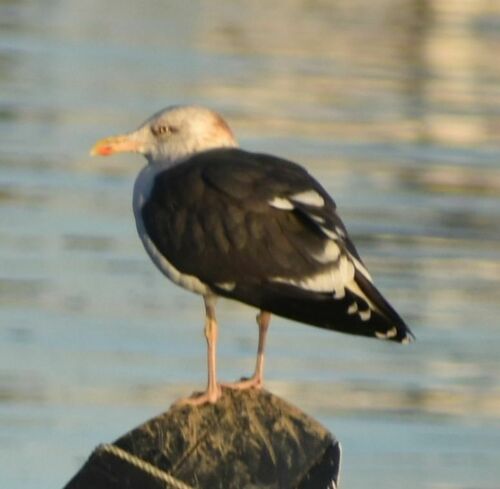
Lesser Black-backed Gull, adult adult
Photo: Sally Anderson · CC BY-NC

Bird 4 of 4

Lesser Black-backed Gull

Larus fuscus

How to recognise it

  • A little smaller and slimmer than a Herring Gull
  • Dark grey back
  • Yellow legs

Where and when

Coasts, reservoirs, landfill sites and city rooftops. Many fly south for the winter; some stay.

Call A deeper, hoarser "kyow" than a Herring Gull. Recording: Peter Boesman · xeno-canto

Herring Gull or Lesser Black-backed Gull?

Herring Gull
Lesser Black-backed GullLesser Black-backed Gull

Look at the back and the legs. Pale grey back and pink legs: Herring Gull. Dark grey back and yellow legs: Lesser Black-backed Gull. The Lesser Black-backed is also a little slimmer.

Quiz

8 questions, with a few birds from earlier lessons mixed in. Your answers stay in this browser.

Out and about this week

Look at the gulls near you this week. Is it a Black-headed Gull with a red bill? Or a big one: check the back and the legs. And is it an adult, or one of the brown ones?