Motmot

Bird course · Lesson 5 · 14 minutes

The other half

Females and young of birds you already know

In week 1 we only looked at the male Blackbird and the male House Sparrow. That was on purpose: the females look completely different. A brown "blackbird" is not a different bird; it's the female of the same species. Today we meet the other half.

For each bird in this lesson there's a bird you've met before. First look for the shape you already know. Then check the colours: females are usually brown, grey or streaky, which helps them hide on the nest.

Young birds wear a plumage of their own for a while. We take one example, the young Mute Swan. At the end there's a quiz of ten questions, with birds from the last two weeks mixed in.

Today: 5 birds

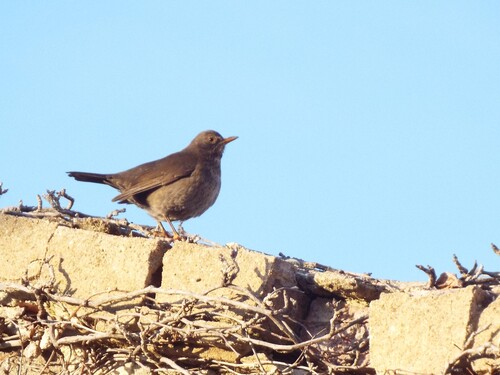
Blackbird, adult female adult female
Photo: ahmedm · CC BY-NC

Bird 1 of 5

Blackbird

Turdus merula

How to recognise it

  • Dark brown, not black
  • Paler throat with faint streaks
  • Long tail, hops just like the male

Where and when

The same places as the male: lawns, borders, hedges. She builds the nest and does most of the sitting on the eggs.

Call A sharp, chattering "chink-chink-chink" when alarmed, especially at dusk. Recording: Marc Anderson · xeno-canto
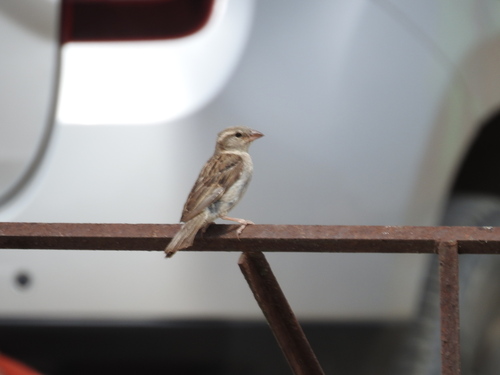
House Sparrow, female female
Photo: Eduardo Kucich · CC BY-NC

Bird 2 of 5

House Sparrow

Passer domesticus

How to recognise it

  • Grey-brown, with no bib and no grey crown
  • Pale eyebrow stripe behind the eye
  • Streaky brown back, thick bill

Where and when

With the males, in groups, near houses. At feeders she is often the one that comes first.

Call The same chirping "chilp, chilp" as the male. Recording: Esperanza Poveda · xeno-canto

Don’t confuse with: Dunnock (week 4): slimmer, thin bill, grey head.

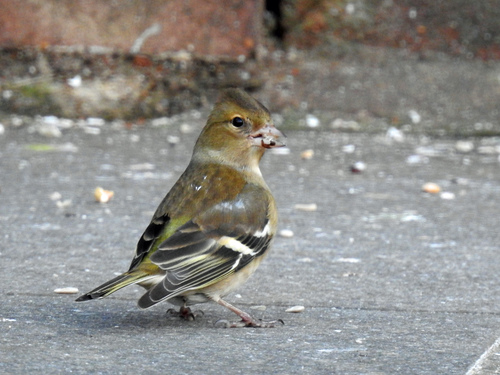
Chaffinch, female female
Photo: Neil Shepherd · CC BY-NC

Bird 3 of 5

Chaffinch

Fringilla coelebs

How to recognise it

  • Plain grey-brown, with no pink or blue
  • White shoulder patch and wing bar, just like the male
  • White along the sides of the tail in flight
shoulder patch A pale patch at the top of the folded wing.

Where and when

Under feeders and in hedges, with the males. In winter the sexes often feed in separate flocks.

Call A soft "chip" and the same ringing "pink" as the male. Recording: Paul Driver · xeno-canto

House Sparrow or Chaffinch?

House SparrowHouse Sparrow
ChaffinchChaffinch

Both are brownish, with a thick bill. The female Chaffinch has a plain grey-brown head and a lot of white in the wing: a white shoulder patch and wing bar. The female House Sparrow has a streaky back, a pale stripe behind the eye, and only a narrow pale line on the wing.

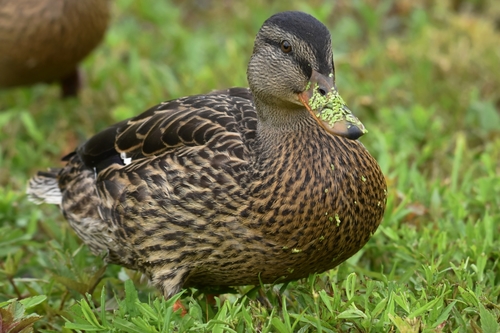
Mallard, female female
Photo: gwpiel · CC BY

Bird 4 of 5

Mallard

Anas platyrhynchos

How to recognise it

  • Brown with dark speckles
  • Orange bill with a dark patch on top
  • Blue speculum with white edges
speculum A coloured, often shiny patch on the wing of a duck.

Where and when

On every pond, with her ducklings in spring. She is the one that quacks.

Call The loud, descending "quack-quack-quack-quack" that everybody knows. Recording: Xavier Riera · xeno-canto

Bird 5 of 5

Mute Swan

Cygnus olor

How to recognise it

  • Grey-brown juvenile plumage, later with white patches
  • Greyish bill, with no knob yet
  • A swan shape, usually with its parents
juvenile plumage The first coat of feathers of a young bird.

Where and when

Swimming close behind the parents in summer and autumn. By the second summer the young bird is nearly white.

Sound Quiet hissing and soft grunts; the wing beats of the adults carry far. Recording: Stanislas Wroza · xeno-canto

Quiz

10 questions, with a few birds from earlier lessons mixed in. Your answers stay in this browser.

Out and about this week

Look closely at every Blackbird, sparrow and duck this week. Is it a male or a female? Count how many of each you see. Bonus: find a young bird with its parents.