Motmot

Bird course · Lesson 4 · 12 minutes

How to look at a bird

Four birds and a fixed order for looking

Today we sit on a bench by a hedge in the park. A small bird shoots into the bushes, and it's gone. A bird often sits still for just a few seconds. Anyone who looks at the colours straight away usually sees too little. That's why experienced birdwatchers look in a fixed order.

First size and shape: smaller than a sparrow, about as big as a Blackbird, or bigger? Round or slim, with a long or a short tail? Then the bill: thick, for cracking seeds, or thin, for picking up insects? Only then the colours and markings. And finally behaviour: does it hop, walk, or bob its tail?

We practise that with four birds from the garden and the park. Each bird has the things to look for in that order. At the end there's a quiz of eight questions, with two birds from earlier lessons mixed in.

Today: 4 birds

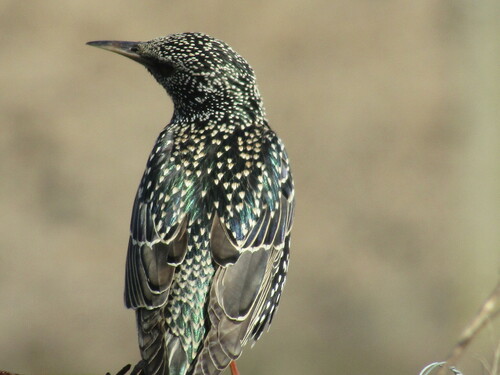
Starling, adult, speckled (winter) or glossy (summer) adult, speckled (winter) or glossy (summer)
Photo: stevem4560 · CC BY

Bird 1 of 4

Starling

Sturnus vulgaris

How to recognise it

  • Short and stocky, with a short tail
  • Long, pointed bill, yellow in summer
  • Summer: glossy green-purple. Winter: speckled with white

Where and when

Everywhere, all year. Walks in small groups over the grass, prodding the ground with its bill. In autumn and winter, huge flocks gather to roost at dusk.

Song A rambling jumble of clicks, whistles and copied sounds: from a Buzzard to a car alarm, even a mobile ringtone. Recording: Jorge Leitão · xeno-canto

The white spots are the tips of new feathers. Over the winter they wear off, and by spring the Starling is glossy and dark.

Don’t confuse with: Blackbird (week 1): longer tail, hops instead of walking, and often alone.

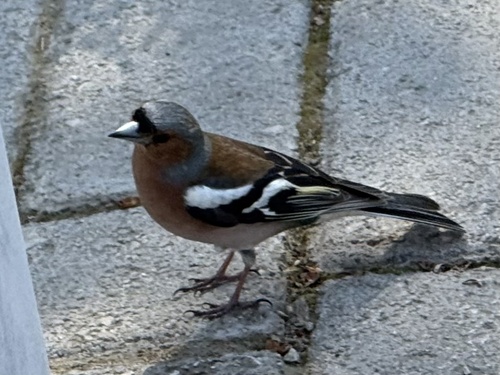
Chaffinch, adult male adult male
Photo: aurora_993 · CC BY

Bird 2 of 4

Chaffinch

Fringilla coelebs

How to recognise it

  • As big as a sparrow, with a longer tail
  • Short, thick bill: a seed-eater
  • Blue-grey cap, pinkish breast, chestnut mantle
mantle The upper back, between the wings.

Where and when

Woods, parks, gardens and hedges. Scratches around under feeders. In flight you see a lot of white in wing and tail. One of the commonest birds in Britain.

Song A cheerful rattle that runs downhill and ends with a flourish, from February to July. Its call is a ringing "pink". Recording: Romuald Mikusek · xeno-canto
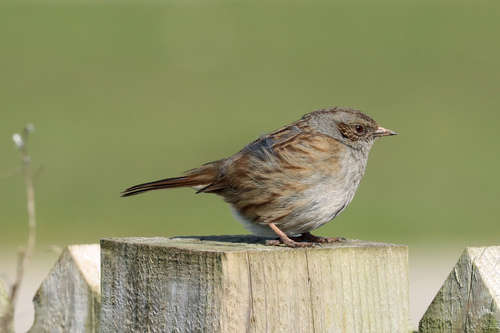
Dunnock, adult adult
Photo: rkl · CC BY

Bird 3 of 4

Dunnock

Prunella modularis

How to recognise it

  • About as big as a sparrow, but slimmer
  • Thin, pointed bill: an insect-eater
  • Grey head and throat, streaky brown back
throat The front of the neck, below the bill.

Where and when

Shuffles along the ground under hedges and shrubs, flicking its wings. Alone or in pairs. Often called a hedge sparrow, but it is not a sparrow at all.

Song A fast, high, tinkling warble from the top of a bush, quieter than a Wren's. Recording: Benjamin Drillat · xeno-canto

Don’t confuse with: House Sparrow (week 1): thick bill, and the male has a black bib.

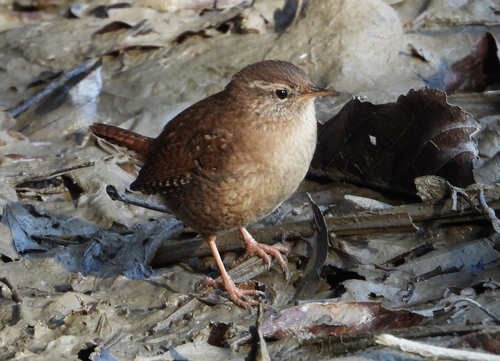
Wren, adult adult
Photo: Elio Giacone · CC BY-NC

Bird 4 of 4

Wren

Troglodytes troglodytes

How to recognise it

  • Tiny and round, tail cocked up
  • Thin, slightly curved bill
  • Warm brown, with a pale eyebrow stripe
eyebrow stripe A pale stripe above the eye, like an eyebrow.

Where and when

Low in bushes, ivy and log piles. Rarely sits in the open, except to sing. In cold winters, dozens roost together in one nest box.

Song Deafening for such a little bird: fast and clear, about five seconds long, with a rattling trill. Recording: François Guibert · xeno-canto

Dunnock or Wren?

DunnockDunnock
WrenWren

Look at size and tail first. A Wren is tiny and round, and holds its tail cocked up. A Dunnock is slimmer, holds its tail low, and has a grey head and throat.

Quiz

8 questions, with a few birds from earlier lessons mixed in. Your answers stay in this browser.

Out and about this week

Pick a hedge near you and watch it for ten minutes. In which order do you see things: size, bill, colours, behaviour? Try saying them out loud.