Motmot

Bird course · Lesson 18 · 12 minutes

Waders

Five birds of the estuary and the shore

Today we go to the coast. At high tide on an estuary, thousands of waders gather on the last bits of dry land, and there's nothing quite like it. Waders are birds with long legs and bills, which feed in the mud and the shallows.

They are among the hardest birds for beginners: lots of brown, grey and white, and a lot of birds that look alike. To keep it simple we look at five, each with an obvious feature: the huge curved bill, the red legs, the black belly, the white sprinter, the orange legs.

At the end there's a quiz of ten questions, with birds from the last two lessons mixed in.

Today: 5 birds

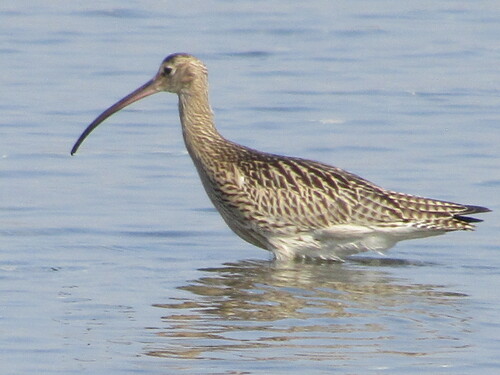
Curlew, adult adult
Photo: stevem4560 · CC BY

Bird 1 of 5

Curlew

Numenius arquata

How to recognise it

  • Big and streaky brown
  • A very long, downward-curved bill
  • A white wedge on the back in flight

Where and when

Estuaries and mudflats in winter, and moorland and rough fields in spring. Probes the mud with its long bill.

Call A rising, bubbling "cur-lee", and a long, bubbling trill in spring: one of the great sounds of the countryside. Recording: Lars Edenius · xeno-canto

It is Britain's largest wader, and is in serious decline.

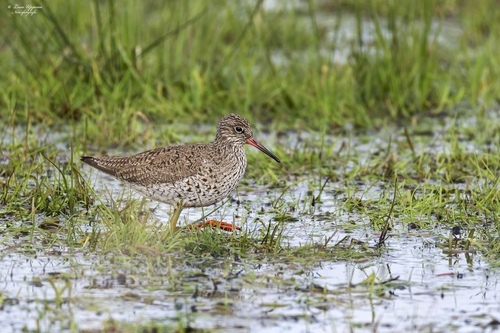
Redshank, adult adult
Photo: bristolian · CC BY

Bird 2 of 5

Redshank

Tringa totanus

How to recognise it

  • Bright orange-red legs
  • Brown with fine spots, and a red base to the bill
  • In flight: a broad white edge on the back of the wing

Where and when

Saltmarshes, estuaries and wet meadows. Often the first bird to see you and give the alarm, flying off with a ringing call.

Call A ringing, yodelling "tyu-hu-hu", the alarm call of the shore. Recording: Markus Jacobs · xeno-canto
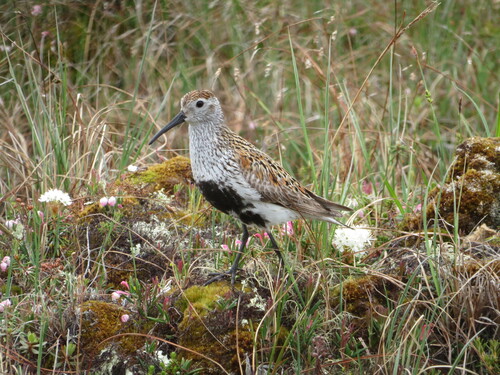
Dunlin, adult, summer and winter adult, summer and winter
Photo: lauralovebird · CC BY

Bird 3 of 5

Dunlin

Calidris alpina

How to recognise it

  • The bill droops a little at the tip
  • Summer: black belly patch, chestnut back
  • Winter: grey above, white underparts
belly patch A patch in the middle of the belly.
underparts The whole underside of a bird: throat, breast, belly and undertail.

Where and when

Estuaries and mudflats, in big flocks that twist and turn in the air. In summer on upland moors.

Call A rough, buzzing "treeep", from a flock. Recording: Jarek Matusiak · xeno-canto

One of the commonest waders on British estuaries in winter.

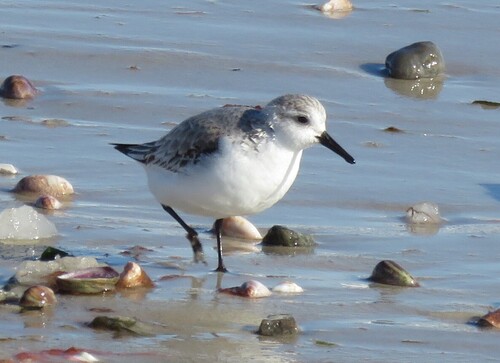
Sanderling, winter plumage winter plumage
Photo: Roger Debenham · CC BY-NC

Bird 4 of 5

Sanderling

Calidris alba

How to recognise it

  • Very pale: silver-grey upperparts, snow-white below
  • Black bill and black legs
  • Runs like a clockwork toy along the waves
upperparts The whole top side of a bird: crown, nape, back and wings.

Where and when

Sandy beaches, in winter. Chases the waves in and out, picking up small creatures from the sand.

Call A short, sharp "twick", from a small flock. Recording: Sonothèque ADVL · xeno-canto

Dunlin or Sanderling?

DunlinDunlin
SanderlingSanderling

Look at the colour and where they are. A Sanderling in winter is very pale: silver-grey above and snow-white below, and it runs along the waves on a sandy beach. A Dunlin is browner and greyer, with a drooping bill, and feeds in the mud of an estuary.

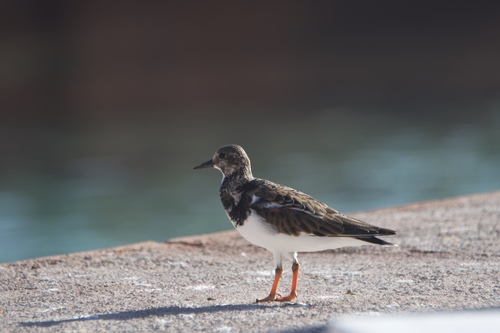
Turnstone, adult, winter adult, winter
Photo: otomops · CC BY

Bird 5 of 5

Turnstone

Arenaria interpres

How to recognise it

  • Stocky, with short orange legs
  • Short, pointed bill
  • Dark on the breast, white belly

Where and when

Rocky shores, harbours and piers. Flips over seaweed and pebbles with its bill, to find food.

Call A quick, rattling "tuk-a-tuk-tuk". Recording: Christophe Gruwier · xeno-canto

Turnstones are very confiding: you can often get very close in a harbour.

Quiz

10 questions, with a few birds from earlier lessons mixed in. Your answers stay in this browser.

Out and about this week

Visit an estuary or a beach this week, at high tide if you can. How many kinds of wader can you find? Listen for the Curlew's call and the Redshank's alarm.