Motmot

Bird course · Lesson 17 · 10 minutes

Thrushes

Four relatives of the Blackbird

In week 1 you met the Blackbird, and the Blackbird is a thrush. So are the four birds in this lesson: two that live here all year, and two that come from Scandinavia for the winter. They are all brown or grey above, with spotted breasts.

That's where it gets tricky: they look alike at first. But once you know what to look at, the spots, the colour of the underwing and the stripe above the eye, you can tell them apart in seconds.

At the end there's a quiz of eight questions, with birds from the last two lessons mixed in.

Today: 4 birds

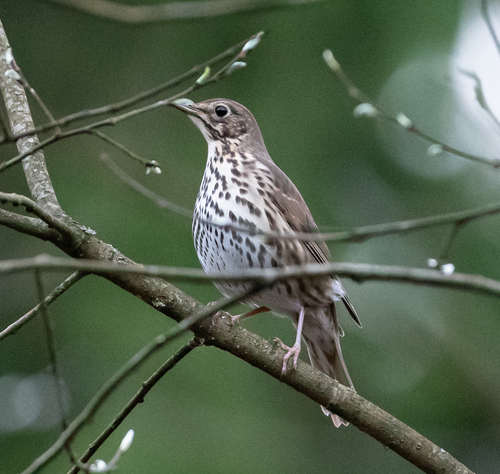
Song Thrush, adult adult
Photo: stanislav_murashkin · CC BY

Bird 1 of 4

Song Thrush

Turdus philomelos

How to recognise it

  • Warm brown, plain back
  • Small arrowhead spots in neat rows
  • Buff wash on the breast

Where and when

Gardens, parks and woods. Smashes snails open on a stone, called an anvil.

Song Loud, clear phrases, each repeated two or three times: "tea-cher, tea-cher, cheerily, cheerily". Recording: Filippo Ceccolini · xeno-canto

Song Thrush numbers have dropped by over half since the 1970s.

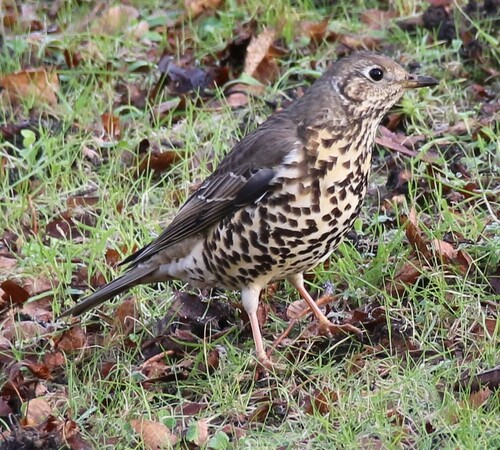
Mistle Thrush, adult adult
Photo: gen-geode · CC BY-NC

Bird 2 of 4

Mistle Thrush

Turdus viscivorus

How to recognise it

  • Bigger and greyer than a Song Thrush
  • Big, round spots, scattered over the belly
  • White underwing and tail corners in flight
underwing The underside of the wing. You mostly see it in flight.
tail corners The corners at the end of the tail, on the left and right.

Where and when

Parks, gardens with big trees, and open woods. Often sits upright on a treetop or on the grass, and is bold and wary.

Song A loud, fluting song, from the top of a tree, often in wild weather: its old name is the "storm cock". Recording: Lars Edenius · xeno-canto

Song Thrush or Mistle Thrush?

Song ThrushSong Thrush
Mistle ThrushMistle Thrush

A Mistle Thrush is bigger and greyer, with big, round, scattered spots on a pale belly. A Song Thrush is smaller and warmer brown, with small arrowhead-shaped spots in neat rows.

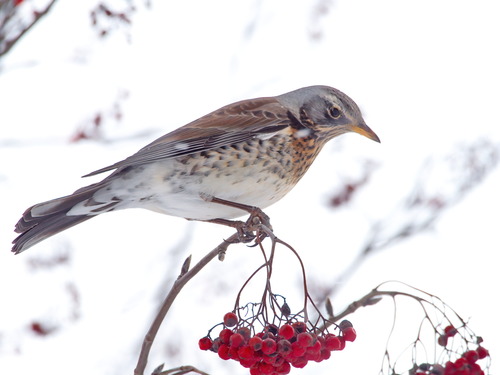
Fieldfare, adult adult
Photo: svetlario · CC BY-NC

Bird 3 of 4

Fieldfare

Turdus pilaris

How to recognise it

  • Grey head and grey rump
  • Chestnut back
  • Black tail

Where and when

Fields and hedges with berries, from October to March, in flocks that sometimes number hundreds. Often with Redwings.

Call A loud, harsh "chack-chack-chack", from the whole flock. Recording: Beatrix Saadi-Varchmin · xeno-canto
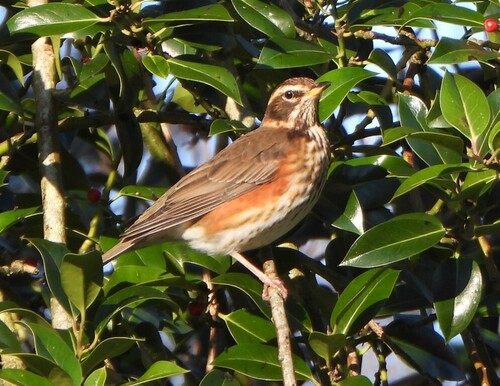
Redwing, adult adult
Photo: Trevor Marshall · CC BY-NC

Bird 4 of 4

Redwing

Turdus iliacus

How to recognise it

  • A broad, creamy eyebrow stripe
  • Red-orange flank and armpit
  • Smaller than a Song Thrush, streaky breast
armpit The place under the wing, where it joins the body.

Where and when

Fields, parks and gardens, from October to March, in flocks. Eats berries off hawthorn and holly. On autumn nights you can hear them calling as they migrate over towns.

Call A thin, high "tseeep", especially on a still October night. Recording: Lars Edenius · xeno-canto

Quiz

8 questions, with a few birds from earlier lessons mixed in. Your answers stay in this browser.

Out and about this week

In autumn or winter, look for berries: a holly, a hawthorn or a rowan. Wait quietly nearby. Do thrushes come? Which of the four is it? Look at the head and the underwing when it flies.