Motmot

Bird course · Lesson 19 · 10 minutes

Coast and sea

Four big birds of the shore and open water

For the last lesson of part 2, we stay on the coast, with four big birds. They are easy to recognise when you know what to look for, and some are a surprisingly new sight in Britain: the Little Egret was a rarity until the 1990s.

Big birds are good news for beginners: you can see them from far away, and their shape tells you a lot. A gull-like bird that dives from the sky, a snow-white heron with golden feet, a black bird with its wings hung out to dry, and a smart black-and-white duck.

At the end there's a quiz of eight questions, with birds from the last two lessons mixed in.

Today: 4 birds

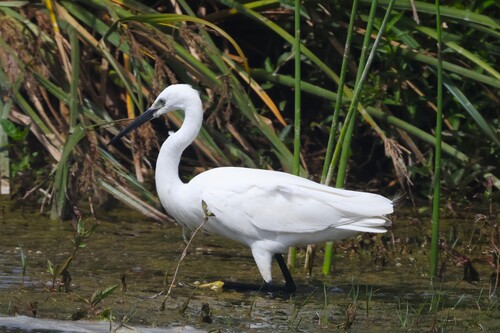
Little Egret, adult adult
Photo: Gerald Wingate · CC BY-NC

Bird 1 of 4

Little Egret

Egretta garzetta

How to recognise it

  • Small, slim and all white
  • Black bill and black legs, with yellow feet
  • In spring: long plumes on the head and back
plume A long, wispy feather, on the head, neck or back.

Where and when

Estuaries, marshes, rivers and lakes, mostly in the south and east. Runs through the shallows, stirring up fish with its feet.

Call A harsh, croaking "arrk", given in flight or at a roost. Recording: Agris Celmins · xeno-canto

The first Little Egrets bred in Britain in 1996. Now there are thousands.

Don’t confuse with: Grey Heron (week 2): bigger and grey, with a pale yellow bill.

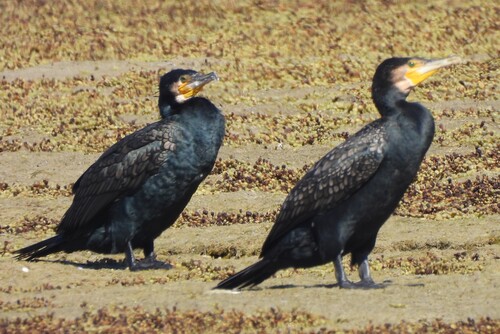
Cormorant, adult adult
Photo: Jeff Giddins · CC BY-NC

Bird 2 of 4

Cormorant

Phalacrocorax carbo

How to recognise it

  • Black, with a white thigh patch in spring
  • White cheek, yellow at the gape
  • Perches with its wings spread out to dry
thigh patch A patch on the thigh, just above the leg.

Where and when

Coasts, estuaries, rivers and lakes, inland too. Dives for fish and then sits on a post, with its wings held out.

Call A deep, croaking "gorrk", usually only heard at colonies. Recording: Sonothèque ADVL · xeno-canto
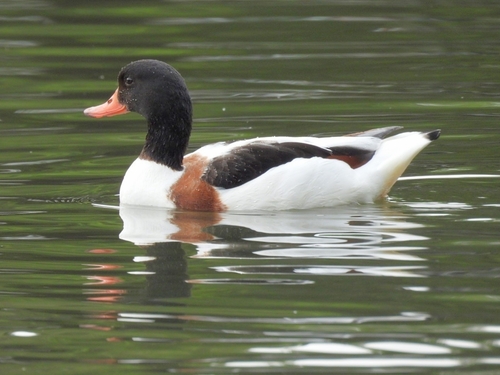
Shelduck, adult adult
Photo: Inma Torres · CC BY-NC

Bird 3 of 4

Shelduck

Tadorna tadorna

How to recognise it

  • Big, black-and-white duck, with a dark green head
  • Broad chestnut band round the breast
  • Bright red bill (a knob in the male, in spring)

Where and when

Muddy estuaries and shores, and the occasional gravel pit. Sweeps its bill through the mud, and nests in rabbit burrows.

Call A deep, nasal "ah-ah-ah" and, in spring, a whistled "wheee". Recording: Arjun Dutta · xeno-canto

It is closer to a goose than to a duck, and much bigger than a Mallard.

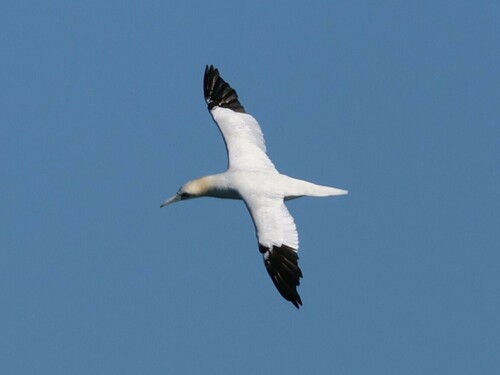
Gannet, adult adult
Photo: Rob Van Epps · CC BY-NC

Bird 4 of 4

Gannet

Morus bassanus

How to recognise it

  • Big and white, with a long pointed bill
  • Black primaries at the tip of the wings
  • Dives into the sea from a great height, with folded wings
primaries The long flight feathers at the tip of the wing.

Where and when

Over the sea, and at big cliff colonies like Bass Rock, Grassholm and Bempton. Around half the world's Gannets nest in Britain and Ireland.

Call A harsh, rhythmic "arrah-arrah", from a colony, with thousands going at once. Recording: David Darrell-Lambert · xeno-canto

Young birds are dark brown with white spots, and slowly turn white over five years.

Quiz

8 questions, with a few birds from earlier lessons mixed in. Your answers stay in this browser.

Out and about this week

Go to the coast this week. Scan the sea for a white bird, diving with its wings folded. Look at the rocks, the posts and the groynes for a Cormorant with its wings spread. In the south or east, check the estuary for a snow-white egret.