Motmot

Advanced birding · Lesson 8 · 20 minutes

Reed and marsh warblers

Reed, Marsh, Sedge, Great Reed, Blyth's Reed, Paddyfield, Aquatic and Grasshopper Warbler

Acrocephalus warblers are brown, secretive and hard to see. They live in reeds, willows, nettles and thick grass. By ear they are a lot easier than by eye: each species has a different song, and Marsh and Blyth's Reed Warblers copy other birds as well. The standard trio is Reed, Sedge and Marsh Warbler. After that come the rarities that make birders get up before dawn.

Season: they all arrive late. Sedge Warblers come first, in mid-April, then Reed Warblers in late April, and Marsh Warblers not until late May or June, when the others are already feeding young. The Great Reed Warbler is a southern bird that overshoots in May. Autumn adds a different set: Aquatic Warblers pass in August, and the eastern Blyth's Reed and Paddyfield Warblers turn up from September.

Habitat helps. Reed Warblers live in reeds, Sedge Warblers in rank vegetation on the edge, Marsh Warblers in tall herbage and nettles by the water, and the Grasshopper Warbler is a bird of rough, damp grass.

Today: 8 birds

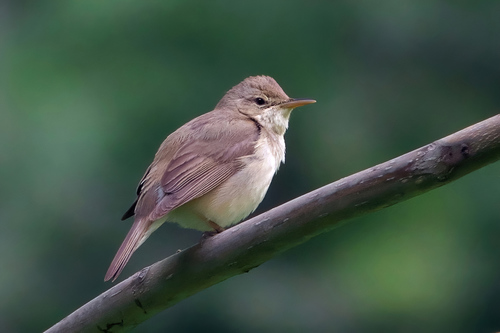
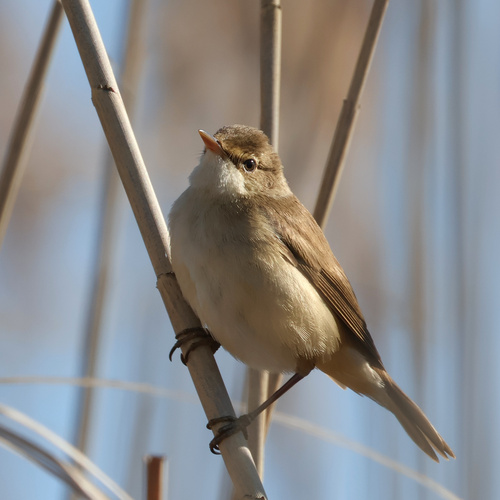
Common Reed Warbler, adult adult
Photo: Mileta Čeković · CC BY-NC

Bird 1 of 8

Common Reed Warbler

Acrocephalus scirpaceus

How to recognise it

  • Plain warm brown above and buff below, with a rusty rump
  • Long, thin bill, a flat crown and a short, weak supercilium
  • Song: a steady, churring “chirruc-chirruc-jag-jag”, repeated
supercilium The pale stripe above the eye ("eyebrow").

Where and when

NL, DE, FR, BE: common in reedbeds, from late April to August. UK: fairly common in the south and east. DK: uncommon. IE: very rare. NO, SE, FI: rare. Arrives in late April and leaves in August and September.

Sound A monotonous, rhythmic, churring song, each phrase repeated two or three times. Recording: Thomas Bergman · xeno-canto

The reed warbler is the bird you hear in the reeds all day in May. A long, sloping head and a rusty rump are the best marks.

Don’t confuse with: Marsh Warbler (this week): olive, paler, with pink legs and a musical, mimicking song.

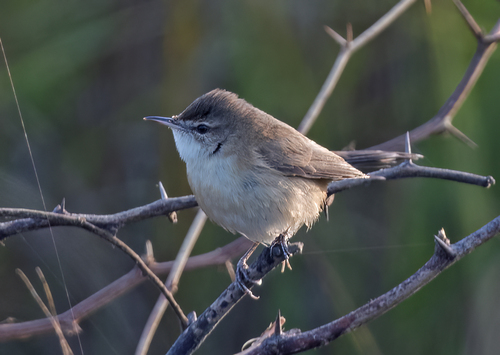
Marsh Warbler, adult adult
Photo: unknown

Bird 2 of 8

Marsh Warbler

Acrocephalus palustris

How to recognise it

  • Olive-brown above, colder and greyer than a Reed Warbler, with a paler throat
  • Pale pink legs, and a longer, more elegant wing with a long primary projection
  • Song: rich, fast and musical, a mimic of other birds
primary projection The length of the wing tip sticking out past the tertials on a resting bird.
mimic To copy the sounds of other birds. Marsh Warblers can imitate dozens of species, including African ones.

Where and when

NL, DE, DK, SE, FI: fairly common in tall damp herbage from late May. BE and FR: uncommon. UK: very rare, a handful of pairs. IE and NO: almost never. One of the last migrants to arrive, late May to June, and gone by August.

Sound A rich, fast, sweet song that mimics other birds, with a lot of ‘chee-chee’ and ‘tchuk’ notes. Recording: Ulf Elman · xeno-canto

A song that is almost impossible to describe, which includes copies of House Sparrow, Blackbird, Swallow and African species. You will not see the singer: it sings from deep in the nettles.

Don’t confuse with: Reed Warbler (this week): warm brown, a rusty rump and a repetitive song.

Reed or Marsh Warbler?

Common Reed WarblerCommon Reed Warbler
Marsh WarblerMarsh Warbler

The song is the sure way. The Reed Warbler is a rhythmic, churring repeat of two or three notes. The Marsh Warbler is a long, musical, quick improvisation with a lot of mimicry. By eye: Reed is warm brown with a rusty rump and dark legs, Marsh is olive-brown, colder and paler, with pink legs and a longer wing.

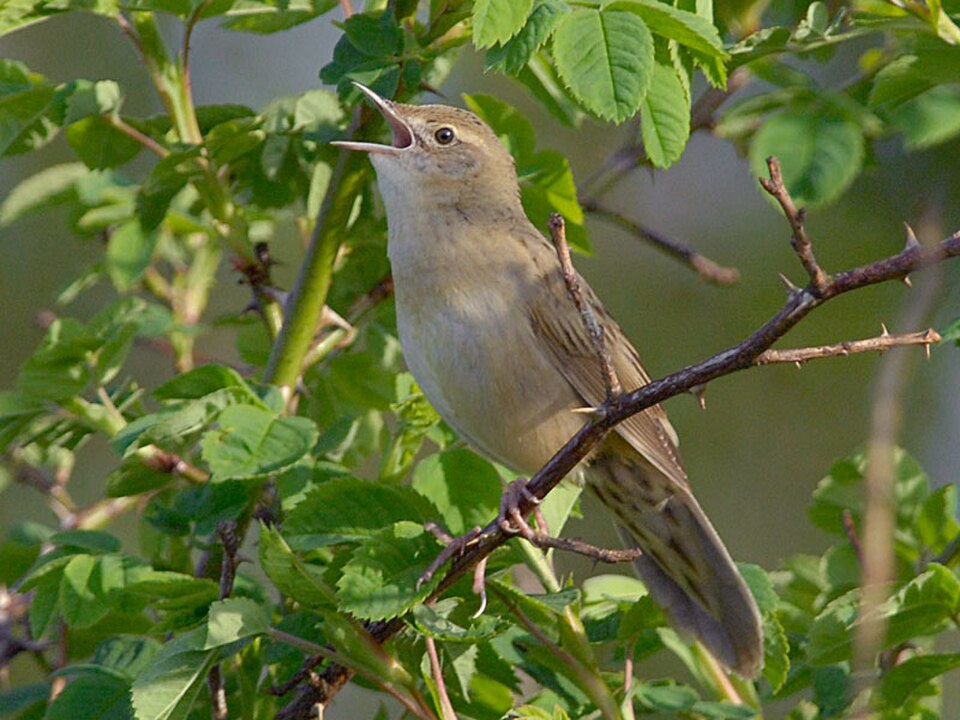
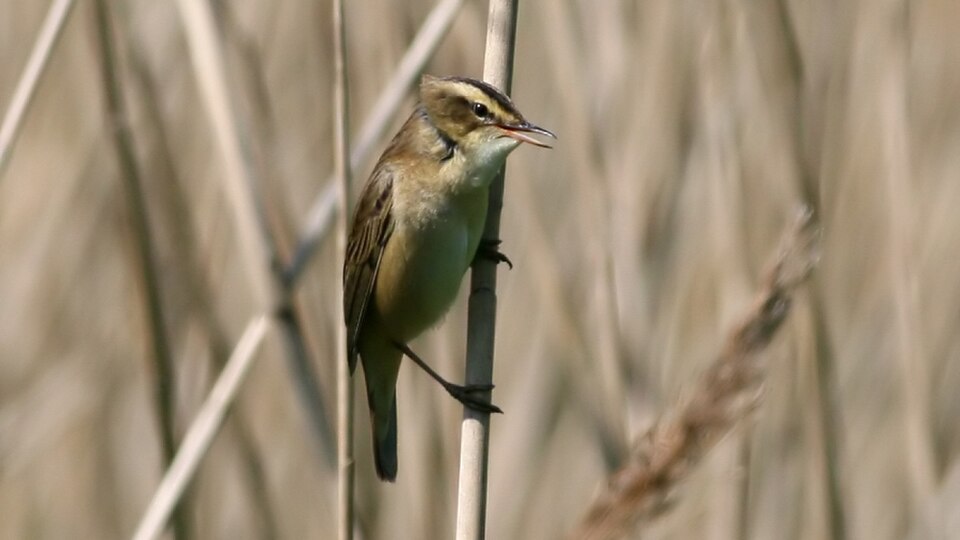
Sedge Warbler, adult adult
Photo: Ken Billington · CC BY-SA

Bird 3 of 8

Sedge Warbler

Acrocephalus schoenobaenus

How to recognise it

  • Streaked brown back and a clear, creamy supercilium
  • Dark crown and a plain rusty rump
  • Song: a fast, noisy mix of whistles, rattles and buzzes, going off in all directions
supercilium The pale stripe above the eye ("eyebrow").

Where and when

UK, IE, NL, BE, DE, DK, FI: fairly common to common in rank vegetation, reedbeds and scrub. FR, SE, NO: uncommon. Arrives in mid-April, the first of the reed warblers, and leaves in August.

Sound A rapid, chattering, random mix of harsh and sweet notes, with no repeating pattern. Recording: Albert Lastukhin · xeno-canto

The loudest, most excited singer of the reedbed. If there is a bold eyebrow and streaked back, it is a Sedge Warbler.

Don’t confuse with: Aquatic Warbler (this week): a pale crown stripe, streaked back with buff lines.

Great Reed Warbler, adult adult
Photo: unknown

Bird 4 of 8

Great Reed Warbler

Acrocephalus arundinaceus

How to recognise it

  • The size of a thrush, with a thick bill and a long, strong head
  • A pale supercilium that is longer in front of the eye, and a rusty brown back
  • Song: loud and harsh, “karra-karra-kit-kit-gurk-gurk”
supercilium The pale stripe above the eye ("eyebrow").

Where and when

DE: rare in reedbeds in the south and east. NL, BE, DK, SE, FI: rare to very rare. UK: very rare, in May and June. FR: rare in the south. IE, NO: almost never. A few overshoot north every spring.

Sound A loud, hoarse, croaking “karra-karra-gurk-gurk” that can be heard 200 metres away. Recording: Maarten Sluijter · xeno-canto

Twice the size of a Reed Warbler, with a song like a frog in a bucket. If a reed warbler is bigger than expected, check the bill.

Don’t confuse with: Common Reed Warbler (this week): smaller, with a thin bill and a steady, quiet churring.

Blyth's Reed Warbler, adult adult
Photo: agulivanov · CC BY

Bird 5 of 8

Blyth's Reed Warbler

Acrocephalus dumetorum

How to recognise it

  • Plain, cold grey-brown, with no rusty rump
  • A short primary projection, a rounded head and a short supercilium
  • Song: a mimic, with each phrase repeated several times, “chak-chak-chee-chee”
primary projection The length of the wing tip sticking out past the tertials on a resting bird.

Where and when

SE, FI: rare breeders in the north and east, with the song heard in June. UK, NL, DE, DK, NO: very rare, mainly in autumn, from September. BE, FR, IE: almost never. A bird from Russia.

Sound A rich, varied warble in which phrases are repeated three or four times, plus a hard “tchak” call. Recording: Aku Kalliomäki · xeno-canto

Close to a Marsh Warbler in song, and plain in looks. If it is cold-toned, with a short wing, singing in June in Finland or Sweden, it is probably a Blyth's.

Don’t confuse with: Marsh Warbler (this week): more olive, a long wing, and a song with fewer repeats.

Paddyfield Warbler, adult adult
Photo: Sourav Halder · CC BY-NC

Bird 6 of 8

Paddyfield Warbler

Acrocephalus agricola

How to recognise it

  • Small and warm rufous-brown, with a rusty rump and a short bill
  • A bold white supercilium with a dark upper border
  • A short, rounded wing with a short primary projection
supercilium The pale stripe above the eye ("eyebrow").
primary projection The length of the wing tip sticking out past the tertials on a resting bird.

Where and when

UK: very rare, in October. NL, DE, DK, SE, FI: almost never. BE, FR, IE, NO: almost never. A rarity from central Asia, found in reedbeds on the east coast.

Sound A hard “tchak” and a fast, scratchy, Reed-Warbler-like song. Recording: Stanislas Wroza · xeno-canto

A small reed warbler with a strong head pattern, like a mini Sedge Warbler with a rusty back. Check the short bill, the rusty rump and the dark upper edge to the eyebrow.

Don’t confuse with: Common Reed Warbler (this week): larger, a longer bill and a flat head. Sedge Warbler: a streaked back.

Aquatic Warbler, adult adult
Photo: W Reintjes · CC BY-NC-ND

Bird 7 of 8

Aquatic Warbler

Acrocephalus paludicola

How to recognise it

  • A pale crown stripe between two dark stripes
  • A streaked back with two buff stripes down the sides
  • A bold buff supercilium and a streaked rump
supercilium The pale stripe above the eye ("eyebrow").
crown stripe A pale stripe along the middle of the crown.

Where and when

FR, UK, DE, NL, BE: rare on passage, in late July and August in wet reed and sedge beds. A small breeding population remains in Poland and Belarus. DK, SE, NO, FI, IE: almost never.

Sound A Sedge-Warbler-like, but quieter and more musical, song with a whistling note at the end. Recording: Romuald Mikusek · xeno-canto

Europe's rarest passerine, and a conservation icon. The pale crown stripe, not the streaked back, is the one reliable mark.

Don’t confuse with: Sedge Warbler (this week): a dark crown, with no pale stripe, and a plain rump.

Common Grasshopper Warbler, adult adult
Photo: Stefan Hage, Birds.se · CC BY-SA

Bird 8 of 8

Common Grasshopper Warbler

Locustella naevia

How to recognise it

  • Streaked olive-brown above and plain buff below
  • A rounded, graduated tail with pale tips, and a thin, pale supercilium
  • Song: a long, high, insect-like reel, like a fishing reel
supercilium The pale stripe above the eye ("eyebrow").

Where and when

UK, IE, NL, DE, DK: uncommon in rough grass and scrub from mid-April, and hard to see. BE, FR, SE, FI: scarce. NO: rare. It sings at dusk and dawn, and moves through the grass like a mouse.

Song A continuous, mechanical “zzzzzzzzzzzz”, 30 seconds or more, that seems to move around when the bird turns its head. Recording: Jérémy Simar · xeno-canto

Easier to hear than to see. Like a mouse running along a hedge bottom, it creeps out only when you stay still.

Don’t confuse with: Sedge Warbler (this week): a streaked back, a bold eyebrow, and a chaotic, noisy song.

Quiz

12 questions, with birds you have to repeat mixed in. Your answers decide when each bird comes back.

Out and about this week

In May and June, go to a reedbed, a ditch with nettles and tall herbs, and a patch of rough grass. Listen for the three songs: the churring Reed, the chattering Sedge, and the reeling Grasshopper. Try to find a Marsh Warbler after the third week of May.