Motmot

Advanced birding · Lesson 7 · 20 minutes

Siberian leaf warblers

Yellow-browed, Pallas's, Hume's, Arctic, Greenish, Radde's and Dusky Warbler

Each autumn thousands of leaf warblers set off from the Siberian taiga on a south-western course. Most go to south-east Asia, but a stream of Yellow-browed Warblers takes a wrong turn and arrives on the North Sea coast. From mid-September to early November, the east coast of the UK, the Netherlands, the German Bight and the Danish and Swedish coasts are the best places to look.

A Yellow-browed Warbler is the bird to know first: it is tiny, it calls loudly and it is regular. After that come the rarer ones. Pallas's Leaf Warbler arrives later, from late October, and is smaller still. Hume's, Arctic, Greenish, Radde's and Dusky are scarce to very rare, and each one is an event.
Method: do not trust the wing bars alone. Listen first, then look at the head pattern, the number of wing bars, the colour of the legs and the bill. Photos here are mostly of birds in the hand or in the open in autumn.

Today: 7 birds

Yellow-browed Warbler, adult adult
Photo: Mike Pennington · CC BY-SA

Bird 1 of 7

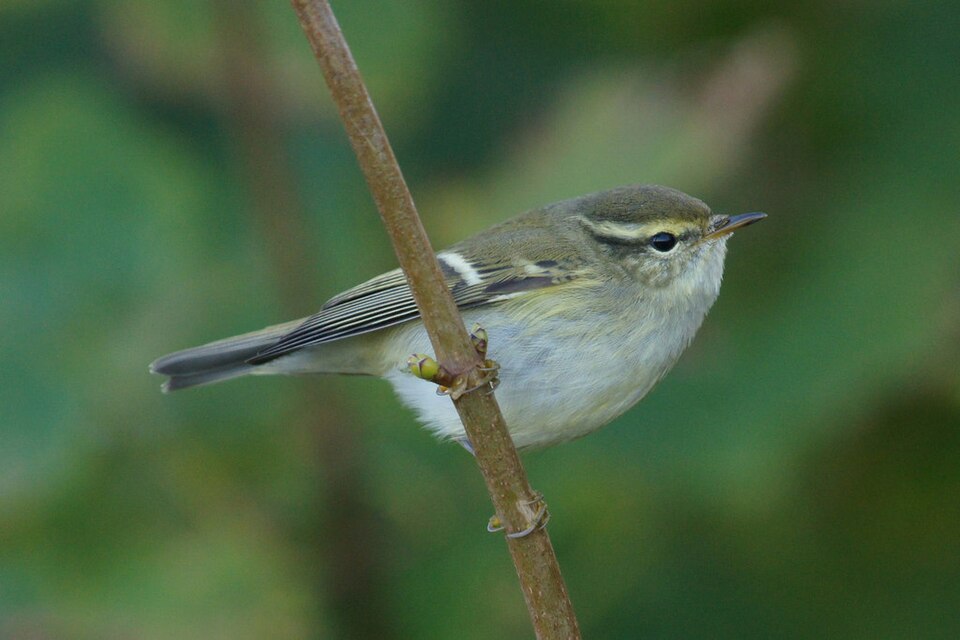
Yellow-browed Warbler

Phylloscopus inornatus

How to recognise it

  • Tiny, with a long, pale yellow-white eyebrow and a dark eye-stripe
  • Two clear wing bars, the upper one shorter
  • Call: a loud, rising “tsu-eest” that carries across a wood
wing bar A pale line across the folded wing, made by the pale tips of the wing coverts. Many leaf warblers have one or two.
eye-stripe The dark line through the eye. Its width, and whether it reaches the bill, are good clues.

Where and when

UK, NL, DK, DE, BE, NO, SE: scarce but annual, mostly on the coast from mid-September to early November, with hundreds in the UK in a good year, and a few overwinter. FR, IE, FI: rare. Never breeds here.

Call A loud, thin, rising “tsoo-eest” (a bit like a cross between a sparrow and a Pied Wagtail). Recording: Stanislas Wroza · xeno-canto

The commonest Siberian bird in autumn: more are seen every year. Listen for the call in a tit flock or in a sycamore in October.

Don’t confuse with: Pallas's Warbler (this week): smaller still, with a pale crown stripe and a lemon rump. Goldcrest (week 6): a crown stripe, and no eyebrow.

Pallas's Leaf Warbler, adult adult
Photo: 小铖/Smalltown · CC BY-NC

Bird 2 of 7

Pallas's Leaf Warbler

Phylloscopus proregulus

How to recognise it

  • Tiny, bright and busy, with a lemon-yellow rump patch
  • Pale yellow crown stripe and a bold eyebrow, with two wing bars
  • Call: a soft, plaintive “chu-ee”
rump patch A pale patch on the lower back, just above the tail. Pallas's Warbler has a lemon-yellow one.
crown stripe A pale or coloured stripe along the middle of the crown.

Where and when

UK: scarce but annual, in late October and November, mainly on the east coast. NL, DE, DK, SE: very rare, a few each year. BE, FI, NO, FR, IE: almost never.

Call A soft, high, fluty “chwee” or a quiet “wee-wee”. Recording: Bo Shunqi · xeno-canto

A gem. It often hovers in front of foliage like a miniature hummingbird, and flashes its yellow rump. The size is smaller than a Yellow-browed Warbler and the call is quieter.

Don’t confuse with: Yellow-browed Warbler (this week): bigger, with no pale crown stripe or yellow rump.

Yellow-browed or Pallas's?

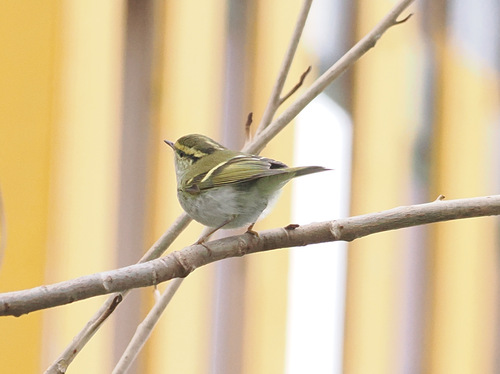
Yellow-browed WarblerYellow-browed Warbler
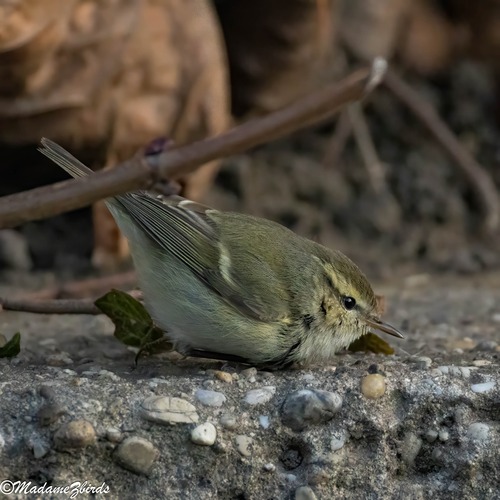
Pallas's Leaf WarblerPallas's Leaf Warbler

Pallas's Leaf Warbler is smaller and brighter. It has a lemon-yellow rump patch, a pale crown stripe, and a more rounded head. A Yellow-browed Warbler is plain green on the back, with no stripe on the crown, and calls with a loud rising “tsu-eest”. Pallas's has a quiet, soft call.

Hume's Leaf Warbler, adult adult
Photo: madamez · CC BY-NC

Bird 3 of 7

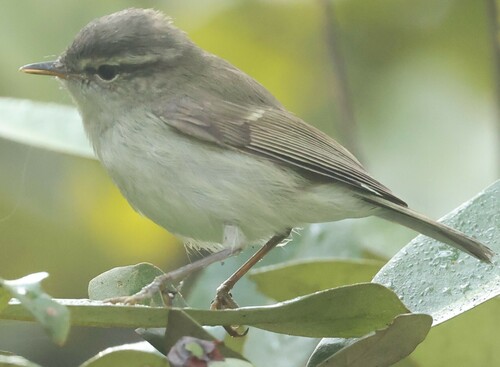
Hume's Leaf Warbler

Phylloscopus humei

How to recognise it

  • Duller and greyer than a Yellow-browed Warbler, with one clear wing bar (the greater coverts)
  • Dark bill, dark legs and a weak, pale eyebrow
  • Call: a flatter, two-note “wee-soo”, with no rise at the end
wing bar A pale line across the folded wing, made by the pale tips of the wing coverts. Many leaf warblers have one or two.

Where and when

UK: very rare, in October and November, with a few records in a good year. NL, BE, DE, DK, SE, FI: almost never. Not recorded regularly in the other countries.

Call A disyllabic, flat “tsiu-eet”, less shrill and with the stress on the first syllable. Recording: Arjun Dutta · xeno-canto

Hume's is the one you get by call: a rare, dull Yellow-browed look-alike. The call tells you, and a photograph of the wing bars tells the rest.

Don’t confuse with: Yellow-browed Warbler (this week): two clear wing bars, brighter green, and a rising call.

Arctic Warbler, adult adult
Photo: Terje Pettersen · All Rights Reserved

Bird 4 of 7

Arctic Warbler

Phylloscopus borealis

How to recognise it

  • A large, robust warbler with a long, white supercilium and a thick eye-stripe
  • One faint wing bar, and a bill that is quite long and heavy
  • Flesh-pink legs and a rather dull, grey-green look
wing bar A pale line across the folded wing, made by the pale tips of the wing coverts. Many leaf warblers have one or two.
eye-stripe The dark line through the eye. Its width, and whether it reaches the bill, are good clues.

Where and when

NO, SE, FI: uncommon on breeding grounds in the far north, from June to August. UK: very rare, in September. DK, NL, DE, BE, FR, IE: almost never. It winters in south-east Asia.

Sound A hard, short “tzik” call, and a fast, dry trill as a song. Recording: Ding Li Yong · xeno-canto

A big, plain leaf warbler for a late September gale. It is a long-distance migrant, wintering in the Philippines and Indonesia.

Don’t confuse with: Greenish Warbler (this week): smaller, a shorter bill, and a call like a House Sparrow's. Willow Warbler (week 6): no wing bar.

Greenish Warbler, adult adult
Photo: peter maaskant · CC BY-NC

Bird 5 of 7

Greenish Warbler

Phylloscopus trochiloides

How to recognise it

  • A neat, grey-green warbler with one thin pale wing bar
  • Long, whitish supercilium with a dark eye-stripe
  • Call: a loud, high two-note “chi-wee”, more like a sparrow than a warbler
wing bar A pale line across the folded wing, made by the pale tips of the wing coverts. Many leaf warblers have one or two.
eye-stripe The dark line through the eye. Its width, and whether it reaches the bill, are good clues.

Where and when

FI, SE, NO, DE, DK: rare to scarce breeders in the east and north. UK: very rare, in autumn, with a few each year. NL, BE: almost never. A bird of the eastern edge of the region.

Sound A loud, high “chi-wee” and a hurried song that ends with a flourish. Recording: Peter Boesman · xeno-canto

A leaf warbler, with a 'something not quite right' look: a thin wing bar, a pale supercilium and a long bill. Often found by its call.

Don’t confuse with: Willow Warbler (week 6): no wing bar, and a different song. Arctic Warbler (this week): bigger, and a much longer bill.

Radde's Warbler, adult adult
Photo: 偷猫头 · CC BY-NC

Bird 6 of 7

Radde's Warbler

Phylloscopus schwarzi

How to recognise it

  • A big, chunky warbler, olive-brown above with a bold buff supercilium that curves down at the back
  • A thick, short bill, a thick eye-stripe and orange-pink legs
  • Call: a hard, dry “tchk”, like a Dusky Warbler's
eye-stripe The dark line through the eye. Its width, and whether it reaches the bill, are good clues.

Where and when

UK, NL, DK, DE, SE: very rare, in October. BE, FR, IE, NO, FI: almost never. Typically one or two a year in each country, mostly on the east coast, skulking low in dense cover.

Call A short, hard “tchk” or “chk”, like a stone being tapped. Recording: David Darrell-Lambert · xeno-canto

A skulker: it moves like a mouse in thick scrub, and a view of the bold eyebrow and the heavy legs tells you what it is.

Don’t confuse with: Dusky Warbler (this week): slimmer, a dark leg and a thin, black bill.

Dusky Warbler, adult adult
Photo: pintail · CC BY

Bird 7 of 7

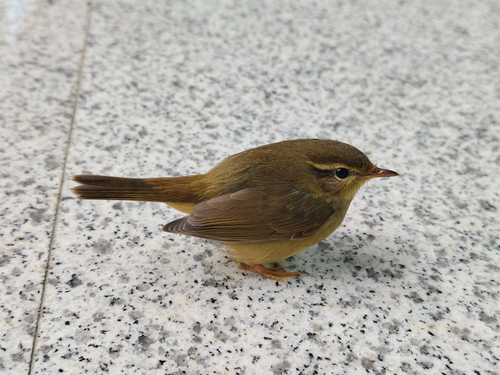
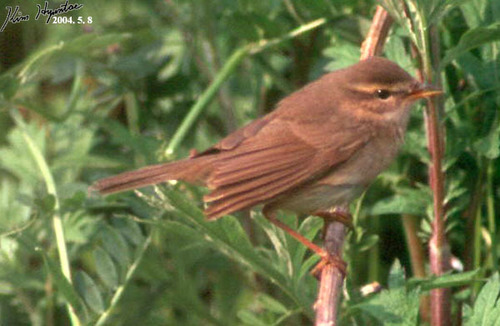
Dusky Warbler

Phylloscopus fuscatus

How to recognise it

  • Brown above and pale below, with a buff-white supercilium that starts at the bill
  • A dark eye-stripe, a thin, dark bill with a yellow base, and dark legs
  • Restless, flicking wings and tail, and a call that is hard and loud: “tchack”
eye-stripe The dark line through the eye. Its width, and whether it reaches the bill, are good clues.

Where and when

UK, NL, DK, DE, SE: very rare, in October and November, with a few overwintering. BE, FR, IE, FI: almost never. A bird of reeds, brambles and ditches.

Call A very hard, sharp “tchak”, like two pebbles knocked together, often repeated. Recording: Paul Kelly · xeno-canto

Even when it hides, the call betrays it. Like a Chiffchaff that has been dipped in tea and has had a stronger eyebrow added.

Don’t confuse with: Radde's Warbler (this week): bigger, with a heavier bill and pinker legs. Common Chiffchaff (week 6): no strong eyebrow.

Quiz

12 questions, with birds you have to repeat mixed in. Your answers decide when each bird comes back.

Out and about this week

Between mid-September and early November, spend a morning in a coastal wood or hedgerow, or the sycamores of a park near the east coast, and listen for the Yellow-browed call. If you do not live near the coast, watch the bird reports of the nearest hotspot and try to see a bird that has been found.