Motmot

Advanced birding · Lesson 9 · 20 minutes

Tree warblers and Sylvias

Icterine, Melodious, Booted, Eastern Olivaceous, Garden Warbler, Blackcap and two Whitethroats

The tree warblers (Hippolais and Iduna) are bigger than leaf warblers, with a flat head and a long, pointed bill. The Sylvia warblers are plumper, with a different build, a strong song and a hedge to hide in. In this lesson they come together because they overlap in habitat, and because the plain ones, Garden Warbler and Booted Warbler, are famous for being featureless.

Icterine and Melodious are the standard overshoots in late May and June. They arrive in a spring rush on the south and east coasts. In autumn, in August and September, young birds of both species and of the rarer Booted and Eastern Olivaceous Warbler turn up. Their identification is a classic: Icterine has a long wing, a pale wing panel and blue-grey legs, Melodious has a short wing and a rounded head.

Blackcap, Garden Warbler and the two Whitethroats are more regular. The Blackcap now spends the winter in the UK and IE, which has surprised many people: most of these winter birds are German and Austrian breeders.

Today: 8 birds

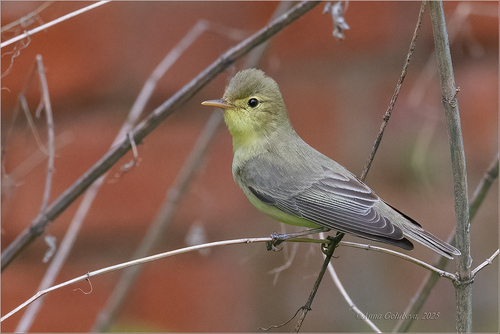
Icterine Warbler, adult adult
Photo: Анна Голубева · CC BY-NC-ND

Bird 1 of 8

Icterine Warbler

Hippolais icterina

How to recognise it

  • A bright lemon-yellow throat and breast, a pale yellow supercilium, and a pale wing panel
  • Long wings: a long primary projection, a flat, steep head, and a thick bill
  • Blue-grey legs and a loud, jumbled song
wing panel A pale panel on the folded wing, made by the pale edges of the flight feathers. Icterine has a clear one.
primary projection How far the wing tip sticks out beyond the tertials. Long in Icterine, short in Melodious.

Where and when

NL, DE, DK: uncommon breeders in the east, from mid-May. BE, NO, SE, FI: rare to scarce. UK and FR: very rare, mostly in autumn. IE: almost never. Late migrants, arriving in late May and gone by August.

Sound A very loud, fast, jumbled song of sweet notes mixed with harsh “chack” notes, with a high ‘ee’ squeak. Recording: Bodo Sonnenburg · xeno-canto

A summer visitor with a lot of sparrow-like, mimicking song. The wing panel and the long wing separate it from a Melodious Warbler.

Don’t confuse with: Melodious Warbler (this week): a shorter wing, no wing panel and a rounder head.

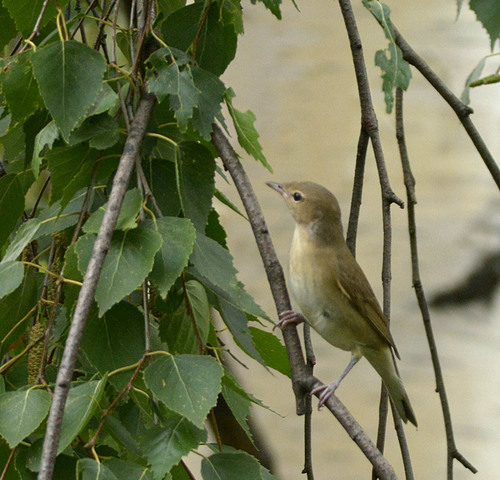
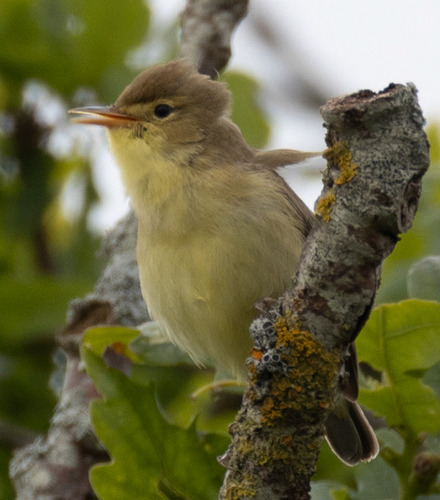
Melodious Warbler, adult adult
Photo: Claverie · CC BY-NC

Bird 2 of 8

Melodious Warbler

Hippolais polyglotta

How to recognise it

  • Pale yellow, with a rounded head and a short primary projection
  • Rather plain wings, with no pale wing panel, and brown-grey legs
  • Song: a continuous, babbling warble, with sparrow-like chirps mixed in
wing panel A pale panel on the folded wing, made by the pale edges of the flight feathers. Icterine has a clear one.
primary projection How far the wing tip sticks out beyond the tertials. Long in Icterine, short in Melodious.

Where and when

FR: fairly common in the south and west. BE, NL, DE: rare. UK: very rare in spring and autumn, mostly on the south coast. IE: almost never. Arrives in late April and leaves in August.

Sound A musical, rapid, sustained babble, with a sparrow-like chirrup in it. Recording: Lionel FREDERIC · xeno-canto

A southern bird that overshoots in spring. When it stops singing, the shape does the work: a short wing and a rounder head.

Don’t confuse with: Icterine Warbler (this week): a long wing, a wing panel and a flat, steep head.

Icterine or Melodious?

Icterine WarblerIcterine Warbler
Melodious WarblerMelodious Warbler

Wing first, then the head and the legs. Icterine has a long wing (the tips reach almost halfway down the tail), a pale wing panel, a flat head and blue-grey legs. Melodious has a short wing, no wing panel, a rounded head and brown legs. Both sing a lot, but the Icterine sings louder and harsher, the Melodious faster and more musical.

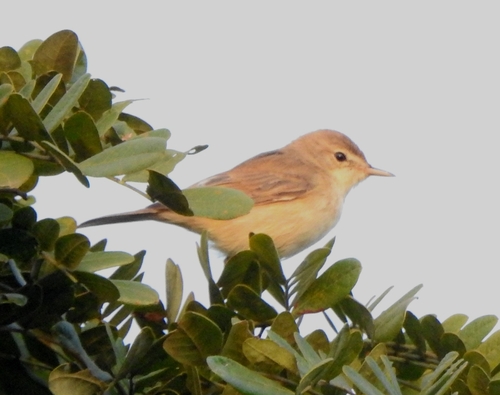
Booted Warbler, adult adult
Photo: afsarnayakkan · CC BY

Bird 3 of 8

Booted Warbler

Iduna caligata

How to recognise it

  • Small and plain, pale grey-brown above and off-white below
  • A short, thin bill, a short, pale supercilium and a rounded head
  • Call: a hard “tchek”, and a small, rapid, rather weak song

Where and when

FI: very rare breeder in the east. UK, NL, DK, SE, NO, DE: very rare, in autumn, mostly in late August and September. BE, FR, IE: almost never. A bird from the Russian steppe, often on the east coast.

Sound A hard “chek-chek” and a small, quick warble like a Sedge Warbler with no energy. Recording: Stanislas Wroza · xeno-canto

Easily overlooked: a small, pale bird that looks like a Sylvia warbler without a pattern. The tiny bill and a quick, flicking tail help.

Don’t confuse with: Eastern Olivaceous Warbler (this week): longer bill, longer tail, and more extensive pale on the tail edges.

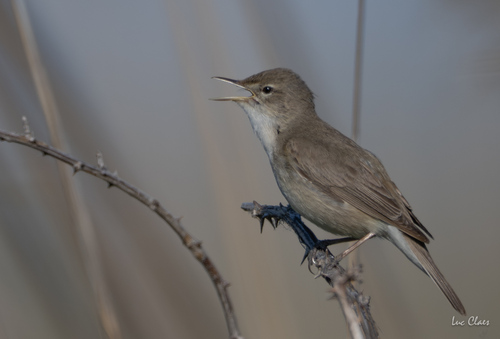
Eastern Olivaceous Warbler, adult adult
Photo: Luc Claes · CC BY-NC

Bird 4 of 8

Eastern Olivaceous Warbler

Iduna pallida

How to recognise it

  • Plain pale grey-brown, with a long bill, a flat head and a long tail
  • A paler face with a short eyebrow, and a faint pale wing panel
  • Dips its tail slowly downwards, like a chat, not sideways
wing panel A pale panel on the folded wing, made by the pale edges of the flight feathers. Icterine has a clear one.

Where and when

UK: very rare, in autumn. NL, DE, DK, FR, SE: almost never. A bird from south-eastern Europe and western Asia, usually seen in autumn.

Call A short, hard “tchek” and a quiet, scratchy warble. Recording: Grégoire Chauvot · xeno-canto

A very grey, long-billed bird that looks "wrong" for any other warbler. The slow downward tail dip is a unique habit among the warblers.

Don’t confuse with: Booted Warbler (this week): a smaller bill, a shorter tail and a flick of the wings.

Garden Warbler, adult adult
Photo: oleg-yumashev · CC BY

Bird 5 of 8

Garden Warbler

Sylvia borin

How to recognise it

  • Plain brown above and buff-grey below, with a blank face and a big dark eye
  • A short, thick bill, a rounded head and a plump shape
  • Song: a long, even, mellow warble, a bit like a Blackbird being fast
blank face A face with no marks, a round dark eye and no eyebrow, as in a Garden Warbler.

Where and when

BE, DE, DK, FI, UK, NL, FR and SE: fairly common in woods and scrub. NO: scarce. IE: rare. Arrives in late April and leaves in August and September.

Sound A long, smooth, mellow warble that goes on for a minute or more, on the same pitch. Recording: David Darrell-Lambert · xeno-canto

The bird with no features: its name is easy to remember, because there is a garden warbler in every garden but is never seen in one. If a plain brown warbler has a round eye, it is this one.

Don’t confuse with: Eurasian Blackcap (this week): the male has a black cap, and the song ends in a flourish. Common Reed Warbler (week 8): warm brown, with a longer bill.

Eurasian Blackcap, adult male adult male
Photo: Frode Falkenberg · All Rights Reserved

Bird 6 of 8

Eurasian Blackcap

Sylvia atricapilla

How to recognise it

  • A neat black cap on a grey head, and a grey body
  • Slightly plump, with a short bill, and a clean, dark eye
  • Song: a rich, flutey warble that ends in a flourish, with some harsh notes
cap The dark crown of a bird. Male Blackcaps have a black one, the females a rusty-brown one.

Where and when

UK, IE, NL, BE, DE, FR, DK and SE: common in woods, hedges and gardens from March. FI and NO: uncommon. Many central European birds now winter in UK and IE gardens, in the winter feeding on fat balls.

Sound A loud, clear, flutey warble that begins hesitantly and ends with a flourish, with a hard “tac-tac” call. Recording: Jacobo Ramil Millarengo · xeno-canto

A common bird, and now a winter garden bird too. Females and young birds have a rusty-brown cap, so look for the face shape, not just the cap.

Don’t confuse with: Garden Warbler (this week): plain, with a blank face and a smoother, longer song.

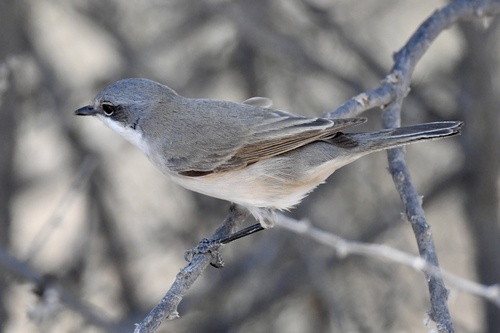
Lesser Whitethroat, adult adult
Photo: timothylloyd · CC BY-NC

Bird 7 of 8

Lesser Whitethroat

Curruca curruca

How to recognise it

  • Small and grey, with a dark mask through the eye and a white throat
  • Dark grey legs and a dark bill, and a thin white eye ring
  • Song: a dry rattle, “chikka-chikka-chikka-chikka”, on a single note

Where and when

BE, DE, DK, FI, SE: fairly common in hedges and scrub from late April. UK, NL, FR: uncommon, mostly in the east and south in the UK. IE and NO: rare. The Siberian form is a pale vagrant in autumn.

Sound A short, dry rattle, “chikka-chikka-chikka”, on one note, preceded by a quiet warble if you are close enough. Recording: Stanislas Wroza · xeno-canto

A skulker, so the song is the key. If you see it, the grey back with no rusty wing panel and the dark mask separate it from a Whitethroat.

Don’t confuse with: Common Whitethroat (this week): a rusty wing panel and a white throat on a grey head. Garden Warbler: plain and brown.

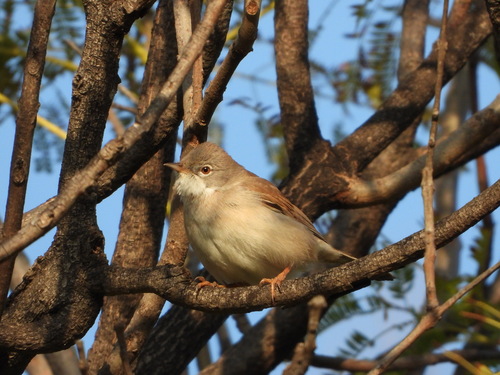
Common Whitethroat, adult male adult male
Photo: Itay Berger · CC BY-NC

Bird 8 of 8

Common Whitethroat

Curruca communis

How to recognise it

  • A grey head and a brilliant white throat that puffs when it sings
  • A bright rusty wing panel and a pale eye ring
  • Song: a short, scratchy burst, “chit-chit-whit-whit-chuh”, from a bush or in a display flight
wing panel A pale panel on the folded wing, made by the pale edges of the flight feathers. Icterine has a clear one.

Where and when

UK, IE, NL, BE, DE, FR, DK: common in hedges and scrub from mid-April. SE and FI: fairly common. NO: rare. After the Sahel drought crash of 1969, numbers recovered partly.

Sound A short, scratchy, hurried burst, with a rising and falling sound, often in a song flight. Recording: Eetu Paljakka · xeno-canto

The commonest Sylvia of scrub and field edges. Its song flight is very distinctive: a short flight up and then back down into the bush.

Don’t confuse with: Lesser Whitethroat (this week): a grey back, a dark mask and a dry rattle.

Quiz

12 questions, with birds you have to repeat mixed in. Your answers decide when each bird comes back.

Out and about this week

In May or June look for a singing Whitethroat and Blackcap in a hedge near you. Compare the two songs, then try to find a Garden Warbler: its song is the longest, smoothest and most even of the three.