Motmot

Advanced birding · Lesson 6 · 20 minutes

Chiffchaff, Willow and Wood

The classic leaf warblers, and the tiny birds that get mistaken for them

You know a Chiffchaff from a Willow Warbler by ear. Now we add the eye, and the birds that complicate things. Leaf warblers are small, olive and green, and they never keep still. They differ in tiny things: the leg colour, the length of the wing, the strength of the eyebrow, and above all the voice. In the field a lot of them are identified by call alone.

This lesson has the three "normal" leaf warblers: Chiffchaff, Willow Warbler and Wood Warbler, two lookalikes you will meet later in the south (Iberian Chiffchaff and Western Bonelli's Warbler) and the two crests, Goldcrest and Firecrest. They are not leaf warblers, but in the canopy in autumn they are the birds you check twice.

Season: Chiffchaffs arrive from mid-March, a month before Willow Warblers, and a few spend the winter in the southwest of the UK and in IE. Wood Warblers arrive in late April and May and have gone by August. In autumn the same birds move through again, plus Scandinavian Goldcrests by the thousand in October.

Today: 7 birds

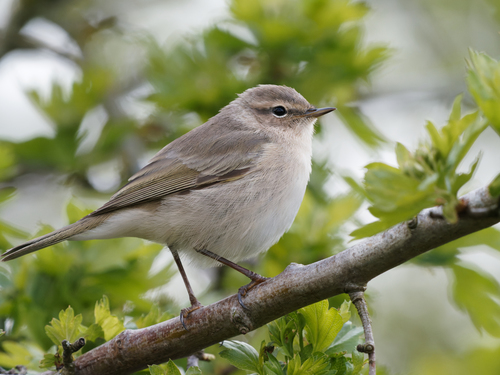
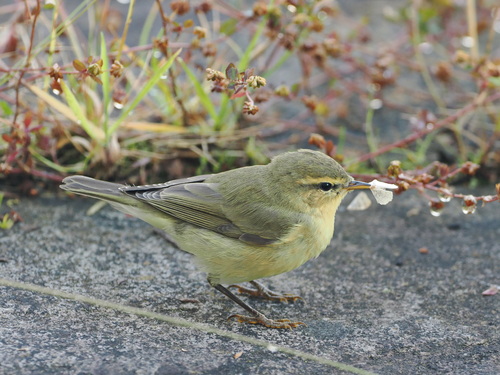
Common Chiffchaff, adult adult
Photo: william_stephens · CC BY

Bird 1 of 7

Common Chiffchaff

Phylloscopus collybita

How to recognise it

  • Olive-brown above and buff below, with a faint pale supercilium
  • Dark, almost black legs, short primary projection and a habit of dipping the tail
  • Song: a repeated “chiff-chaff”; call: a thin, rising “hweet”
supercilium The "eyebrow": the pale stripe above the eye. Its length, colour and width are a main clue in warblers.
primary projection How far the wing tip sticks out beyond the tertials on a resting bird. Long in Willow Warbler, short in Chiffchaff.

Where and when

All ten countries. UK, IE, NL, BE, DE, FR and DK: common summer visitors from mid-March (FR is a winter bird too). FI, SE and NO: fairly common, from April. A few overwinter in the southern UK and IE.

Sound A bouncy “chiff-chaff-chiff-chiff-chaff” in no fixed order, and a thin “hweet” call. Recording: João Tomás · xeno-canto

The first migrant warbler in spring, and the one you hear in winter in a sewage works in Cornwall. Birds in the east may be Siberian Chiffchaffs, paler and buff, with a very different call.

Don’t confuse with: Willow Warbler (this week): paler legs, a longer wing, a clearer yellow eyebrow and a falling song.

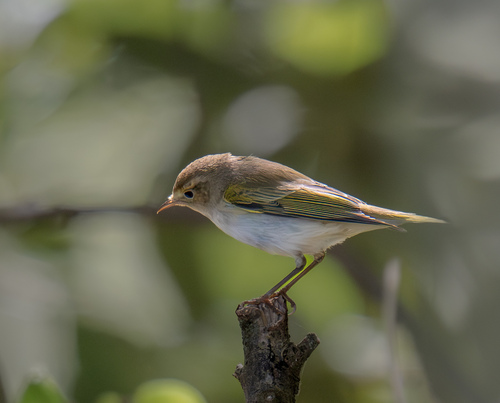
Willow Warbler, adult adult
Photo: pma · CC BY

Bird 2 of 7

Willow Warbler

Phylloscopus trochilus

How to recognise it

  • Clean greenish above and white-yellow below, with a clear yellow-white supercilium
  • Pale brown-pink legs, and a long primary projection
  • Song: a silvery, descending cascade; call: a soft “hoo-eet”
supercilium The "eyebrow": the pale stripe above the eye. Its length, colour and width are a main clue in warblers.
primary projection How far the wing tip sticks out beyond the tertials on a resting bird. Long in Willow Warbler, short in Chiffchaff.

Where and when

NO, SE, FI, IE and UK: common summer birds, with declines in southern England. NL, DE, DK: fairly common. BE and FR: uncommon, mostly on passage. Arrives in mid-April and leaves in August and September.

Sound A sweet, falling phrase that fades at the end, and a soft “hoo-eet”. Recording: João Tomás · xeno-canto

The commonest bird in a Scandinavian forest in May. Its numbers have fallen heavily in southern England in the last thirty years.

Don’t confuse with: Common Chiffchaff (this week): darker legs, a shorter wing, a duller look and a two-note song.

Chiffchaff or Willow Warbler?

Common ChiffchaffCommon Chiffchaff
Willow WarblerWillow Warbler

Voice first: the Chiffchaff says its own name in two notes, the Willow Warbler sings a falling, sweet phrase. Legs: black for Chiffchaff, pale brown for Willow Warbler. Wing: short for Chiffchaff, long for Willow Warbler, so that in the Willow Warbler the tips reach about two-thirds of the way down the tail. Colour: Willow Warbler is cleaner, with a clearer eyebrow.

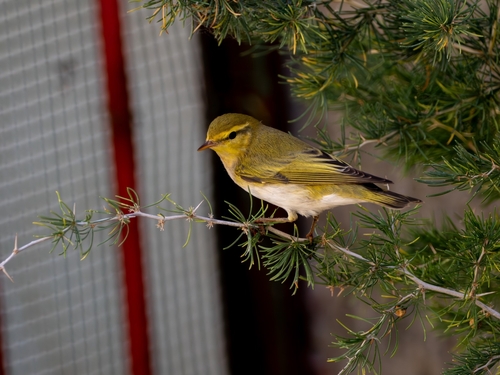
Wood Warbler, adult adult
Photo: Ludwig53 · CC BY-NC

Bird 3 of 7

Wood Warbler

Phylloscopus sibilatrix

How to recognise it

  • Bright lemon-yellow throat and breast, sharply cut off from a pure white belly
  • Strong yellow supercilium and a green wing panel
  • Song: a silvery trill that accelerates like a spinning coin; call: a clear “piu”
supercilium The "eyebrow": the pale stripe above the eye. Its length, colour and width are a main clue in warblers.
wing panel A pale, greenish or yellowish panel on the folded wing, made by the pale edges of the flight feathers.

Where and when

DE, SE, FI: uncommon breeding birds in beech and oak woods. UK: a scarce and declining bird of the oak woods in the west and north, from May. NL, BE, DK, NO, FR: rare to scarce. IE: very rare. Arrives in late April and leaves in July and August.

Sound A single note that falls and speeds up into a shivering trill, and a soft, sad “piu, piu”. Recording: Lars Edenius · xeno-canto

A wood warbler needs old woods with little undergrowth, and it is declining. The song and the clean white belly are what you look for.

Don’t confuse with: Willow Warbler (this week): less lemon, no sharp edge to the yellow, and a falling song.

Iberian Chiffchaff, adult adult
Photo: Marcel de Vries · CC BY-NC-ND

Bird 4 of 7

Iberian Chiffchaff

Phylloscopus ibericus

How to recognise it

  • Greener on the back than a Chiffchaff, with a yellower supercilium and breast
  • Dark legs and a short wing, looking like a bright Chiffchaff
  • Song: a stuttering, more varied “chiff-chiff”, often ending in a short rattle
supercilium The "eyebrow": the pale stripe above the eye. Its length, colour and width are a main clue in warblers.

Where and when

FR: breeds in the south-west and passes through on its way north. UK: very rare, in spring, usually singing. Other countries: almost never. It winters in West Africa and arrives in April.

Sound A stuttering, repeated “chip-chip-chip-chiff-chaff” with a rattle at the end. Recording: Jorge Leitão · xeno-canto

A bird to identify by ear, not by sight. In Britain a singing bird in April, with a song that does not match a Chiffchaff's, is the one to record.

Don’t confuse with: Common Chiffchaff (this week): a duller bird with an unmistakable “chiff-chaff” song.

Western Bonelli's Warbler, adult adult
Photo: Lluís Amat · CC BY-NC

Bird 5 of 7

Western Bonelli's Warbler

Phylloscopus bonelli

How to recognise it

  • Pale and clean: grey-brown above with a bright green wing panel
  • Very white underparts, with no yellow in the breast and a weak supercilium
  • Song: a dry, quick trill; call: a soft “hu-eet”
supercilium The "eyebrow": the pale stripe above the eye. Its length, colour and width are a main clue in warblers.
wing panel A pale, greenish or yellowish panel on the folded wing, made by the pale edges of the flight feathers.

Where and when

FR: uncommon summer visitor in the south and centre, April to August. DE: very rare. UK, IE, NL, BE, DK, NO, SE, FI: almost never, in spring and autumn, perhaps once or twice a year in the UK.

Sound A short, dry trill on one note, like a sewing machine, and a clear two-note call. Recording: Jack Berteau · xeno-canto

A southern bird that, with its pale back and green wing, looks quite different from Willow Warbler. In the UK it is a spring or autumn rarity.

Don’t confuse with: Willow Warbler (this week): a yellower, darker, more olive look and an eyebrow that is clear.

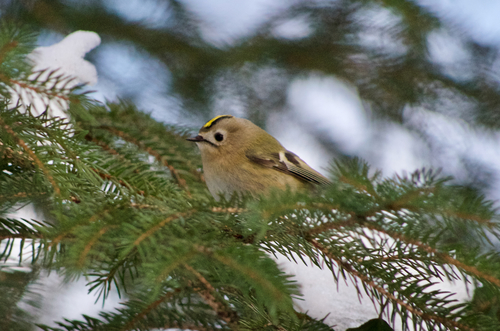
Goldcrest, adult adult
Photo: codrin_bucur · CC BY

Bird 6 of 7

Goldcrest

Regulus regulus

How to recognise it

  • Tiny, with a golden-orange crown stripe bordered with black
  • A plain face with a big dark eye, and two white wing bars
  • A very high, thin “si-si-si”, almost too high for older ears
crown stripe A pale or coloured stripe along the middle of the crown, as in the crests.

Where and when

All ten countries. UK, IE, NL, BE, DE, DK, SE, FI, FR and NO: fairly common, with many more in autumn and winter, when Scandinavian birds arrive. In October, thousands from Scandinavia arrive on the east coast, sometimes landing exhausted.

Sound A very high-pitched, thin “see-see-see” and a rapid, high little song with a flourish at the end. Recording: Tanguy Loïs · xeno-canto

The smallest bird in Europe, and it often travels with tits in winter. In autumn, a tree-top full of Goldcrests is a good sign that other rarities are about.

Don’t confuse with: Common Firecrest (this week): a bold white eyebrow and a black eye-stripe, brighter bronze shoulders.

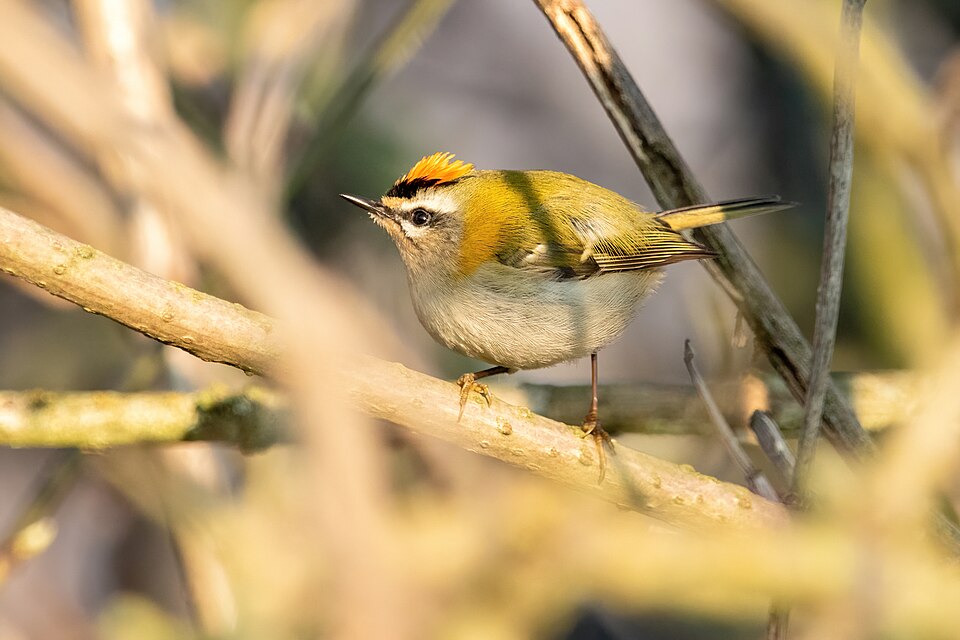
Common Firecrest, adult adult
Photo: Alexis Lours · CC BY

Bird 7 of 7

Common Firecrest

Regulus ignicapilla

How to recognise it

  • A bold white supercilium with a black eye-stripe below it
  • Orange-gold crown stripe (male) and a bronze patch on the shoulder
  • Call: a lower, harder “zit-zit” than the Goldcrest's
supercilium The "eyebrow": the pale stripe above the eye. Its length, colour and width are a main clue in warblers.
crown stripe A pale or coloured stripe along the middle of the crown, as in the crests.

Where and when

FR: fairly common, resident and migrant. BE and DE: uncommon, spring and autumn. UK: scarce, mostly in autumn, with a few that winter in the south. NL, DK, SE: very rare to rare, on passage. IE, NO and FI: almost never.

Sound A short, thin “zit-zit-zit”, a bit lower and harder than a Goldcrest's, and a song that speeds up. Recording: Arjun Dutta · xeno-canto

Very smart: the face looks painted. In the UK it is a scarce bird of south coast woods and gardens in winter.

Don’t confuse with: Goldcrest (this week): a plain face with no stripes, and a higher call.

Quiz

12 questions, with birds you have to repeat mixed in. Your answers decide when each bird comes back.

Out and about this week

In spring, go to a wood or a pit on a calm morning and listen. Try to separate Chiffchaffs from Willow Warblers by song first, then confirm with the legs and the wing. Try this with a friend: one calls the species, the other checks.