Motmot

Advanced birding · Lesson 38 · 24 minutes

Mixed plumages: finches, shrikes and waxwings

Males, females and youngsters that look like different birds

The same species can look like three different birds. A male Crossbill is red, a female is green, a young bird is streaky. A male Red-backed Shrike has a grey head and a chestnut back, a female is brown with a scaly belly. This lesson is the gauntlet: it pushes you to name each bird in a plumage that you do not expect.

The birds are the winter finches and the shrikes. Bramblings, Twites and Redpolls arrive from Scandinavia in autumn and winter, in numbers that vary from year to year. Crossbills, Hawfinches and Waxwings can come in irruptions, when a food shortage in the north sends them south. The two shrikes are quite different: the Great Grey Shrike is a winter visitor, the Red-backed a summer one.

The plumages we use here are chosen for their difficulty: the female Crossbill and the female Red-backed Shrike are harder than the males. In the quiz you may meet the same species in a different plumage from the one you learned.

Today: 8 birds

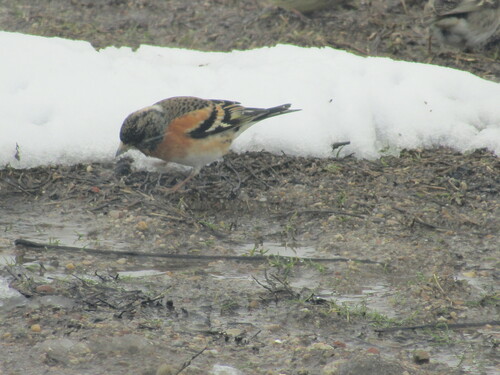
Brambling, adult male, non-breeding adult male, non-breeding
Photo: stevem4560 · CC BY

Bird 1 of 8

Brambling

Fringilla montifringilla

How to recognise it

  • Orange breast and shoulder, with a mottled brown-and-black head and back
  • A bold white rump that shows in flight
  • A yellow bill with a dark tip, and a white belly
rump The lower back, above the tail. White in a Brambling, pink in a male Twite.

Where and when

UK, NL, BE, DE, FR, DK, SE: uncommon to fairly common in winter, from October to March, in beech woods and fields, with numbers that vary with the beech mast. NO, FI: breeds in the north from May. IE: scarce.

Call A nasal, hard “tsweek” or “chwek”, and a harsh wheezing song. Recording: Twan Mols · xeno-canto

It flocks in beech woods. In winter a male has a mottled head, and in summer he is jet black. Look for the white rump.

Don’t confuse with: Chaffinch (beginners): a pink breast, a grey cap, and a white wing bar.

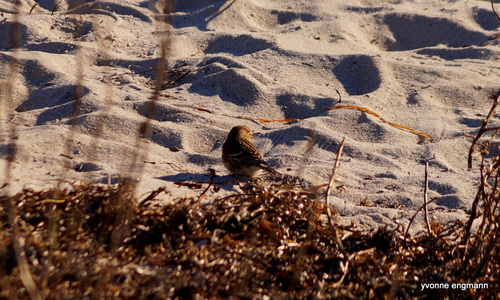
Twite, adult adult
Photo: yvonne147 · CC BY

Bird 2 of 8

Twite

Linaria flavirostris

How to recognise it

  • A streaky, brown, buff finch with a long tail
  • A yellow bill in winter and a pink rump in the male
  • Feeds in flocks on saltmarsh seeds, often on the coast
rump The lower back, above the tail. White in a Brambling, pink in a male Twite.

Where and when

UK, NO: uncommon, breeding on the Pennines, the Scottish moors and in Norway, and wintering on the coast. IE: scarce. DK, NL, DE, BE: scarce on the coast in winter. SE, FI, FR: rare.

Call A nasal “twit” or “chwee-eet”, the sound that gives it its name. Recording: Jarek Matusiak · xeno-canto

A finch of the moors and the saltmarsh. It is seen on a winter beach, feeding on the seeds of sea-aster and glasswort.

Don’t confuse with: Linnet (beginners): a smaller bill, a red breast, and no yellow bill in winter.

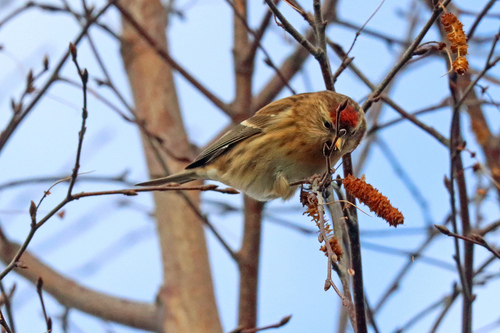
Redpoll, adult adult
Photo: rkl · CC BY

Bird 3 of 8

Redpoll

Acanthis flammea

How to recognise it

  • A small, streaky finch with a red forehead and a black chin
  • A short, yellow bill and a streaked rump
  • Flocks acrobatically in birches and alders, upside down

Where and when

UK, IE, NO, SE, FI: fairly common, in birch and conifer woods, breeding in the north. NL, BE, DE, DK, FR: uncommon in winter, with more in irruption years. Look in birches and alders.

Call A dry, rattling “chet-chet-chet” in flight, and a buzzing trill. Recording: Teet Sirotkin · xeno-canto

A bird of birches, in tight flocks that hang upside down. The size of a Siskin but with a red forehead.

Don’t confuse with: Eurasian Siskin (beginners): a yellow-green body, a black cap and a yellow wing bar.

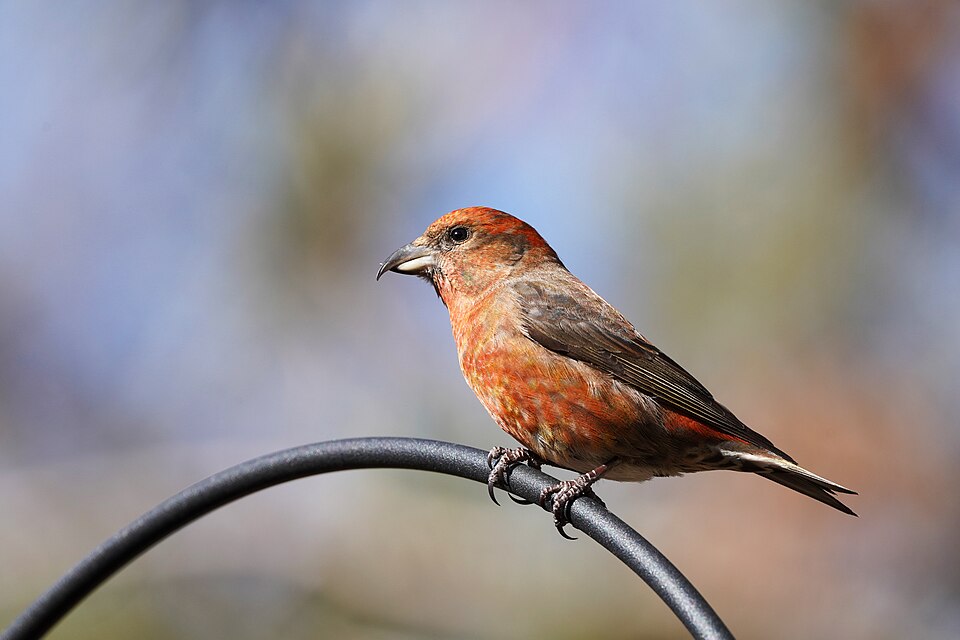
Common Crossbill, adult female adult female
Photo: USFWS Midwest Region · Public Domain

Bird 4 of 8

Common Crossbill

Loxia curvirostra

How to recognise it

  • Stocky, with a big head and a crossed bill
  • Dull olive-green, with a yellower rump
  • Clings to a cone and climbs like a small parrot
crossed bill A bill with tips that cross over, which a Crossbill uses to open pine cones.

Where and when

UK, IE, NL, BE, DE, FR, DK, SE, FI, NO: uncommon to fairly common, resident, in conifer forests, with big irruptions from the north and east in some years. A bird of pine and spruce, and a breeder in late winter.

Call A loud, hard, repeated “jip-jip-jip” in flight. Recording: Lars Edenius · xeno-canto

The male is red, the female green, the young streaked. The call is the best way to find them in a pine tree top.

Don’t confuse with: European Greenfinch (beginners): a green body with a yellow wing patch, and a thick, pale bill.

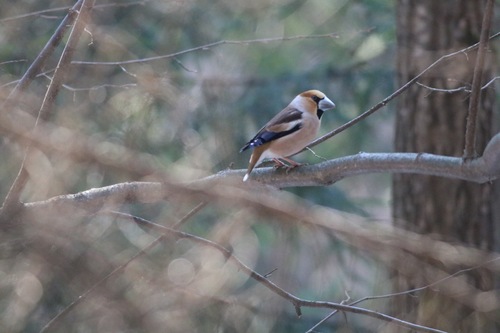
Hawfinch, adult adult
Photo: ruseva · CC BY

Bird 5 of 8

Hawfinch

Coccothraustes coccothraustes

How to recognise it

  • A huge, triangular, steel-blue bill, and a big head with a short neck
  • Chestnut head, a black bib and a bold white wing bar
  • A short, white-tipped tail and a heavy, thick-set body

Where and when

DE, FR, UK, NL, BE, DK, SE: uncommon to scarce, in old woods, especially hornbeam, and parks. FI, NO, IE: rare. A shy bird that sits at the top of a tall tree. In winter it may come to yew trees to eat berries.

Call A hard, explosive “tzik” or “tick”, like a camera click. Recording: Stephan Börnecke · xeno-canto

The bill can crack cherry stones. A bird that is quite easy to overlook, sitting still at the top of a tall tree.

Don’t confuse with: European Greenfinch (beginners): a smaller bill and a green body.

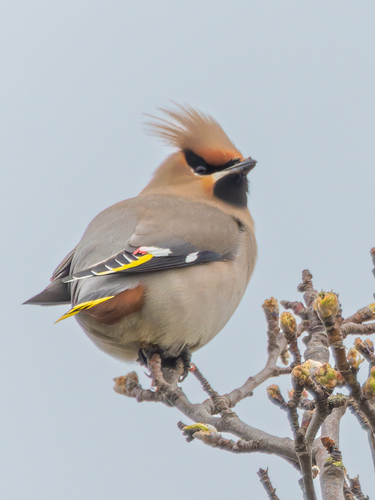
Bohemian Waxwing, adult adult
Photo: william_stephens · CC BY

Bird 6 of 8

Bohemian Waxwing

Bombycilla garrulus

How to recognise it

  • A pinkish-brown bird with a pointed crest, a black mask and a black bib
  • A yellow tip to the tail, and white-and-yellow wing marks with red, wax-like tips
  • Feeds on berries in groups, in a winter irruption from the north
irruption A sudden, large movement of a species outside its normal range, driven by a food shortage in the north.

Where and when

SE, FI, NO: uncommon to fairly common in the north in summer, and on passage in winter. UK, NL, BE, DE, DK, FR: scarce in winter in most years, but in an irruption year, hundreds or thousands, from November to March. IE: very rare.

Call A high, ringing, trilling “sirrrr”, like a small bell. Recording: Alwin van Lubeck · xeno-canto

In an irruption year, flocks of Waxwings eat berries in supermarket car parks and gardens.

Don’t confuse with: Common Starling (beginners): a black, speckled body, and no crest.

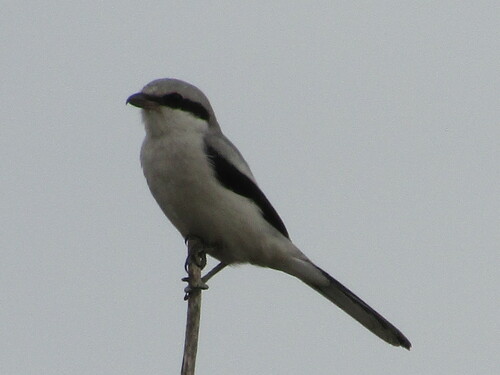
Great Grey Shrike, adult adult
Photo: stevem4560 · CC BY

Bird 7 of 8

Great Grey Shrike

Lanius excubitor

How to recognise it

  • A pale grey and white, with a bold black mask through the eye
  • Black wings and tail with white patches, and a long tail
  • Sits on the top of a bush or a tree, and hovers
mask A dark patch through the eye. Shrikes have one; its size and shape differ.

Where and when

SE, FI, NO: uncommon, breeding in the north. UK, NL, BE, DE, DK, FR: scarce in winter, from October to March. IE: very rare. A bird that hunts mice and small birds from a high perch.

Call A harsh, scolding “shek-shek”, and a quiet, varied song. Recording: Michael John O Mahony · xeno-canto

A pale grey predator of open heath in winter. It impales its prey on thorns, a habit that gives the shrikes their name “butcher birds”.

Don’t confuse with: Red-backed Shrike (this week): smaller, with a rufous back, and only here in summer.

Great Grey or Red-backed Shrike?

Great Grey ShrikeGreat Grey Shrike
Red-backed ShrikeRed-backed Shrike

Great Grey Shrike is a winter bird, big and pale grey, with black wings and a long tail. Red-backed Shrike is a summer bird, smaller, with a rufous back and, in the male, a grey head. A female Red-backed is brown with scaly underparts. Look at the date: a shrike in January is a Great Grey.

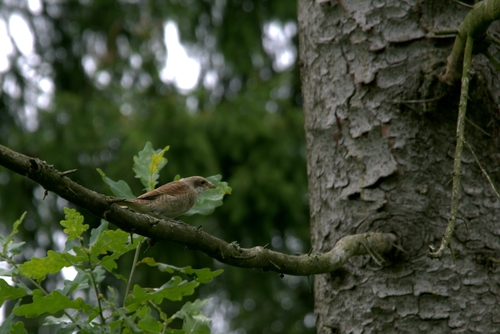
Red-backed Shrike, adult female adult female
Photo: sergey53 · CC BY

Bird 8 of 8

Red-backed Shrike

Lanius collurio

How to recognise it

  • Brown-grey, with scaly, barred underparts and a faint dark mask
  • A rufous-brown back and a rounded tail with white edges
  • Sits on top of a bush and watches, with a bold, upright look
mask A dark patch through the eye. Shrikes have one; its size and shape differ.

Where and when

DE, FR, SE, FI, NO, DK, NL, BE: uncommon to fairly common summer visitors, from mid-May to August, in open scrub. UK: very rare, with a few pairs. IE: almost never. A migrant to southern Africa that arrives late in spring.

Call A harsh, short “chek-chek”, and a quiet, rambling song. Recording: Dominique Guillerme · xeno-canto

A female is brown and scaly, and much harder than the male with his grey head. Look at the scaly flanks and the rufous back.

Don’t confuse with: Woodchat Shrike (week 34): a chestnut cap and a white shoulder patch, and a black back.

Quiz

12 questions, with birds you have to repeat mixed in. Your answers decide when each bird comes back.

Out and about this week

In winter, search for Waxwings in car parks and gardens with berries, and for a Great Grey Shrike on the top of a heath bush. In summer, look for a Red-backed Shrike in open scrub with thorny bushes.