Motmot

Advanced birding · Lesson 39 · 22 minutes

Marsh and Willow Tit, woodpeckers and treecreepers

The last of the lookalikes: tits, woodpeckers and the other treecreeper

Some pairs have a reputation. Marsh Tit and Willow Tit were not separated until 1897, and many experienced birders still prefer to hear the bird before they commit. The Treecreeper and the Short-toed Treecreeper can't be separated at all without the song or call. This lesson is for those pairs.

The tits are best separated by the cap (glossy or dull), the wing panel and above all the call. The woodpeckers (Lesser Spotted, Middle Spotted and Black) are the ones that you almost never see, but you can hear: drumming in spring, and calls year-round.

After this lesson comes the final exam. You will be able to name the main birds of the whole course, from gulls to waders and from warblers to ducks.

Today: 8 birds

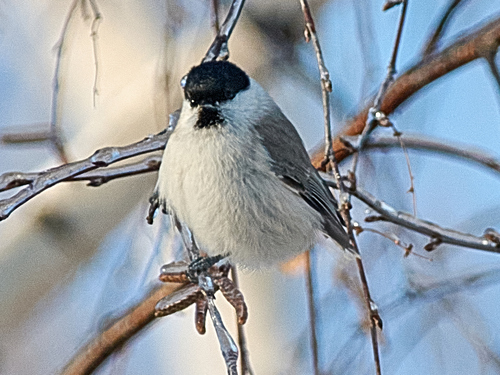
Marsh Tit, adult adult
Photo: sneckl · CC BY

Bird 1 of 8

Marsh Tit

Poecile palustris

How to recognise it

  • A glossy black cap and a small, neat bib
  • A plain wing, without a pale wing panel, and a pale spot at the base of the bill
  • A sharp, explosive “pitchou!” call
bib The patch of black on the throat and chest. Marsh Tit has a small neat one; Willow Tit has a larger, untidy one.
cap The dark crown of the head. Glossy black in a Marsh Tit, dull sooty in a Willow Tit.
wing panel A pale panel on the folded wing. A Willow Tit often shows a pale one; a Marsh Tit does not.

Where and when

UK (England and Wales), BE, NL, DE, FR, DK, SE: uncommon to fairly common, resident, in deciduous woods. IE, NO: absent. FI: rare. Declining in the UK.

Call A loud, explosive “pit-choo!” and a scolding “chika-dee-dee”. Recording: Dominique Guillerme · xeno-canto

The call is the way to tell it from the Willow Tit, and a shiny cap from a dull cap helps if you get a good view.

Don’t confuse with: Willow Tit (this week): a dull cap, a bigger bib, a pale wing panel and a nasal, buzzing call.

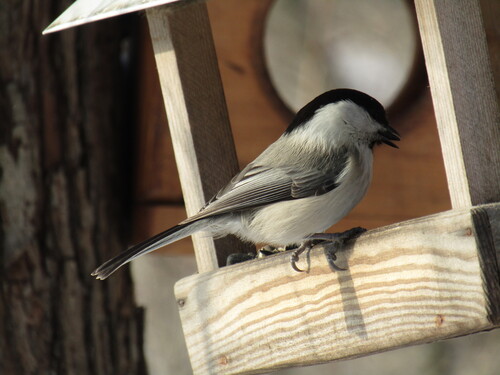
Willow Tit, adult adult
Photo: belyaev · CC BY-NC

Bird 2 of 8

Willow Tit

Poecile montanus

How to recognise it

  • A dull, sooty-black cap and a bigger, untidy bib
  • A pale wing panel on the folded wing, and a thick, short neck
  • A nasal, buzzing “tchay-tchay-tchay” call
bib The patch of black on the throat and chest. Marsh Tit has a small neat one; Willow Tit has a larger, untidy one.
cap The dark crown of the head. Glossy black in a Marsh Tit, dull sooty in a Willow Tit.
wing panel A pale panel on the folded wing. A Willow Tit often shows a pale one; a Marsh Tit does not.

Where and when

UK, NL, BE, DE, FR, DK, SE, FI, NO: scarce to fairly common, resident, in damp woods, birch, alder and conifer. IE: absent. A bird that excavates its own nest hole in rotten wood. Declining a lot in the UK.

Call A nasal, buzzing “tchay-tchay-tchay” and a high, thin “tsee-tsee”. Recording: Lars Edenius · xeno-canto

It excavates a hole in rotten birch or alder, which is why it likes damp woods. The call is a nasal buzz, unlike any other tit.

Don’t confuse with: Marsh Tit (this week): a glossy cap, a small bib and an explosive call.

Marsh Tit or Willow Tit?

Marsh TitMarsh Tit
Willow TitWillow Tit

Voice first. A Marsh Tit calls an explosive “pitchou!”, a Willow Tit a nasal, buzzing “tchay-tchay”. Then the cap: glossy and neat for the Marsh Tit, dull and sooty for the Willow Tit. A Willow Tit has a larger, untidy bib and a pale wing panel. The habitat helps: Marsh Tit in dry deciduous woods, Willow Tit in damp woods.

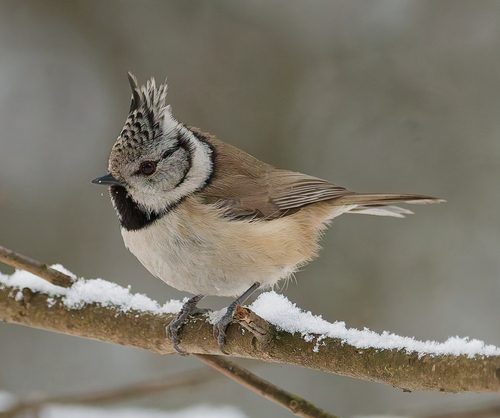
Crested Tit, adult adult
Photo: Vasily Kalinichenko · CC BY-NC

Bird 3 of 8

Crested Tit

Lophophanes cristatus

How to recognise it

  • A pointed, speckled black-and-white crest
  • A pale face, with a dark curved line behind the eye
  • A small, buff-brown bird of pine forest
crest A tuft of feathers on the head. The Crested Tit has a pointed, speckled black-and-white one.

Where and when

UK (Scottish Highlands), SE, FI, NO, DE, FR, DK: uncommon to fairly common, resident, in conifer forests. NL, BE: rare. IE: absent. A bird of Caledonian pine forest in the UK.

Call A soft, purring, trilling “tsee-tsee-trrrr” call. Recording: Rob van Bemmelen · xeno-canto

The only British tit with a crest. It lives in old pine forest, in the Highlands.

Don’t confuse with: Coal Tit (this week): a white nape patch, and no crest.

Coal Tit, adult adult
Photo: Sławek Staszczuk · CC BY-SA

Bird 4 of 8

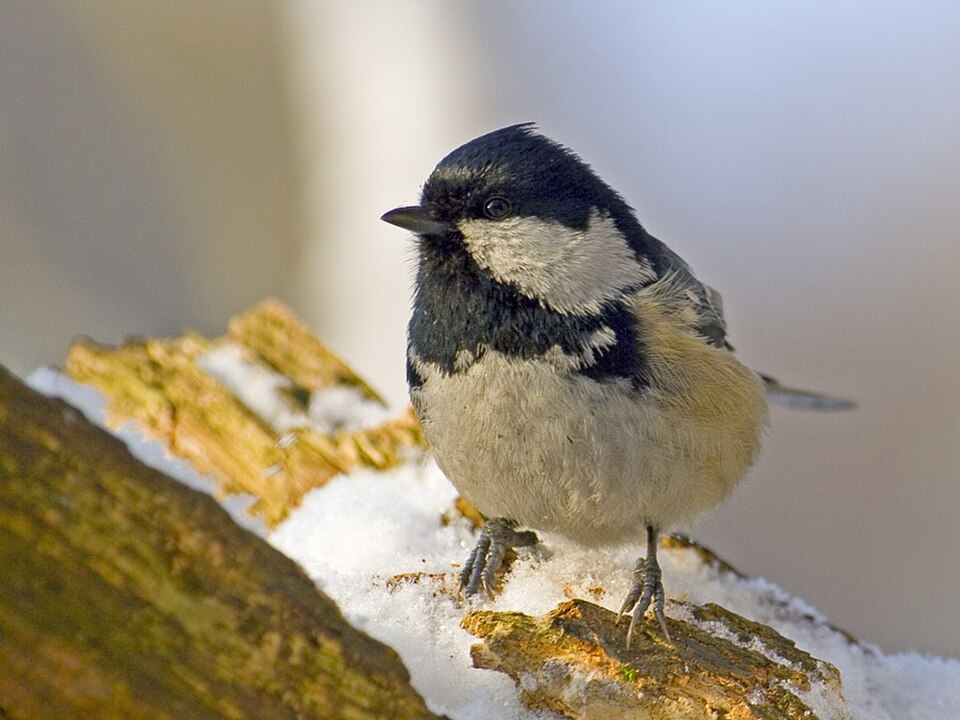
Coal Tit

Periparus ater

How to recognise it

  • A black head with a bold white patch on the nape
  • Two thin white wing bars and an olive back
  • Small, active, often in conifers, and a quick, high-pitched call

Where and when

UK, IE, NL, BE, DE, FR, DK, SE, FI, NO: common, resident, in conifers and mixed woods, and at garden feeders. A bird that takes seeds and hides them in tree bark.

Call A thin, high, “tsee-tsee-tsee” and a repeated, ringing song, “weetsy-weetsy-weetsy”. Recording: Jorge Leitão · xeno-canto

A small tit with a white spot on the nape, that you see at a garden feeder. It takes a seed and flies away to hide it.

Don’t confuse with: Crested Tit (this week): a crest and no white nape.

Lesser Spotted Woodpecker, adult male adult male
Photo: Tania Shamanchik · CC BY-NC

Bird 5 of 8

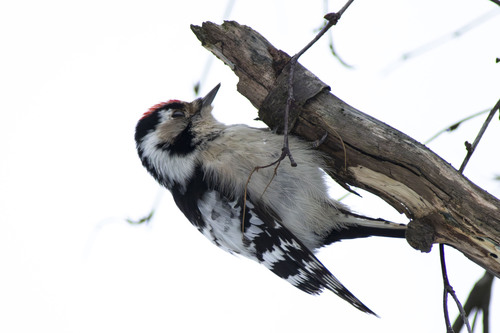
Lesser Spotted Woodpecker

Dryobates minor

How to recognise it

  • Tiny, the size of a sparrow, with a barred black-and-white back
  • A red crown on the male, and no red on the underparts
  • Drums in a quick, long burst, in spring

Where and when

UK, NL, BE, DE, FR, DK, SE, FI, NO: scarce, resident, in old woods and parks, declining. IE: absent. A bird of the treetops. Drums from February to April.

Call A fast, high “pee-pee-pee-pee-pee” and a soft “kik”. Recording: Stanislas Wroza · xeno-canto

A woodpecker that is rarely seen, as it spends its time in the high branches of a tree. A bird to find by the drumming in March.

Don’t confuse with: Great Spotted Woodpecker (beginners): larger, with large white shoulder patches and red under the tail.

Middle Spotted Woodpecker, adult adult
Photo: Всеволод Лупанов · CC BY-NC

Bird 6 of 8

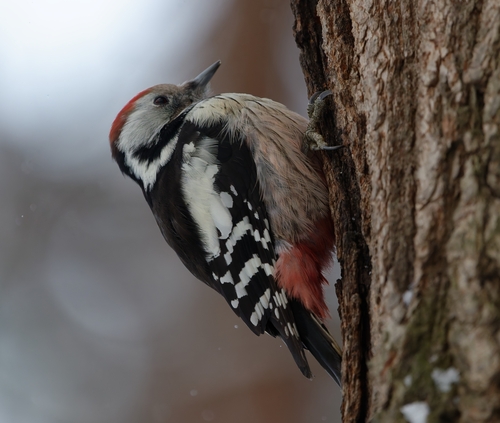
Middle Spotted Woodpecker

Dendrocoptes medius

How to recognise it

  • A red crown (in both sexes), and a pale face with a thin dark line
  • Pink-red undertail, and a finely streaked, pale breast
  • No red moustache, and a rather gentle, thin-billed look

Where and when

DE, FR: uncommon, in old oak woods. SE, FI, NO, DK, NL, BE, UK, IE: very rare or almost never (a few records in the UK). A bird of ancient oak woods in central Europe.

Call A nasal, wailing “gwek-gwek-gwek”, and a soft “kik”. Recording: Christian Kerihuel · xeno-canto

A woodpecker of old oak woods that does not drum much. A bird with a red cap and a pale breast.

Don’t confuse with: Great Spotted Woodpecker (beginners): a black crown (in the female), red moustache and black back.

Black Woodpecker, adult male adult male
Photo: stevem4560 · CC BY

Bird 7 of 8

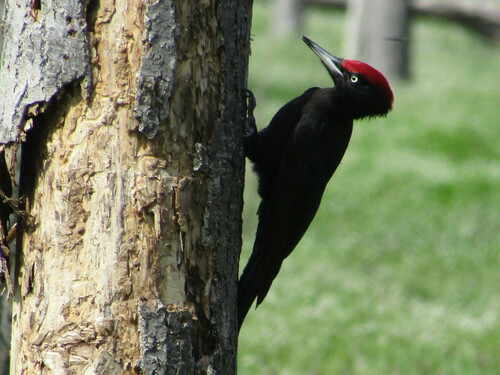
Black Woodpecker

Dryocopus martius

How to recognise it

  • A crow-sized, all-black woodpecker with a pale bill
  • A bright red crown in the male, and a pale eye
  • A loud, laughing call and a deep, roaring drumming

Where and when

SE, FI, NO, DE, FR, DK: uncommon to fairly common, resident, in big forests. NL, BE: scarce. UK, IE: absent. A bird of mature pine and beech forest that is expanding west.

Call A loud, ringing “kri-kri-kri-kri” in flight, and a long, penetrating “kwee-ah” call. Recording: Teet Sirotkin · xeno-canto

The biggest woodpecker of the region, with a call that echoes through the forest.

Don’t confuse with: Carrion Crow (beginners): a black bird with a black bill, and no red.

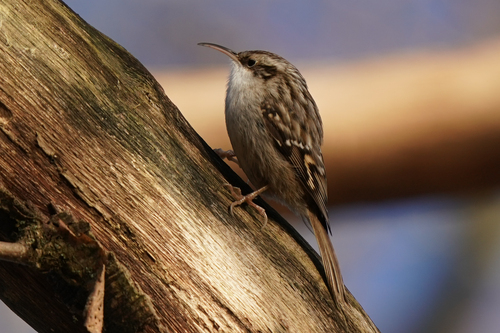
Short-toed Treecreeper, adult adult
Photo: Dr. Sven Gippner · CC BY-NC

Bird 8 of 8

Short-toed Treecreeper

Certhia brachydactyla

How to recognise it

  • Looks almost identical to the Eurasian Treecreeper: a brown, streaked back and white underparts
  • A slightly longer bill and a dirtier flank
  • The call is the key: a loud, penetrating “tiit”

Where and when

FR, BE, DE, NL, UK (Channel Islands): fairly common to uncommon, resident, in woods and parks in the south and west of the range. UK mainland, IE, DK, SE, FI, NO: absent (a rare vagrant in the south-east of England). A bird that lives with Eurasian Treecreeper in the same woods in the south.

Call A loud, sharp “tiit-tiit” and a song of a short, steady series ending in a note, “tit-tit-tit-teeroyee”. Recording: Francesco Sottile · xeno-canto

Many Short-toed Treecreepers are recorded as Eurasian Treecreepers, unless you hear the song or call.

Don’t confuse with: Eurasian Treecreeper (beginners): a thin, high “tsee” call and a bright, flowing song.

Quiz

12 questions, with birds you have to repeat mixed in. Your answers decide when each bird comes back.

Out and about this week

Go to a mixed wood in winter and try to find tit flocks. Listen for the calls: the explosive “pitchou” of the Marsh Tit and the buzzing call of the Willow Tit. If you are in the south-east of the range, check the treecreepers by call.