Motmot

Advanced birding · Lesson 37 · 22 minutes

Bad photos and jizz

Hawks, falcons, a cuckoo and a swift: naming a bird from its shape alone

Most birds that you see are poor views: far away, against the light, in a hurry or half behind a branch. This lesson is about reading shape and movement. Experienced birders call it jizz: the 'general impression of size and shape' that tells them the species before they see a single field mark.

The test is the group that most often shows up as a dark shape in the sky: the hawks and the falcons. The Sparrowhawk, Goshawk, Peregrine, Hobby, Merlin and Kestrel all hunt birds or small animals on the wing, and each has a distinctive silhouette and wingbeat. We add the Cuckoo, which looks like a hawk, and the Alpine Swift, which looks like a big, pale Swift.

The photos in this lesson are deliberately not perfect: silhouettes, backlit birds, distant views. In the quiz, the answers are other birds of the same shape, so the pros' advice applies: do not guess from colour, look at the wings, the tail and the way it flies.

Today: 8 birds

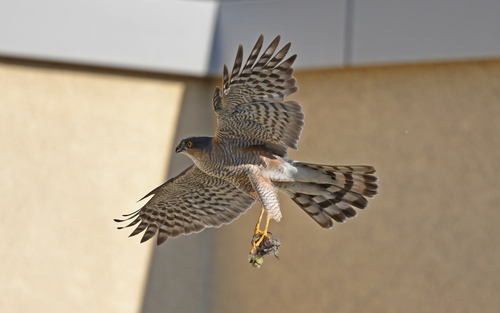
Eurasian Sparrowhawk, adult adult
Photo: birdingjulia · CC BY

Bird 1 of 8

Eurasian Sparrowhawk

Accipiter nisus

How to recognise it

  • Short, broad, rounded wings and a long, barred tail: a silhouette like a boomerang with a tail
  • Flap-flap-glide wingbeat, low and fast through a hedge
  • Female is much bigger than the male, and has a grey-brown back and barred underparts
silhouette The outline of a bird against the sky, with no colour or detail. Wing and tail shape alone often tells the species.
wingbeat The rhythm and depth of the wing strokes. A Hobby's is quick and scythe-like, a Sparrowhawk's is flap, flap, glide.

Where and when

All ten countries. UK, IE, NL, BE, DE, FR, DK, SE, FI, NO: fairly common, resident, in woods, gardens and farmland. A bird you see in a garden hunting small birds, with a very fast, low flight.

Call A fast, sharp “kek-kek-kek-kek”, near the nest. Recording: Simon Elliott · xeno-canto

Sparrowhawk is the hawk of the garden and the hedge. Rounded wings and a long tail are the first things to see.

Don’t confuse with: Eurasian Goshawk (this week): bigger, broader-bodied, with a thicker neck and a shorter, more powerful flight.

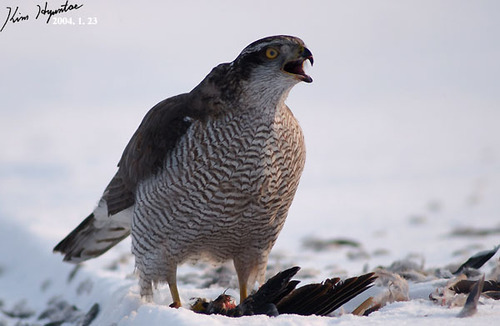
Eurasian Goshawk, adult adult
Photo: pintail · CC BY

Bird 2 of 8

Eurasian Goshawk

Astur gentilis

How to recognise it

  • Like a large Sparrowhawk: bigger, deeper-chested, with broad, rounded wings
  • A thick neck, a long head, and bulging rear edge to the wing
  • A bold white eyebrow and a white undertail, which puffs out in display

Where and when

SE, FI, NO, DE, FR: uncommon to fairly common in big forests, resident. UK, NL, BE, DK: scarce, with a few in woods. IE: very rare. A bird of old forests that is easy to overlook.

Call A fast, hard “gik-gik-gik-gik” near the nest, much deeper than a Sparrowhawk's. Recording: Walter Wallner · xeno-canto

A huge and powerful hawk. In the spring, a high display flight with white undertail feathers puffed out is the best way to see one.

Don’t confuse with: Eurasian Sparrowhawk (this week): smaller, slimmer and a more rapid wingbeat.

Peregrine Falcon, adult adult
Photo: sdz456 · CC BY

Bird 3 of 8

Peregrine Falcon

Falco peregrinus

How to recognise it

  • A heavy, broad-based, anchor-shaped silhouette, with a short tail
  • A dark hood and a clear 'moustache', and barred underparts
  • Fast, powerful wingbeat, and a stoop of up to 300 km/h
silhouette The outline of a bird against the sky, with no colour or detail. Wing and tail shape alone often tells the species.
wingbeat The rhythm and depth of the wing strokes. A Hobby's is quick and scythe-like, a Sparrowhawk's is flap, flap, glide.

Where and when

All ten countries. UK, IE, NL, BE, DE, FR, DK, SE, FI, NO: scarce to fairly common, resident or on passage, on cliffs, towers and on coasts. In winter, many hunt waders on estuaries.

Call A harsh, repeated “kak-kak-kak-kak” near the nest. Recording: David Darrell-Lambert · xeno-canto

A bird that nests on cathedrals and tall buildings. A pigeon flock that suddenly scatters often means a Peregrine.

Don’t confuse with: Eurasian Hobby (this week): smaller, slimmer, with scythe-like wings and a red thigh.

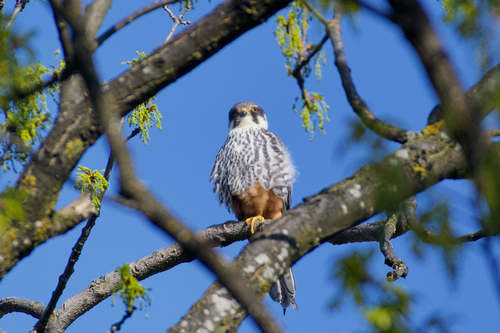
Eurasian Hobby, adult adult
Photo: codrin_bucur · CC BY

Bird 4 of 8

Eurasian Hobby

Falco subbuteo

How to recognise it

  • A slim, swift-like silhouette, with long, pointed, scythe wings and a short tail
  • A dark moustache on a white cheek and red thighs
  • Fast, agile, hunts dragonflies and swallows on the wing
silhouette The outline of a bird against the sky, with no colour or detail. Wing and tail shape alone often tells the species.

Where and when

UK, NL, BE, DE, FR, DK, SE, FI: uncommon summer visitors from late April to September, over heaths, wetlands and farmland. NO, IE: rare. A bird that appears overhead like a big Swift.

Call A clear, quick “kew-kew-kew-kew”, higher than a Kestrel. Recording: Elias A. Ryberg · xeno-canto

Hobbies follow Swifts and hunt martins. A falcon with a Swift-like silhouette in summer is a Hobby.

Don’t confuse with: Merlin (this week): smaller, a plain face, a low, fast flight. Peregrine Falcon: heavier.

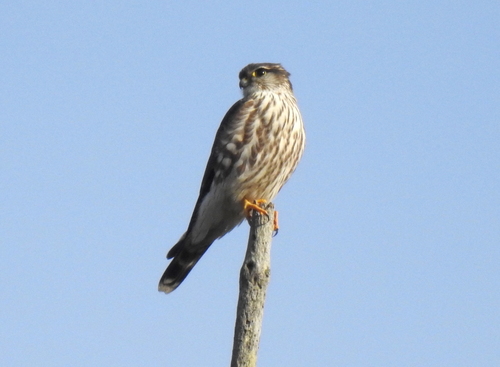
Merlin, adult adult
Photo: rudyard · CC BY

Bird 5 of 8

Merlin

Falco columbarius

How to recognise it

  • Small, compact, fast: the smallest falcon, the size of a Mistle Thrush
  • A plain face with no moustache, and a barred tail in the female
  • Flies low over open ground, chasing small birds

Where and when

UK, IE, NO, SE, FI: scarce, breeding on moors and in the north from May. NL, BE, DE, DK, FR: scarce in winter, on coasts and fields, from October to March. A bird of open ground.

Call A fast, high “kee-kee-kee-kee” near the nest. Recording: Simon Elliott · xeno-canto

A small, fast falcon, with a low, dashing flight over a field of Meadow Pipits.

Don’t confuse with: Common Kestrel (this week): bigger, hovers, a long tail with a black band.

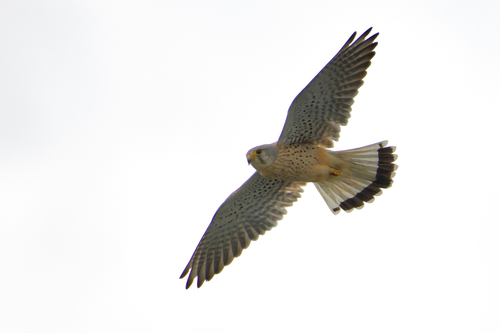
Common Kestrel, adult adult
Photo: codrin_bucur · CC BY

Bird 6 of 8

Common Kestrel

Falco tinnunculus

How to recognise it

  • Hovers on rapidly beating wings, with its head still
  • A long tail with a black band at the tip, and chestnut upperparts with black spots
  • A long, pointed silhouette, with pointed wings and a thin body
silhouette The outline of a bird against the sky, with no colour or detail. Wing and tail shape alone often tells the species.

Where and when

All ten countries. UK, IE, NL, BE, DE, FR, DK, SE, FI, NO: common to fairly common over fields and verges, resident, though northern birds migrate. A very familiar bird of the roadside.

Call A shrill, repeated “kee-kee-kee-kee”. Recording: David Darrell-Lambert · xeno-canto

The hovering falcon of the roadside. A silhouette hovering is almost always a Kestrel, and only a hovering Buzzard or Rough-legged Buzzard is similar.

Don’t confuse with: Merlin (this week): smaller, a plain face and a short tail without a band.

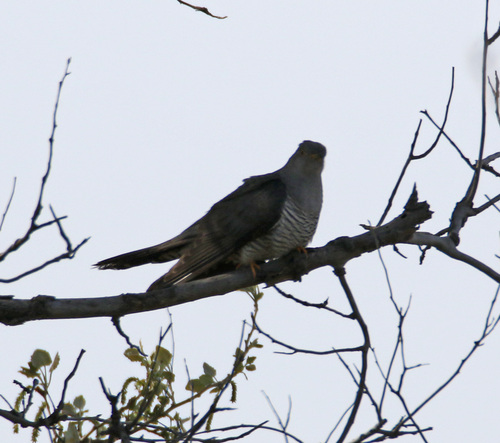
Common Cuckoo, adult adult
Photo: dimitriskokkinidis · CC BY-NC

Bird 7 of 8

Common Cuckoo

Cuculus canorus

How to recognise it

  • A hawk-like jizz, but with a long, graduated tail and long, pointed wings
  • A slim grey body, a barred belly and a slightly drooped wing
  • A very flat, level, whirring flight, with the wings below the body line
jizz The overall impression of a bird: its size, shape, movement and behaviour together.

Where and when

UK, IE, NL, BE, DE, FR, DK, SE, FI, NO: fairly common summer visitors, from mid-April to July (the adults leave in July). The male's song is the first sign of spring. Declining in the UK.

Sound A clear, two-note “cu-coo” from the male, and a bubbling, rolling call from the female. Recording: Lim Ying Hien 林勇贤 · xeno-canto

A bird with the shape of a Sparrowhawk and the flight of a pigeon, that you hear more often than you see.

Don’t confuse with: Eurasian Sparrowhawk (this week): short, round wings and a flap-flap-glide flight.

Alpine Swift, adult adult
Photo: karimhaddad · CC BY

Bird 8 of 8

Alpine Swift

Tachymarptis melba

How to recognise it

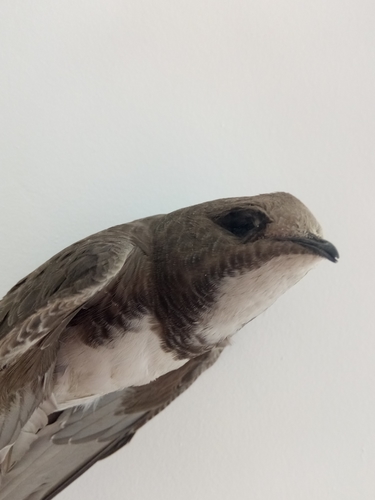
  • A very large, pale swift, with a white belly and a brown breast band
  • Long, scythe-shaped wings, the size of a small falcon
  • Powerful, fast flight, often over cliffs and towns

Where and when

FR: fairly common in the south, May to September. UK, NL, BE, DE, DK: rare overshoots in April to June. IE, NO, SE, FI: almost never. A species of cliffs and towers in southern Europe.

Call A loud, trilling, chattering “trrrrree-ree-ree-ree”, much louder than a Common Swift. Recording: Beatrix Saadi-Varchmin · xeno-canto

A swift that is the size of a Hobby, with a white belly, which looks like a Swift that has been to a gym.

Don’t confuse with: Common Swift (beginners): all dark, smaller, and a thin, screaming call.

Quiz

12 questions, with birds you have to repeat mixed in. Your answers decide when each bird comes back.

Out and about this week

Photograph a distant bird of prey, a bird in flight against the sky or any difficult shape. Try to name it from the silhouette alone: wings, tail, wingbeat. Then check your guess in a field guide or ask an expert.