Motmot

Advanced birding · Lesson 36 · 22 minutes

Calls and night migration

Birds you hear but rarely see: crakes, Quail, Nightjar, Woodcock and the owls

A large part of birding is listening. On a spring night you can hear a Corncrake, a Quail and a Spotted Crake from the same field. On an October night, thousands of Redwings, Song Thrushes and Robins pass overhead, calling to each other in the dark, and an experienced birder can tell what is flying over by the calls alone. This lesson trains your ear on birds that are shy, nocturnal or both.

Most of the birds here are not in your photos for a reason: they hide. Water Rail, Corncrake, Spotted Crake and Quail live in thick vegetation. The Nightjar and the owls come out at dusk. The Woodcock is a wader that behaves like an owl. For each, the recording is the main item, and the photo is the reward.

Season: calls peak in the breeding season, from April to July, but nights in autumn (September to November) are the best for flight calls of migrants. A good way to start is with a nocturnal microphone in the garden.

Today: 8 birds

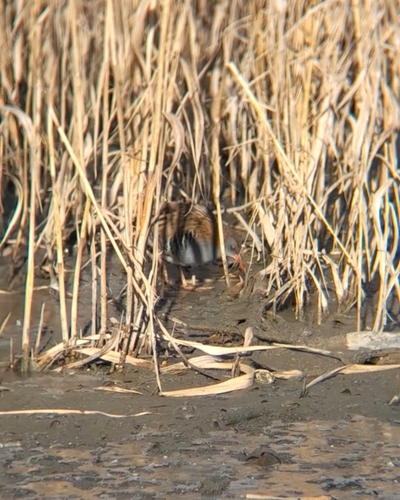
Water Rail, adult adult
Photo: velocidromeus · CC BY-NC

Bird 1 of 8

Water Rail

Rallus aquaticus

How to recognise it

  • A slim, long-legged rail with a long, red bill
  • Grey face and breast, with a black-and-white barred flank
  • A pig-like squeal and grunting from deep in the reeds
squeal A high, drawn-out cry like a piglet. The Water Rail's call.

Where and when

UK, IE, NL, BE, DE, FR, DK: fairly common, mostly resident, in reedbeds, with more in winter when northern birds arrive. SE, FI, NO: uncommon in summer. Rarely seen, often heard.

Call A long, descending, pig-like squeal that ends in grunts, and a sharp “kip-kip-kip”. Recording: Paul Kelly · xeno-canto

You hear it on a winter walk by a frozen reedbed: a sound like a pig being squeezed. A bird that walks out onto the ice in the cold.

Don’t confuse with: Corncrake (this week): a dry, rasping 'crex-crex', from a hay meadow.

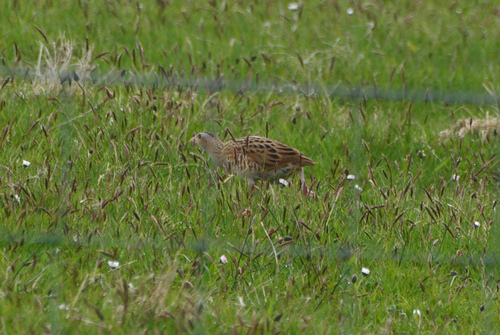
Corncrake, adult adult
Photo: gwynmwilliams · CC BY

Bird 2 of 8

Corncrake

Crex crex

How to recognise it

  • A buff bird with chestnut wing patches and a short, pale bill
  • Rarely seen, it skulks in tall grass
  • A dry, rasping “crex-crex”, repeated for hours at night

Where and when

IE (Donegal, Mayo), UK (Hebrides): scarce, from April to August, protected by farming schemes. DE, FR, DK, SE, FI, NO: uncommon. NL, BE: rare. A bird of hay meadows, which is vulnerable to the early mowing.

Call A dry, rasping, two-part “crex-crex” that sounds like a comb being drawn across a matchbox. Recording: Paul Kelly · xeno-canto

The sound of an unmown hay meadow. The call is so loud that it can be heard from 1 km.

Don’t confuse with: Common Quail (this week): a short, liquid “whit-whit-whit”, quite a different pattern.

Corncrake or Quail?

CorncrakeCorncrake
Common QuailCommon Quail

Both call from the grass at night. The Corncrake gives a dry, rasping 'crex-crex', two notes with a pause, like a comb across a matchbox. The Quail gives a short, liquid 'whit, whit-whit', with three notes, like “wet-my-lips”. The Corncrake is in damp hay meadows, the Quail in crops.

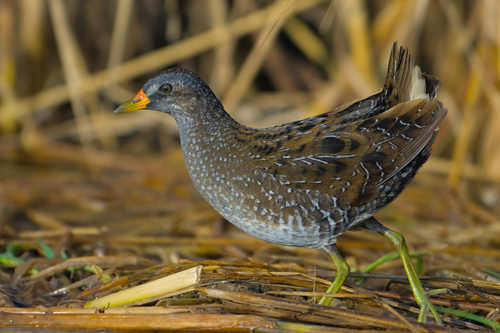
Spotted Crake, adult adult
Photo: Dhruva Punde · CC BY-NC

Bird 3 of 8

Spotted Crake

Porzana porzana

How to recognise it

  • A small, brown crake with white spots on the breast and flanks
  • A buff undertail and a short, yellow-and-red bill
  • A sharp, whip-like “whit” once a second, at night

Where and when

UK, NL, BE, DE, FR, DK, SE, FI, NO: rare to scarce summer visitors, from late April to August, in wet marshes. IE: very rare. A bird that is more often heard than seen, in wet sedge.

Call A sharp, rhythmic “whit-whit-whit”, one a second, like a whiplash, at night. Recording: SonoNatura · xeno-canto

A night bird of marshes that is found by its call, often by chance on a spring night.

Don’t confuse with: Water Rail (this week): a longer bill, and a grunting, squealing voice.

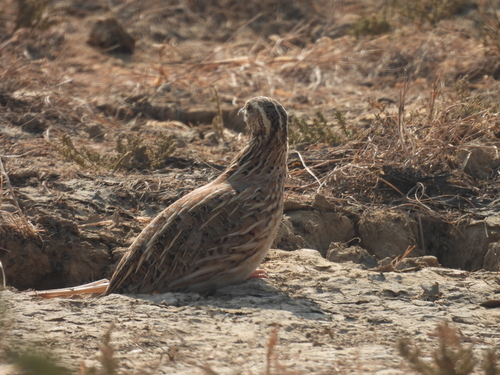
Common Quail, adult adult
Photo: rohitnaniwadekar · CC BY

Bird 4 of 8

Common Quail

Coturnix coturnix

How to recognise it

  • A small, round, brown, streaked, partridge-like bird
  • A cream stripe above the eye and on the crown
  • Hardly ever seen: it sits tight in a crop and calls

Where and when

FR, DE: uncommon summer visitors in fields, from May. UK, NL, BE, DK, SE: scarce, with irruption years. IE, NO, FI: rare. A migrant to Africa that calls in summer from the middle of a barley field.

Call A liquid, three-note “whit, whit-whit”, often rendered as “wet-my-lips”, and a lot of repeats. Recording: Lars Mogensen · xeno-canto

The only migratory game bird of the region. Easy to hear on a May evening, hard to see.

Don’t confuse with: Corncrake (this week): a rasping, two-note 'crex-crex'.

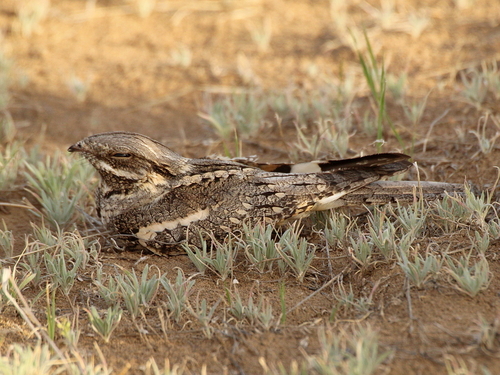
Eurasian Nightjar, adult adult
Photo: andrewbazdyrev · CC BY

Bird 5 of 8

Eurasian Nightjar

Caprimulgus europaeus

How to recognise it

  • A long-winged, long-tailed bird with bark-like, grey-brown plumage
  • A flat head, a tiny bill and a huge mouth; sits along a branch
  • At dusk: the continuous churring of the male, and wing claps
churring A long, continuous, buzzing trill, as in the song of a Nightjar.

Where and when

UK, NL, DE, FR, DK, SE, FI, NO: uncommon to scarce summer visitors, on heaths and in forest clearings, from mid-May to August. BE: scarce. IE: very rare. A bird of dusk, found by its song.

Sound A long, even, mechanical churr, changing pitch, for minutes, and a sharp “koo-ik” flight call. Recording: Jacobo Ramil Millarengo · xeno-canto

A heath on a warm June evening at dusk is the place. The churring seems to come from all directions.

Don’t confuse with: Eurasian Woodcock (this week): a long bill and a different, soft, croaking voice.

Eurasian Woodcock, adult adult
Photo: prokhozhyj · CC BY

Bird 6 of 8

Eurasian Woodcock

Scolopax rusticola

How to recognise it

  • A plump, brown, barred wader with a long, straight bill
  • Large, dark eyes set high on the head, to see all around
  • At dusk: the slow, owl-like roding flight of the male
roding The slow display flight of a male Woodcock over woodland at dusk, calling as he goes.

Where and when

UK, IE, NL, BE, DE, FR, DK, SE, FI, NO: uncommon, resident or breeding in woods, with more in winter (October to March) when big numbers come from Scandinavia and Russia. Rarely seen in the day.

Sound A soft, deep, croaking “orrt-orrt-orrt” and a sharp “tsiwick” in the roding flight. Recording: Jarek Matusiak · xeno-canto

A wader that lives in the wood, and flies in the evening above the treetops. The first Woodcock of the winter flies in on a moonlit night in October.

Don’t confuse with: Common Snipe (week 14): a striped head, a short, straight flight and a different call.

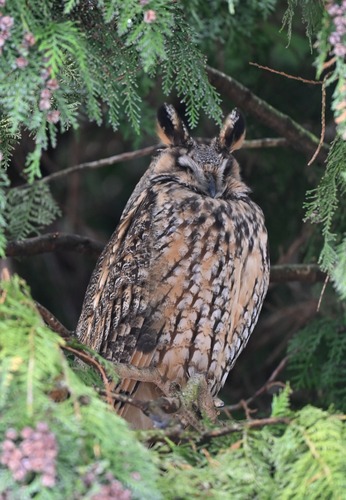
Long-eared Owl, adult adult
Photo: stefan_hageman · CC BY-NC

Bird 7 of 8

Long-eared Owl

Asio otus

How to recognise it

  • Slim, with long ear tufts and bright orange eyes
  • A streaked, buff-brown body, and a upright, slender pose at rest
  • A low, soft “hoo” every few seconds, and a squeaky-gate begging call from the young

Where and when

UK, IE, NL, BE, DE, FR, DK, SE, FI, NO: uncommon to scarce residents, in woods and scrub, with winter roosts of several birds. Often found in a thorn thicket, in a group, in winter.

Sound A low, soft, regular “hoo” (one every 2-3 seconds), and a creaky, squeaking call from the young in summer. Recording: PAULUS · xeno-canto

A woodland owl that roosts in groups in winter, in a dense hawthorn or a conifer.

Don’t confuse with: Tawny Owl (this week): bigger, a round head, no ear tufts and a dark eye.

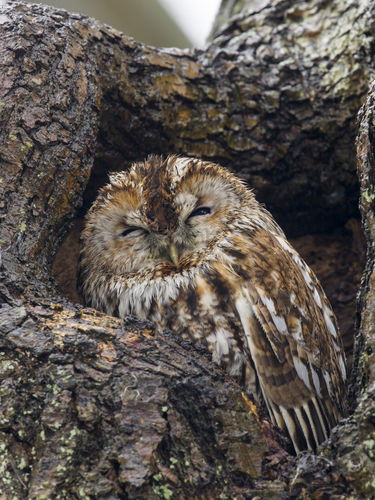
Tawny Owl, adult adult
Photo: Tobias S. Radmer · CC BY-NC

Bird 8 of 8

Tawny Owl

Strix aluco

How to recognise it

  • A large, round-headed owl with big, dark eyes
  • Mottled brown, with a face disc and no ear tufts
  • A famous territorial call: “ke-wick” answered by a long, wavering “hoo-hoo-hooo”
territorial call The call that a bird gives to defend its patch, usually heard at dusk or dawn.

Where and when

UK, NL, BE, DE, FR, DK, SE, FI, NO: common, resident, in woods, parks and gardens. IE: absent. The owl you hear in the garden at night, from October to March.

Sound The female’s sharp “ke-wick” and the male’s long, quavering “hoo-hoo-hoooo”. Recording: Mark Plummer · xeno-canto

Not a single bird: it takes a pair to give the full call, “ke-wick” and “hoo-hoo-hooo”. They usually sit in a tree near a house.

Don’t confuse with: Long-eared Owl (this week): slimmer, ear tufts, orange eyes, and a softer, simpler call.

Quiz

12 questions, with birds you have to repeat mixed in. Your answers decide when each bird comes back.

Out and about this week

Choose a clear night in October, step outside and listen for 15 minutes. How many flight calls do you hear? Try Redwing (a thin 'tseep'), Song Thrush (a short 'tsip') and Robin (a thin 'tic'). In spring, visit a heath at dusk for a Nightjar.