Motmot

Advanced birding · Lesson 33 · 22 minutes

American vagrants

Waders from North America: six sandpipers, a plover, a dowitcher and a phalarope

Every September and October, a few young waders from North America cross the Atlantic with the first autumn gales. They are juveniles, on their first migration, and they are blown from their usual route along the American east coast. Ireland, south-west England, Scotland and the Scilly Isles are the best places, and the Netherlands and Denmark get a few each year.

A lot of the skill is looking at the juveniles of the commoner birds: a Pectoral Sandpiper you know, but what about a Baird's or a White-rumped? The new ones are very small and the differences between them are small too, so use the checklist: wings (do they project beyond the tail?), rump colour, leg colour, bill shape and call.

In the quiz, the wrong answers are the European waders from the earlier blocks: the lesson is as much about what they are not.

Today: 8 birds

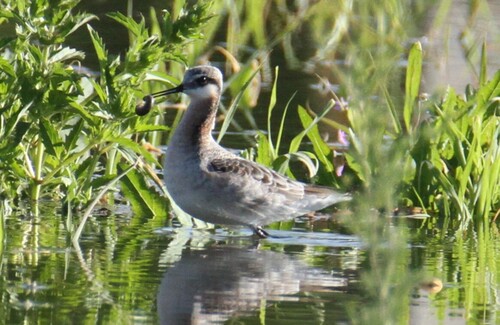
White-rumped Sandpiper, juvenile juvenile
Photo: Curtis Dowhaniuk · CC BY-NC

Bird 1 of 8

White-rumped Sandpiper

Calidris fuscicollis

How to recognise it

  • Looks like a long, slim Dunlin, with wings that project far beyond the tail: a long primary projection
  • A pure white rump, which shows in flight, with no dark stripe
  • A short, thin bill with a pale base, and a rusty edge on the scapulars
primary projection How far the wing tips stick out beyond the tail on a standing bird. Long in White-rumped and Baird's Sandpipers.
rump The lower back, above the tail. Pure white in a White-rumped Sandpiper.

Where and when

UK, IE: rare but annual, from September to October, mostly on the west coast. NL, BE, DE, DK, FR, NO, SE: very rare. FI: almost never. A bird that migrates from the Arctic to Patagonia.

Call A thin, high, mouse-like squeak, “jeeet”, quite unlike any European wader. Recording: Stanislas Wroza · xeno-canto

The call is the best clue, and the wings projecting beyond the tail make it look long and slim.

Don’t confuse with: Curlew Sandpiper (week 11): a longer, more curved bill and a longer neck.

Baird's Sandpiper, juvenile juvenile
Photo: Todd Fitzgerald · CC BY-NC

Bird 2 of 8

Baird's Sandpiper

Calidris bairdii

How to recognise it

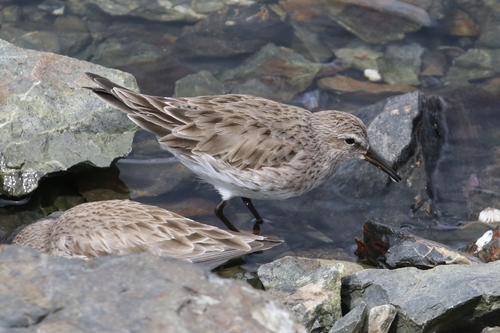
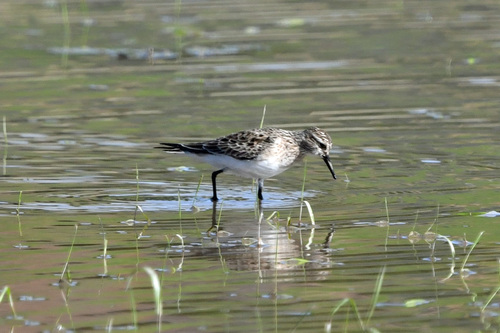
  • A buffy, scaly back and a buff wash across the breast
  • Long wings that project well beyond the tail, with a long primary projection
  • Short, black legs and a short, straight, black bill
primary projection How far the wing tips stick out beyond the tail on a standing bird. Long in White-rumped and Baird's Sandpipers.
scaly With pale edges to every back feather, making a scale pattern. A juvenile Baird's has a scaly back.

Where and when

UK, IE: rare but annual, in September, often on the coast. NL, BE, DE, DK, FR, NO, SE: very rare. FI: almost never. A bird that migrates from the Arctic tundra to the Andes.

Call A soft, trilling, low “kreep”, quite different from a Little Stint. Recording: Stanislas Wroza · xeno-canto

A juvenile Baird's is the most beautiful: scaly buff, with a long body, like a stint in a tweed jacket.

Don’t confuse with: Little Stint (week 11): a pale V on the back and a split eyebrow, and shorter wings.

White-rumped or Baird's Sandpiper?

White-rumped SandpiperWhite-rumped Sandpiper
Baird's SandpiperBaird's Sandpiper

Both have long wings that project beyond the tail. White-rumped has a white rump and a streaked flank, with a bill with a pale base. Baird's has a buffy, scaly back, a dark rump and a short, black bill, and the legs are always black. The calls differ too: White-rumped squeaks, Baird's trills.

Buff-breasted Sandpiper, juvenile juvenile
Photo: diegodgd · CC BY

Bird 3 of 8

Buff-breasted Sandpiper

Calidris subruficollis

How to recognise it

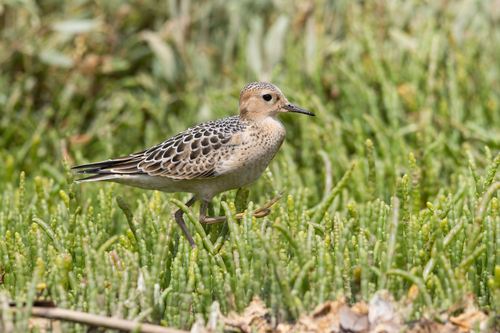
  • Buff underparts from chin to belly, with a plain buff face and a big, dark eye
  • A scaly brown back, a small round head and a short, thin bill
  • Bright yellow-orange legs and a long neck, standing upright

Where and when

UK, IE: rare but annual, in September and October, in short grass and on fields. NL, BE, DE, DK, FR: very rare. NO, SE, FI: almost never. A bird that likes fields more than mud.

Call Mostly silent; a low, soft “tick” or “preet”. Recording: Stanislas Wroza · xeno-canto

A tame, upright, pale-buff wader of dry fields. It looks like a small Ruff with a plainer face.

Don’t confuse with: Ruff (week 14): a longer bill, a scaly back and orange-buff legs.

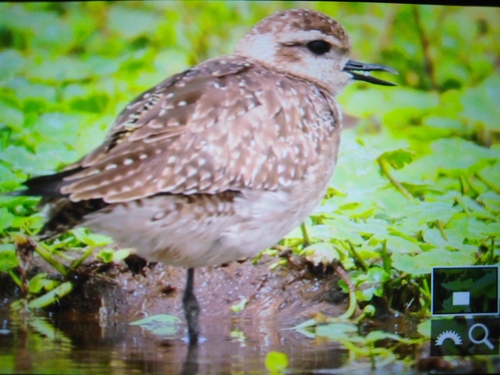
American Golden Plover, juvenile juvenile
Photo: jonathan_chancasana · CC BY

Bird 4 of 8

American Golden Plover

Pluvialis dominica

How to recognise it

  • Darker and greyer than a European Golden Plover, with a bold white eyebrow
  • A dark cap and a grey, scaly back with gold spangles
  • Long wings that project beyond the tail, and grey, not white, underwings

Where and when

UK, IE: rare but annual, from September to October, among flocks of Golden Plovers. NL, BE, DE, DK, FR, NO, SE: very rare. FI: almost never. A bird of the American tundra.

Call A sharp, two-note “queedle” or “chu-wee”, quite different from the European bird. Recording: Vinícius Soares Domingues · xeno-canto

Check every Golden Plover flock for one with a bold eyebrow and a grey look. The grey, not white, underwing is the sign.

Don’t confuse with: European Golden Plover (week 13): a white underwing, a gold look and a shorter wing projection.

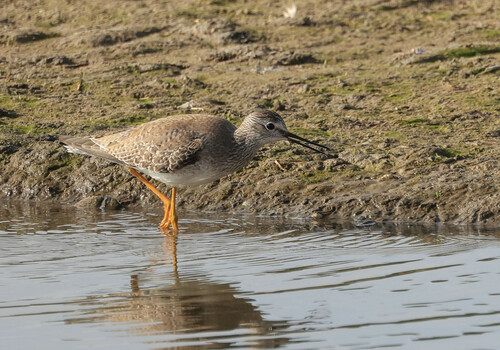
Lesser Yellowlegs, juvenile juvenile
Photo: Tracy Drake · CC BY-NC

Bird 5 of 8

Lesser Yellowlegs

Tringa flavipes

How to recognise it

  • Slim and elegant, with very long, bright yellow legs
  • A thin, straight, dark bill, as long as the head
  • Greyish upperparts with white spots, and a white rump

Where and when

UK, IE: rare but annual, from August to October. NL, BE, DE, DK, FR: very rare. NO, SE, FI: almost never. A bird of the American wetlands.

Call A short, soft “tu” or “tu-tu”, one or two notes, quieter than a Greenshank. Recording: AUDEVARD Aurélien · xeno-canto

A Redshank-sized wader with yellow legs. The call is one or two soft notes, unlike the three-note call of a Greenshank.

Don’t confuse with: Common Greenshank (week 12): a thicker bill, an upturned look and greenish legs.

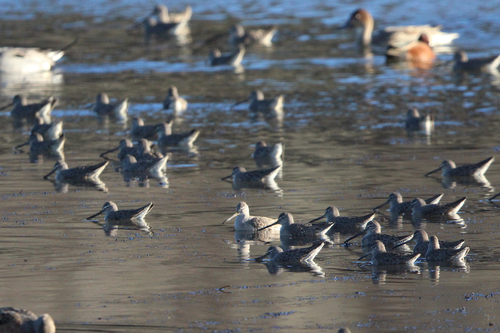
Long-billed Dowitcher, juvenile juvenile
Photo: jayras · CC BY-NC

Bird 6 of 8

Long-billed Dowitcher

Limnodromus scolopaceus

How to recognise it

  • A very long, straight bill, like a snipe's, and a hunched look
  • A dark, plain-backed juvenile, with a bold pale supercilium
  • Feeds with a quick, up-and-down stitching action, like a sewing machine
supercilium The pale stripe above the eye. Bold in a Long-billed Dowitcher.

Where and when

UK, IE: rare but annual, in October, mostly on the coast. NL, BE, DE, DK, FR: very rare. NO, SE, FI: almost never. A bird that comes in on the same gales as the other American waders.

Call A thin, high “keek”, single or a short series, like a Turnstone. Recording: Peter Boesman · xeno-canto

A big, fat, dark wader with a snipe's bill, often seen asleep. Its call, a thin “keek”, is the thing that gives it away.

Don’t confuse with: Common Snipe (week 14): a striped head and a zig-zag flight.

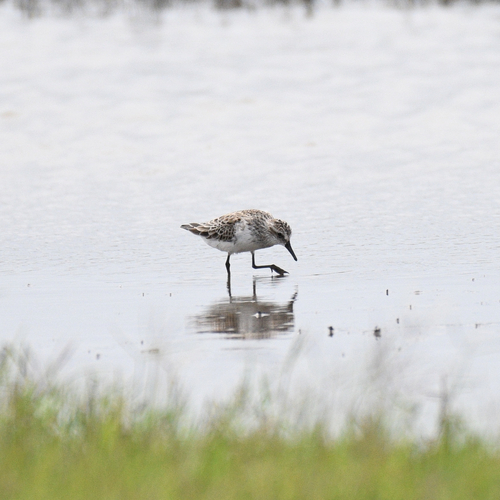
Semipalmated Sandpiper, juvenile juvenile
Photo: Brett Jackson · CC BY-NC

Bird 7 of 8

Semipalmated Sandpiper

Calidris pusilla

How to recognise it

  • A tiny sandpiper with a short, thick, blunt-tipped black bill
  • Black legs and a scaly, grey-brown back, with a paler head
  • Looks like a Little Stint, but plainer and less rusty

Where and when

UK, IE: very rare, in September, mostly in the south-west. NL, BE, DE, DK, FR: almost never. A bird that is very hard to separate from Little Stint, and usually recorded from photographs.

Call A short, dry, rather sparrow-like “cherk”, quite different from the sharp “tit” of a Little Stint. Recording: Paul Driver · xeno-canto

A very hard bird: a good photograph of the bill and a recording of the call are both needed to be sure.

Don’t confuse with: Little Stint (week 11): a split supercilium and a pale V on the back.

Wilson's Phalarope, juvenile juvenile
Photo: James N. Stuart · CC BY-NC

Bird 8 of 8

Wilson's Phalarope

Phalaropus tricolor

How to recognise it

  • A long, needle-thin black bill, a long neck and long, yellow legs
  • Pale grey-brown back with pale feather edges, and a white face with a dark eye-stripe
  • Often feeds on land, running about, not just swimming

Where and when

UK, IE: very rare, in September and October. NL, BE, DE, DK, FR, NO, SE: almost never. FI: almost never. A bird of North American prairie wetlands.

Call A low, grunting “wurk” or “yurp”, quite unlike the other phalaropes. Recording: Paul Marvin · xeno-canto

The biggest of the phalaropes, and the one that feeds on land more than the other two.

Don’t confuse with: Red-necked Phalarope (week 14): a darker back, shorter legs and swimming.

Quiz

12 questions, with birds you have to repeat mixed in. Your answers decide when each bird comes back.

Out and about this week

In September and October, check a wet field or the edge of a pool on the west coast, or your nearest hotspot. Look at every wader: is it a Dunlin, a Pectoral Sandpiper or something rarer? Write down what makes you think so.