Motmot

Advanced birding · Lesson 28 · 22 minutes

Larks and buntings

Skylark, Woodlark, Shore Lark, Snow and Lapland Bunting, Corn, Cirl and Reed Bunting

Larks and buntings are the small brown birds of fields, dunes and reedbeds. Larks walk, buntings hop, and both give calls that identify them. They are easy to overlook, and winter is the best time to see them, because flocks gather on stubble fields, saltmarshes and the coast.

The rarities of today live on the beach: Shore Larks, Snow Buntings and Lapland Buntings are Arctic birds that winter on the coast of the North Sea. The Woodlark and the Cirl Bunting are southern birds in the UK and France, and the Corn Bunting is declining over most of the region.

Learn them by call: the Skylark's liquid trill, the Corn Bunting's jingling keys, the Reed Bunting's single high note.

Today: 8 birds

Eurasian Skylark, adult adult
Photo: fyodorp · CC BY

Bird 1 of 8

Eurasian Skylark

Alauda arvensis

How to recognise it

  • Streaky brown, with a short crest on the head, and a white trailing edge to the wing
  • White outer tail feathers show as it flies
  • Rises from the ground in a long song flight, singing without a break
song flight A flight in which the bird sings while hovering or circling high. Skylarks and Woodlarks do it.
crest A short tuft on the head that can be raised. The Skylark has a small one.

Where and when

All ten countries. UK, IE, NL, BE, DE, FR, DK, SE, FI, NO: common on fields and moors, with many arriving from the north in autumn. Declining in farmland. In winter large flocks gather on stubble.

Sound A long, continuous, bubbling song of trills and whistles, and a liquid, rolling “chirrup” call. Recording: Lars Edenius · xeno-canto

The sound of the countryside in spring. The white trailing edge to the wing and the crest are the marks.

Don’t confuse with: Woodlark (this week): shorter tail, a pale eyebrow that meets on the nape and a descending song.

Woodlark, adult adult
Photo: carabus123 · CC BY

Bird 2 of 8

Woodlark

Lullula arborea

How to recognise it

  • Smaller than a Skylark, with a very short tail, and no white in it
  • A bold pale eyebrow that meets behind the neck, and a black-and-white mark on the wing edge
  • A song of falling, fluty notes, “lu-lu-lu”, in a circling song flight
song flight A flight in which the bird sings while hovering or circling high. Skylarks and Woodlarks do it.

Where and when

FR, UK (south), DE, NL, BE, DK, SE: uncommon to scarce, on heath and clear-fells. NO, FI, IE: rare. It sings in March and April, and sometimes at night.

Sound A fluty, descending “lu-lu-lu-lu-lu” song, and a call of a liquid “tit-looeet”. Recording: Jarek Matusiak · xeno-canto

A lark of heaths and forest clearings. A short tail and a delicate, stubby look make it clear.

Don’t confuse with: Eurasian Skylark (this week): a longer tail, a crest and a white edge to the tail.

Skylark or Woodlark?

Eurasian SkylarkEurasian Skylark
WoodlarkWoodlark

A Skylark is bigger, with a longer tail with white edges and a small crest, and sings in a long, unbroken song in the air. A Woodlark is smaller, with a short tail, a bold pale eyebrow that meets on the nape and a descending, fluty song. In flight the Woodlark looks tailless and bat-like.

Shore Lark, adult, non-breeding adult, non-breeding
Photo: chris buelow · CC BY-NC

Bird 3 of 8

Shore Lark

Eremophila alpestris

How to recognise it

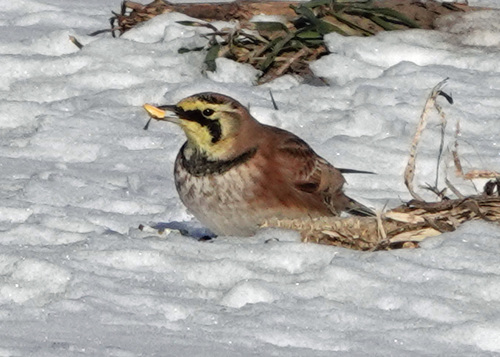
  • A yellow face with a black mask and a black band on the breast
  • Small black 'horns' on the sides of the head
  • A pale pink-brown back, and a white belly, found on beaches

Where and when

NO, SE, FI: breeds in the mountains, from May. UK, NL, DE, DK: scarce in winter on the east coast, usually in small flocks from October to March. FR, BE, IE: rare. A small, pretty lark of the Arctic.

Call A thin, high, silvery “tsee-ree” and a tinkling song. Recording: Frank Lambert · xeno-canto

A lark of the beach and the saltmarsh. Look for the yellow face and the black mask, even in winter.

Don’t confuse with: Snow Bunting (this week): white wing patches and a different shape.

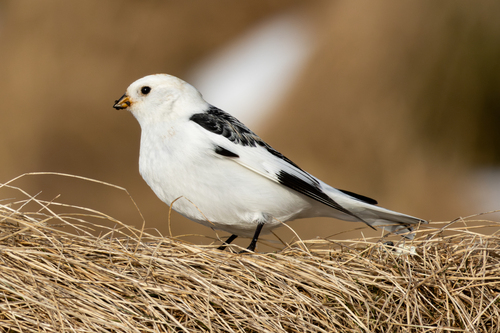
Snow Bunting, adult, non-breeding adult, non-breeding
Photo: diegodgd · CC BY

Bird 4 of 8

Snow Bunting

Plectrophenax nivalis

How to recognise it

  • A white head and belly with warm buff-rusty on the crown and cheek
  • Large white wing patches and white outer tail, which flash in flight
  • A yellow bill, and a short-legged, plump look, often on a beach
wing patch A white patch on the wing, as on the Snow Bunting.

Where and when

UK, NO, SE, FI, DK, NL, DE: fairly common to uncommon in winter, October to March, on shingle, dunes and saltmarshes. Breeds in the Scottish Highlands and the Arctic. FR, BE, IE: scarce.

Call A rippling, whistling “tirrirrip” and a clear “peu” call. Recording: Christian Bøggild · xeno-canto

A snowflake: a flock of Snow Buntings flies up like a flurry of white wings. They are bold and approachable.

Don’t confuse with: Lapland Bunting (this week): a darker, rusty look with no big white patches.

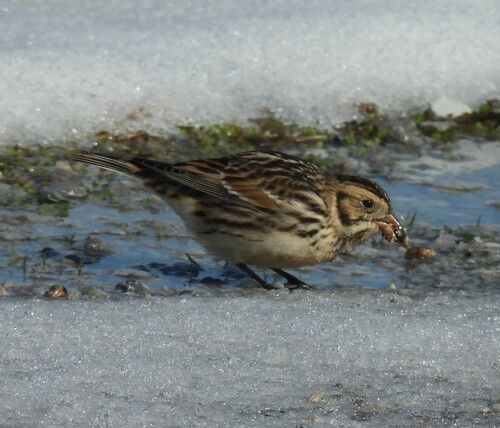
Lapland Bunting, adult, non-breeding adult, non-breeding
Photo: Jeff Garner · CC BY-NC

Bird 5 of 8

Lapland Bunting

Calcarius lapponicus

How to recognise it

  • A rusty nape and a dark, framed cheek, with a pale eyebrow
  • A streaky back and flanks, and a yellow bill with a dark tip
  • Short, dry rattle in flight, followed by a clear 'tew' call

Where and when

NO, SE, FI: breeds in the Arctic, from June. UK, NL, DE, DK: scarce in winter, on saltmarsh and coast, October to March. FR, BE, IE: rare. A bird that likes a fresh field of weeds.

Call A dry, rattling “ticky-tick-tick” followed by a clear, short “tew”. Recording: Lars Edenius · xeno-canto

A shy bird that crouches. It is found by its call, and is often with Snow Buntings or Skylarks.

Don’t confuse with: Snow Bunting (this week): paler, with large white wing patches, and bolder.

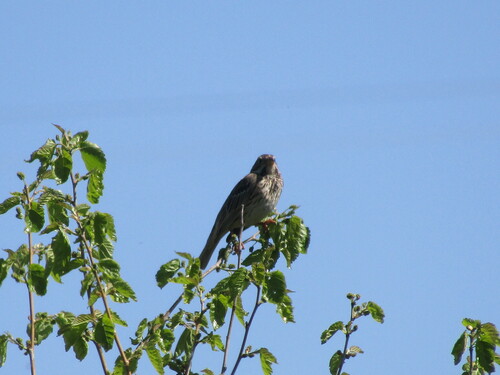
Corn Bunting, adult adult
Photo: stevem4560 · CC BY

Bird 6 of 8

Corn Bunting

Emberiza calandra

How to recognise it

  • A big, streaky, dull brown bunting with a heavy bill
  • No white in the tail pattern, and no pattern on the face
  • Sings from a wire with a call like a bunch of jingling keys
tail pattern The pattern of white on the tail. Larks and buntings often show white outer tail feathers.

Where and when

UK, IE, FR, DE, NL, BE, DK, SE: uncommon to scarce, declining, on open farmland. NO, FI: almost never. A bird of cereal and open fields, with a male that dangles its legs in flight.

Song A short, sharp, jingling song, like a bunch of keys being shaken: “tzik-tzik-tzik-zzzrrrip”. Recording: David Darrell-Lambert · xeno-canto

The most plain and streaky of the buntings, and a farmland bird in steep decline over most of the region.

Don’t confuse with: Eurasian Skylark (this week): a crest and a white edge to the wing.

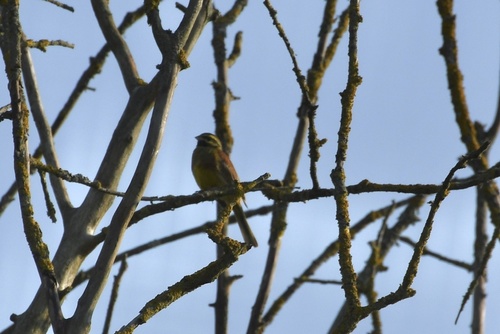
Cirl Bunting, adult male adult male
Photo: rober025 · CC BY

Bird 7 of 8

Cirl Bunting

Emberiza cirlus

How to recognise it

  • A black throat and eye-stripe on a yellow-green head
  • A chestnut breast band, and a bright yellow underside
  • Sings from a hedge top, a rattle on one note

Where and when

FR: fairly common in the south and west. UK: scarce, mostly in south Devon. BE, DE, NL, DK, SE, NO, FI, IE: almost never. A species of the Mediterranean that is declining in the north.

Song A dry, metallic rattle on one note, “zi-zi-zi-zi-zi-zi”, like a Lesser Whitethroat but sweeter. Recording: Grégoire Chauvot · xeno-canto

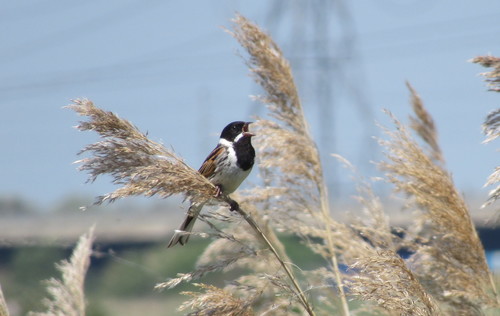
The male's head is a bold black, green and yellow pattern. A very rare bird in Britain, known only from a small area in the south-west.

Don’t confuse with: Yellowhammer (beginners): a yellow head with no black throat or green.

Common Reed Bunting, adult male adult male
Photo: rowan_m · CC BY

Bird 8 of 8

Common Reed Bunting

Schoeniclus schoeniclus

How to recognise it

  • A black head and bib with a white collar and moustache
  • A streaky brown back, and a chestnut-and-black pattern
  • White outer tail feathers, and a short, thick bill

Where and when

UK, IE, NL, BE, DE, FR, DK, SE, FI, NO: common to fairly common in reedbeds, wet fields and ditches, mostly resident. A few move south in winter, and many visit gardens in cold snaps.

Song A monotonous, simple “tseek-tseek-tseek-tissik”, with long gaps between phrases. Recording: Dries Van de Loock · xeno-canto

A common and familiar bird of wet places, but easily overlooked as a bird that sings in a reed top without moving.

Don’t confuse with: House Sparrow (beginners): a black bib but no white collar, and a grey crown.

Quiz

12 questions, with birds you have to repeat mixed in. Your answers decide when each bird comes back.

Out and about this week

In winter, walk along the strandline of a beach or a saltmarsh and listen for the rippling call of Snow Buntings and the thin call of Shore Larks. In spring, find a heath at dawn and listen for the song of a Woodlark.