Motmot

Advanced birding · Lesson 27 · 22 minutes

Pipits and wagtails

Meadow, Tree, Rock, Water and Red-throated Pipit, with Yellow, Grey and White Wagtail

Pipits look alike and sound different. Wagtails look different and sound alike, almost. In both groups, the call helps more than the plumage, and a good birder can name a pipit in the dark. The streaking on the breast and flanks, the colour of the legs and the white on the tail are the other clues.

The pipits of today are from three habitats: Meadow Pipit (open ground), Tree Pipit (woods and heath) and Rock Pipit (rocky shore), with the winter Water Pipit and the rarer Red-throated Pipit. Wagtails are much easier, but the Yellow Wagtail comes in many forms that differ by region and have different head colours.

Season: Tree Pipits arrive in mid-April and leave in August to September, passing through the coast in a rush. Water Pipits spend the winter on watercress beds and flooded fields, from October to March. Yellow Wagtails are summer visitors, April to September.

Today: 8 birds

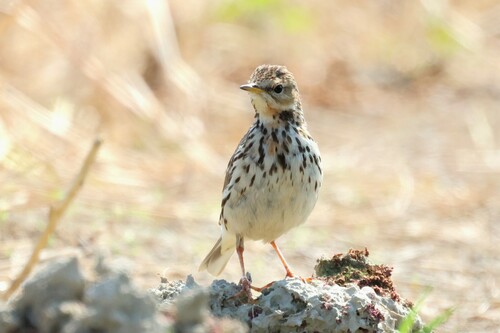
Meadow Pipit, adult adult
Photo: riyga25 · CC BY

Bird 1 of 8

Meadow Pipit

Anthus pratensis

How to recognise it

  • Brown and streaky, with a thin bill and pink-brown legs
  • A fine pattern of streaking on the breast and flanks
  • A long hind claw, and white outer tail feathers
streaking The dark lines on the breast and flanks. Their width and sharpness differ in each pipit.
hind claw The claw of the back toe. Long and nearly straight in a Meadow Pipit, short and curved in a Tree Pipit.
outer tail feathers The outermost feathers of the tail. They are white in pipits and wagtails and show in flight.

Where and when

UK, IE, NL, BE, DE, FR, DK, SE, FI, NO: common on open ground, moors and fields, all year, with northern birds moving south in autumn. Many winter on the coast and in fields.

Call A thin, high “tsip-tsip-tsip” in flight, and a parachuting song flight. Recording: Irish Wildlife Sounds · xeno-canto

The most common small streaky bird of open ground. In October, a stream of Meadow Pipits passes overhead calling.

Don’t confuse with: Tree Pipit (this week): a heavier bill, bolder streaks on the flank, and a short hind claw.

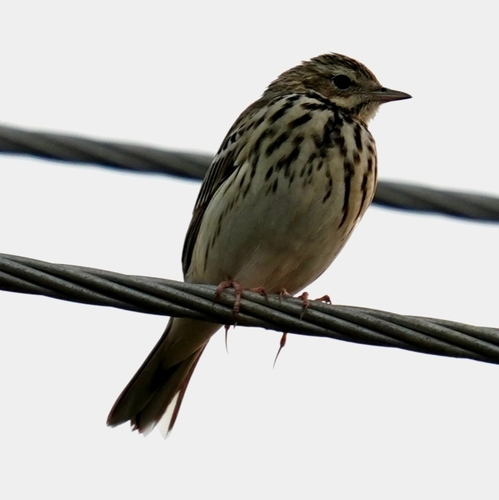
Tree Pipit, adult adult
Photo: SP CHOUDHARY · CC BY-NC

Bird 2 of 8

Tree Pipit

Anthus trivialis

How to recognise it

  • A buffy breast with bold black streaking on the flanks, and a pale, thick bill
  • A short, curved hind claw, and a streaked back
  • Sings from a tree top and parachutes down to the ground
streaking The dark lines on the breast and flanks. Their width and sharpness differ in each pipit.
hind claw The claw of the back toe. Long and nearly straight in a Meadow Pipit, short and curved in a Tree Pipit.

Where and when

UK, NL, BE, DE, FR, DK, SE, FI, NO: fairly common to uncommon summer visitors in woods, heath and clear-fells, from mid-April. IE: rare. Passage in August and September. Declining in the south and west.

Call A buzzing “teez” in flight and a loud, trilling song that ends with “see-ah, see-ah”. Recording: Jacobo Ramil Millarengo · xeno-canto

The song flight, up from a treetop and down on stiff wings, is the best mark. In migration it is the call that you hear overhead.

Don’t confuse with: Meadow Pipit (this week): a smaller bill, thin, fine streaks and a long hind claw.

Meadow or Tree Pipit?

Meadow PipitMeadow Pipit
Tree PipitTree Pipit

Habitat and call first. Meadow Pipits live on open ground and call a thin 'tsip-tsip'. Tree Pipits live around trees and call a buzzing 'teez'. Up close, a Tree Pipit has a heavier bill, a buffy breast with bold streaks on the flank and a short, curved hind claw.

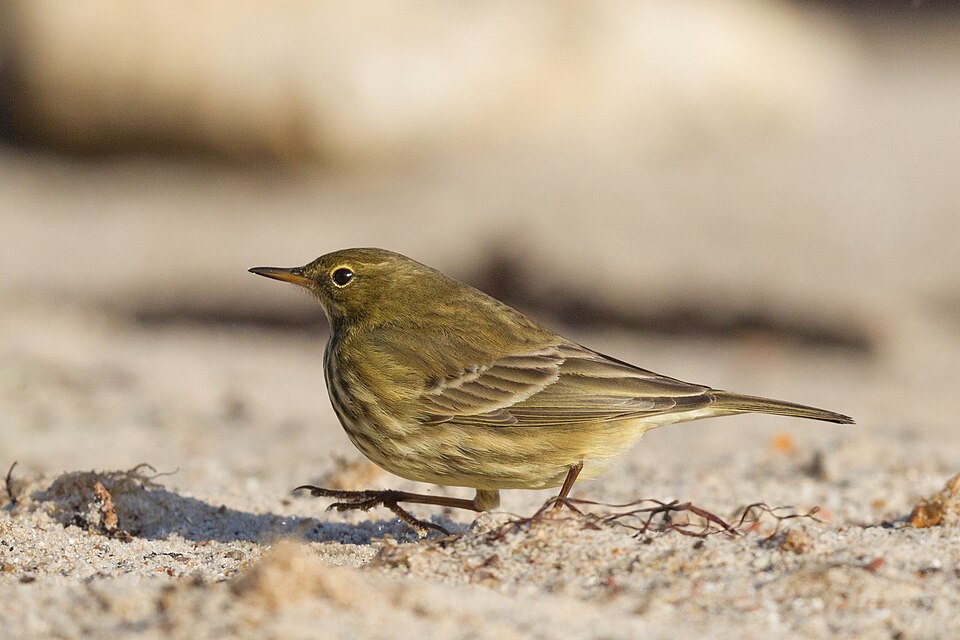
Eurasian Rock Pipit, adult adult
Photo: Andreas Trepte · CC BY-SA

Bird 3 of 8

Eurasian Rock Pipit

Anthus petrosus

How to recognise it

  • A dark olive-grey bird with dull streaks and dark legs
  • A grey, not white, outer tail feathers and a dark bill
  • Sits on rocks and seaweed at the sea's edge
outer tail feathers The outermost feathers of the tail. They are white in pipits and wagtails and show in flight.

Where and when

UK, IE, FR, NO, DK: common on rocky coasts, all year, and the Scandinavian race winters on the coast in the south. NL, BE, DE: scarce, in winter. SE, FI: rare. It is the pipit of the shore.

Call A thin, rather harsh “fiist” or “feest”, and a rising, trilling song. Recording: David Darrell-Lambert · xeno-canto

A pipit that lives on the shore. A dark, olive-grey pipit on rocks in winter is a Rock Pipit.

Don’t confuse with: Water Pipit (this week): paler, whiter below, and a strong eyebrow.

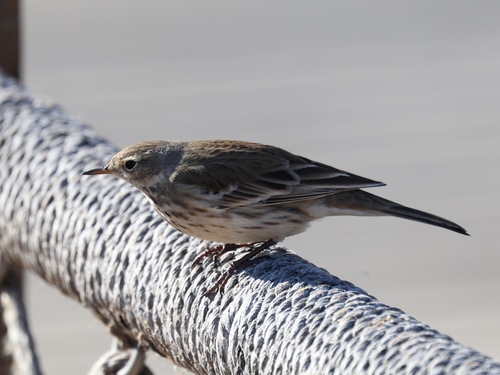
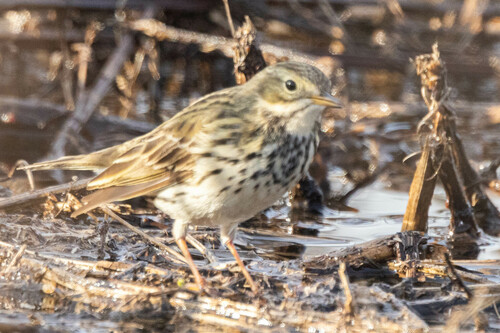
Water Pipit, adult, non-breeding adult, non-breeding
Photo: 莲子 · CC BY-NC

Bird 4 of 8

Water Pipit

Anthus spinoletta

How to recognise it

  • A paler, greyer pipit with a strong white eyebrow
  • White underparts, with fine streaking on the breast, and dark legs
  • White outer tail feathers, and a plain grey back
streaking The dark lines on the breast and flanks. Their width and sharpness differ in each pipit.
outer tail feathers The outermost feathers of the tail. They are white in pipits and wagtails and show in flight.

Where and when

FR, NL, BE, DE, UK: uncommon in winter, October to March, in wet fields and watercress beds. IE, DK, SE: rare. NO, FI: almost never. Breeds in the Alps and Pyrenees.

Call A thin, sharp “pipit” or “tsweep”, higher than a Rock Pipit. Recording: Arjun Dutta · xeno-canto

A winter pipit of watercress beds, a bird of the mountains in summer. Check the strong eyebrow and the clean underparts.

Don’t confuse with: Eurasian Rock Pipit (this week): darker, olive, and a weak eyebrow.

Red-throated Pipit, adult adult
Photo: auntie_uncle · CC BY-NC

Bird 5 of 8

Red-throated Pipit

Anthus cervinus

How to recognise it

  • A heavily streaked back with pale braces, and heavy streaks on the flanks
  • In spring: a brick-red face and throat. Plain buff in autumn
  • A dark, streaked rump, unlike other pipits

Where and when

SE, FI, NO: breeds on the tundra in the north, from June. UK, NL, BE, DE, DK, FR, IE: rare on passage, in spring and autumn. A bird of the far north that migrates to Africa.

Call A thin, drawn-out, descending “pssseeeeu”, a very characteristic call. Recording: Toy Janssen · xeno-canto

A pipit with a long, thin whistle. Known by its call, which is longer and thinner than any other pipit's.

Don’t confuse with: Meadow Pipit (this week): a plain rump and a short call. Tree Pipit: less streaked back.

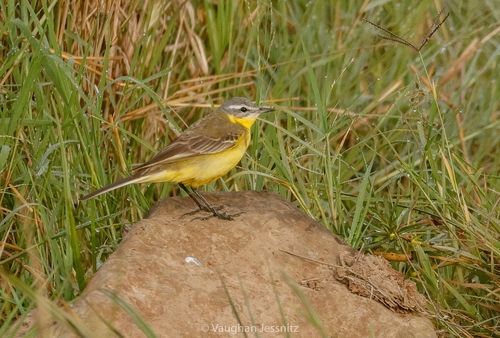
Western Yellow Wagtail, adult male adult male
Photo: Vaughan Jessnitz · CC BY-NC

Bird 6 of 8

Western Yellow Wagtail

Motacilla flava

How to recognise it

  • A bright yellow breast and belly, and an olive back
  • A different head pattern by region: blue-headed, grey-headed or yellow-headed
  • A slim shape, with a medium-long tail, and black legs
head pattern The pattern of eyebrow, cheek and crown on a bird's head.

Where and when

UK, IE, NL, BE, DE, FR, DK, SE, FI, NO: fairly common to uncommon summer visitors, from April to September, in meadows and fields. The blue-headed race breeds on the Continent; the yellow-headed form is British; the grey-headed race nests in Scandinavia.

Call A clear, high “tsweep” in flight, and a short, simple song. Recording: Stanislas Wroza · xeno-canto

It follows cattle, catching the insects they disturb. Several races meet in the area, and a male with a blue head in England is a Continental bird.

Don’t confuse with: Grey Wagtail (this week): a longer tail, grey back, and yellow only on the underparts.

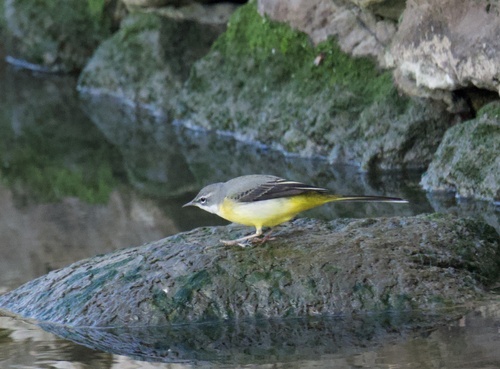
Grey Wagtail, adult male adult male
Photo: befton · CC BY-NC

Bird 7 of 8

Grey Wagtail

Motacilla cinerea

How to recognise it

  • A long, constantly wagging tail and a blue-grey back
  • A bright yellow belly and undertail, and a black bib in summer
  • Near running water: rivers, weirs and mill streams

Where and when

UK, IE, NL, BE, DE, FR, DK, SE: fairly common to uncommon, mostly resident, with a few moving in winter. NO, FI: rare. It breeds by fast, clear streams and moves to lower ground and the coast in winter.

Call A short, sharp “tzi-zit”, higher and sharper than a Pied Wagtail. Recording: Simon Elliott · xeno-canto

The wagtail of clear streams. The long tail is the longest of any wagtail, and the yellow belly is easily seen when it perches on a rock.

Don’t confuse with: Western Yellow Wagtail (this week): a short tail, a green-olive back, yellow all over below.

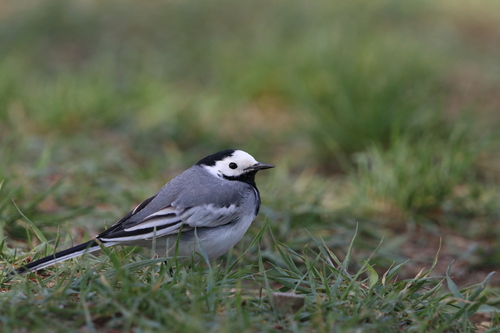
Pied Wagtail / White Wagtail, adult adult
Photo: thedonsky · CC BY

Bird 8 of 8

Pied Wagtail / White Wagtail

Motacilla alba

How to recognise it

  • Black-and-white, with a long tail that wags up and down
  • A black back in the Pied Wagtail of the UK and a grey back in the White Wagtail of the Continent
  • A black bib and a white face, with a bounding flight

Where and when

All ten countries. UK, IE: Pied Wagtail, common all year. NL, BE, DE, FR, DK, NO, SE, FI: White Wagtail, common in summer. Passage White Wagtails pass through the UK in spring and autumn.

Call A bright, two-note “chi-sik” in flight, and a twittering song. Recording: Olivier SWIFT · xeno-canto

The familiar wagtail of car parks and fields. In spring, many of the "Pied" Wagtails you see in England are grey-backed Continental visitors.

Don’t confuse with: Grey Wagtail (this week): a longer tail, and a yellow belly.

Quiz

12 questions, with birds you have to repeat mixed in. Your answers decide when each bird comes back.

Out and about this week

In April, go to a heath or a wood edge and listen for the Tree Pipit's song flight. In October, stand on a hill or a coast and listen to the calls overhead: Meadow Pipits (thin) and Yellow Wagtails (a clear 'tsweep') on the move.