Motmot

Advanced birding · Lesson 26 · 22 minutes

Raptors in flight

Buzzards, Honey-buzzard, three harriers, Osprey and Black Kite

Raptors are mostly seen in the air, and mostly from far away. The skill is to read the silhouette: how the wings are held (flat, in a shallow V, or in a deep V), the length of the tail, the size of the head, and how the bird flaps. Colour comes last, because the light is often behind the bird.

Autumn migration is the best time. From late August to October, buzzards, harriers, Honey-buzzards, Ospreys and Black Kites move south on the same narrow routes. Coastal headlands, the Falsterbo peninsula in Sweden, the Danish islands and the Dutch and German coasts see thousands pass in a day. In winter the Hen Harrier and the Rough-legged Buzzard come south from Scandinavia, and Marsh Harriers move to the west.
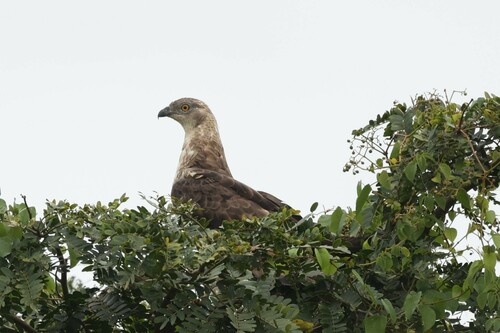
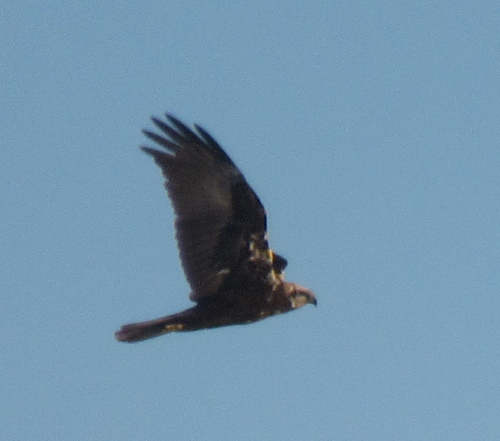
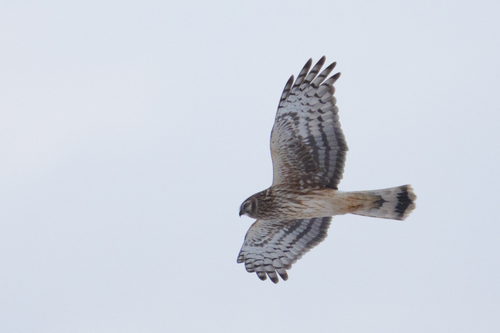
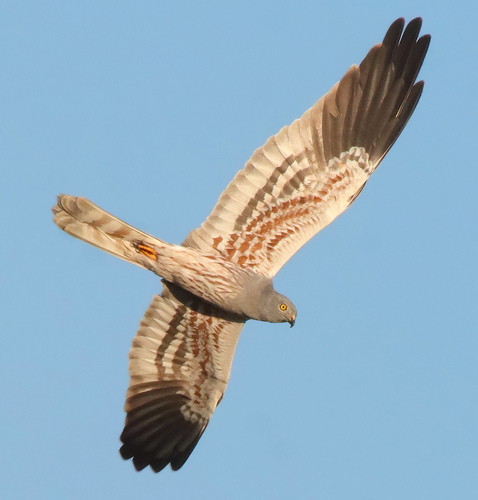
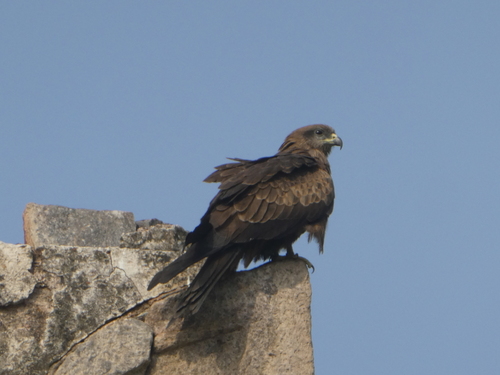
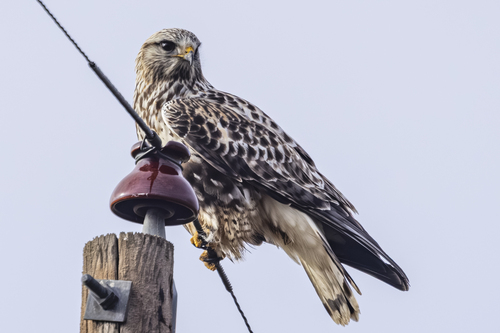
Today's pictures show the common plumages: adult buzzards, a female Marsh Harrier, a female Hen Harrier (the "ringtail") and a male Montagu's Harrier.

Today: 8 birds

Common Buzzard, adult adult
Photo: Trevor Marshall · CC BY-NC

Bird 1 of 8

Common Buzzard

Buteo buteo

How to recognise it

  • Broad wings held in a shallow V, a short tail and a rounded head
  • Very variable in colour, from dark brown to nearly white, but with a pale breast band
  • Soars in circles, with the fingers spread, and a dark trailing edge to the wing
fingers The spread feathers at the tip of the wing in soaring raptors. Their number and shape help with identification.

Where and when

UK, IE, NL, BE, DE, FR, DK, SE, FI: common to fairly common, all year, in woods and farmland. NO: uncommon. Birds from northern Europe move south in autumn. The commonest raptor in much of the region.

Call A loud, mewing, drawn-out “pee-ay” while soaring. Recording: Beatrix Saadi-Varchmin · xeno-canto

Common in the west and the south, and the bird people call an "eagle". The shape is the key: broad wings and a short tail.

Don’t confuse with: European Honey-buzzard (this week): a small, cuckoo-like head, a longer tail and flat wings. Rough-legged Buzzard: a white tail with a dark band.

Rough-legged Buzzard, adult adult
Photo: Jef-B · CC BY-NC

Bird 2 of 8

Rough-legged Buzzard

Buteo lagopus

How to recognise it

  • A white tail with a broad dark band at the tip
  • Large black carpal patches on a pale underwing, and a dark belly patch
  • Hovers in place, like a Kestrel, and glides on long wings
carpal patch A dark patch at the "wrist" of the underwing, where the leading edge bends. Large and black on a Rough-legged Buzzard.

Where and when

SE, FI, NO: breeds in the mountains and tundra, from May. DK, DE, NL, UK: uncommon to scarce in winter, mostly in the east, with a peak in November to January. BE, FR, IE: rare. A winter visitor from Fennoscandia.

Call A mewing “piyaah”, similar to a Common Buzzard. Recording: Elias A. Ryberg · xeno-canto

Numbers swing with the lemming cycle in the north. In a good year many reach the coast. The white tail with a black band is the first thing you see.

Don’t confuse with: Common Buzzard (this week): a brown tail with fine bars, and no dark carpal patches.

Common or Rough-legged Buzzard?

Common BuzzardCommon Buzzard
Rough-legged BuzzardRough-legged Buzzard

Look at the tail. A Rough-legged has a white tail with a broad dark band at the tip, while a Common Buzzard's tail is brown with fine bars. Under the wing, the Rough-legged has big black carpal patches and a dark belly. A Rough-legged Buzzard also hovers on long wings.

European Honey-buzzard, adult adult
Photo: tommy_andriollo · CC BY

Bird 3 of 8

European Honey-buzzard

Pernis apivorus

How to recognise it

  • A small, narrow head on a long neck, like a cuckoo or a pigeon
  • A long tail with a broad dark band at the tip and two bars at the base
  • Holds the wings flat, and soars with a slightly drooped wing

Where and when

SE, FI, NO, DK, DE, FR, NL, BE: uncommon summer visitors, breeding in woods from May. UK: scarce, with a few pairs in the south and Scotland. IE: very rare. A migrant to Africa, passing in large numbers over Falsterbo and the Bosporus in late August.

Call A high, thin, clear “pee-ee-ee-ee”. Recording: Alain Malengreau · xeno-canto

A buzzard-like bird, but it eats wasp grubs, not mice. The long tail and the small head separate it from Common Buzzard.

Don’t confuse with: Common Buzzard (this week): a short tail, a rounder, bigger head and wings in a V.

Western Marsh Harrier, adult female adult female
Photo: Kelsey J.R.P. Byers · CC BY-NC-SA

Bird 4 of 8

Western Marsh Harrier

Circus aeruginosus

How to recognise it

  • Dark chocolate-brown, with a creamy crown and throat and a cream shoulder patch
  • Wings held in a clear dihedral over reeds, quartering low
  • Long, rounded tail and broad wings, a heavy-looking harrier
dihedral A V-shape of the wings when seen from the front. Harriers hold their wings in a clear dihedral when gliding.

Where and when

UK, NL, BE, DE, FR, DK, SE, FI: fairly common to uncommon, in reedbeds, all year. NO, IE: rare. Many northern birds migrate to Africa in September.

Call A thin, high, whistling “kwee-ay” in display. Recording: Pere Josa · xeno-canto

The commonest harrier of the reedbeds. The female is dark with a pale head, and the male has a grey tail and wings.

Don’t confuse with: Hen Harrier (this week): a slim body, with a white rump, and a striped tail.

Hen Harrier, adult female adult female
Photo: Gabi Rusu · CC BY-NC

Bird 5 of 8

Hen Harrier

Circus cyaneus

How to recognise it

  • A white rump above a barred tail, the ringtail
  • A slim, owl-like face disc, and wings held in a clear dihedral
  • Glides low, quartering fields and moors
dihedral A V-shape of the wings when seen from the front. Harriers hold their wings in a clear dihedral when gliding.
ringtail A female or young harrier, with a white band across the rump above a barred tail.

Where and when

UK, IE: scarce in winter on moors and fields, and in the north in summer. NL, BE, DE, DK, FR: uncommon in winter. SE, FI, NO: uncommon to fairly common in summer, breeding. A bird of open land.

Call A chattering “ke-ke-ke-ke” near the nest. Recording: Peter Stronach · xeno-canto

In winter, ringtails (females and young) outnumber the grey males five to one. The white rump is the sign.

Don’t confuse with: Montagu's Harrier (this week): slimmer, with longer wings and a black wing bar in the male.

Montagu's Harrier, adult male adult male
Photo: jjulio2000 · CC BY-NC

Bird 6 of 8

Montagu's Harrier

Circus pygargus

How to recognise it

  • Ash-grey above, with a black wing tip and a thin black bar across the wing
  • Very slim and elegant, with long, pointed wings in a shallow dihedral
  • Chestnut streaks on the belly and a light, buoyant flight
dihedral A V-shape of the wings when seen from the front. Harriers hold their wings in a clear dihedral when gliding.

Where and when

FR, NL, DE, DK, SE: uncommon summer visitors, from late April to August, in cereal fields. UK: very rare, a handful of pairs. BE, FI, NO, IE: rare. A bird that nests in barley and wheat.

Call A rapid “kek-kek-kek-kek”, near the nest. Recording: Jarek Matusiak · xeno-canto

The most graceful of the harriers. Many nests are now protected by farmers and volunteers who mark and fence them.

Don’t confuse with: Hen Harrier (this week): a white rump on the male, a bigger body and wings with no black bar.

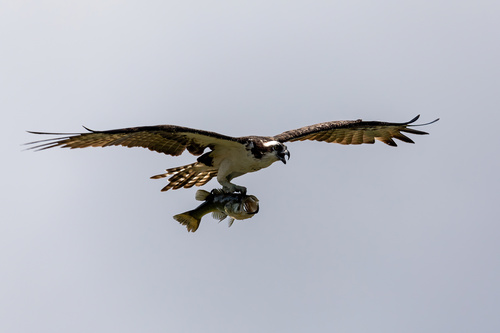
Osprey, adult adult
Photo: arctic_mongoose · CC BY

Bird 7 of 8

Osprey

Pandion haliaetus

How to recognise it

  • White underparts with a dark band across the breast, and a bold dark eye-stripe
  • Long, narrow, angled wings, like a big gull's, with a dark carpal mark
  • Hovers over water, then plunges feet-first for fish

Where and when

UK, IE, SE, FI, NO, DE, FR: uncommon summer visitors, breeding from April, and on passage from August to October. NL, BE, DK: scarce on passage. A migrant to West Africa. Nests on a platform on a tall pine.

Call A series of short, sharp, whistled notes, “pyew-pyew-pyew”. Recording: Peter Stronach · xeno-canto

A fish-eating raptor that pulls itself from the water with a fish in its talons. It appears on reservoirs and lakes on migration.

Don’t confuse with: Common Buzzard (this week): a brown bird, with no dark eye-stripe.

Black Kite, adult adult
Photo: Dmitrii Risenberg · CC BY-NC

Bird 8 of 8

Black Kite

Milvus migrans

How to recognise it

  • A dark brown, slim raptor with a shallow-forked tail
  • Long, flat wings held flat or a little arched, with fingers at the tips
  • A paler head and a pale patch on the underwing, near the tip

Where and when

FR, DE: fairly common summer visitors, from March to August. NL, BE, DK, SE: rare, mostly in spring. UK: very rare, with a few most years. IE, NO, FI: almost never. It follows river valleys, and scavenges at landfills.

Call A shrill, trembling whinny, “pi-ii-i-i-i-i-i”. Recording: Christian Kerihuel · xeno-canto

A kite that is a migrant, not a resident. The tail is less deeply forked than a Red Kite's, and the bird is darker overall.

Don’t confuse with: Red Kite (beginners): a deeper-forked tail, a reddish body and white patches under the wing.

Quiz

12 questions, with birds you have to repeat mixed in. Your answers decide when each bird comes back.

Out and about this week

Go to a headland or a viewpoint on a clear autumn day, with some wind from the north-east, and scan the sky. Note the wing shape of each raptor: flat, shallow V, deep V. Try to name each from the silhouette before you reach for your binoculars.