Motmot

Advanced birding · Lesson 23 · 22 minutes

Eclipse drakes and sawbills

Males in disguise, and the fish-eating ducks with saw-toothed bills

In summer, after the breeding season, male ducks lose their bright feathers and moult into a dull, brown plumage called eclipse. For a couple of months, from June to September, a drake looks like a female. He is not quite the same: the bill, the eye and the wing are still male, and often some of the colour remains. The four ducks in the first half of the lesson are all in eclipse.

The second half of the lesson is the sawbills: Goosander, Red-breasted Merganser and Smew. They are fish-eating ducks with thin, serrated bills. The drakes are easy. We look at the females: the grey-bodied ones with a brown head are the ones that turn up in winter on lakes and the coast.

Season: eclipse is a summer-and-early-autumn plumage, so this lesson fits August to October. Sawbills are winter ducks, from November to March, especially in cold weather.

Today: 7 birds

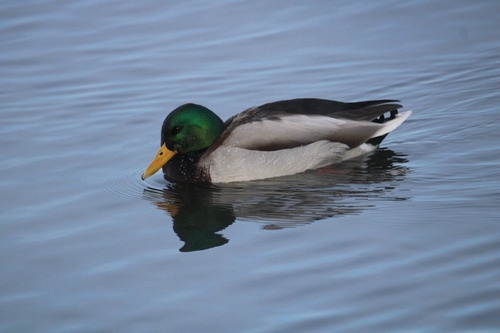
Mallard, adult male, eclipse adult male, eclipse
Photo: Денис Елин · CC BY-NC

Bird 1 of 7

Mallard

Anas platyrhynchos

How to recognise it

  • In eclipse: dull brown like a female, but with a plain yellow-olive bill
  • A dark crown and a dark brown back, with a chestnut tint on the breast
  • The male's blue speculum and white tail are still visible
eclipse The dull, female-like plumage that male ducks wear for a couple of months after breeding. The wing stays male.

Where and when

All ten countries. From June to September, most drakes in lakes and parks. The dull ones in July are mostly male birds; the clue is the bill.

Call A softer, raspy “rhab” from the drake, quite different from the female's loud quack. Recording: Irish Wildlife Sounds · xeno-canto

The bill is the key: yellow and plain in a male in eclipse; orange with a dark blotch in a female.

Don’t confuse with: Mallard female (week 21): an orange bill with a dark blotch.

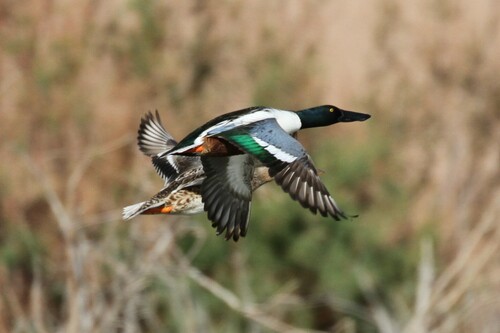
Northern Shoveler, adult male, eclipse adult male, eclipse
Photo: xochitlzeta · CC BY

Bird 2 of 7

Northern Shoveler

Spatula clypeata

How to recognise it

  • In eclipse: dull brown, but with a hint of the pale blue forewing
  • A big spoon-shaped bill that is now dark
  • A rufous belly and flanks still show through the dull body
eclipse The dull, female-like plumage that male ducks wear for a couple of months after breeding. The wing stays male.

Where and when

UK, IE, NL, BE, DE, FR, DK: fairly common, with eclipse males in July to September. SE, FI, NO: uncommon. The spoon bill is the sure sign.

Call A low “thuk-thuk” and a soft quack. Recording: David Darrell-Lambert · xeno-canto

The male gets a plain, dull look, but the spoon bill and the rufous flanks are a giveaway.

Don’t confuse with: Northern Shoveler female (week 21): a paler bill, with an orange edge, and no rufous on the flanks.

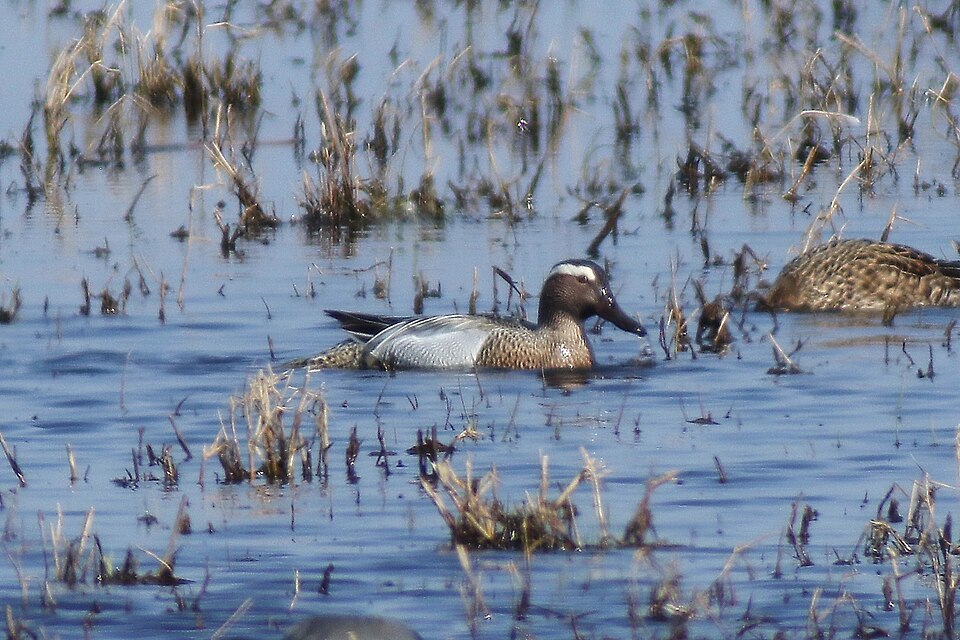
Garganey, adult male, eclipse adult male, eclipse
Photo: Donald Hobern · CC BY

Bird 3 of 7

Garganey

Spatula querquedula

How to recognise it

  • In eclipse: looks like a female, with a bold pale eyebrow
  • The pale blue-grey forewing of the male still shows in flight
  • A dark eye-stripe, a pale spot at the bill base, and a pale belly
eclipse The dull, female-like plumage that male ducks wear for a couple of months after breeding. The wing stays male.

Where and when

NL, DE, DK, BE, FR, UK: scarce, July to September, on passage. IE, NO, SE, FI: rare. The male leaves the breeding area in July and flies south in eclipse plumage.

Call A short, dry rattle, “krrk”. Recording: Irish Wildlife Sounds · xeno-canto

The males leave first and are mostly in eclipse when they fly south. The blue-grey forewing is the best mark that it is a male.

Don’t confuse with: Garganey female (week 21): a brown forewing and no blue-grey.

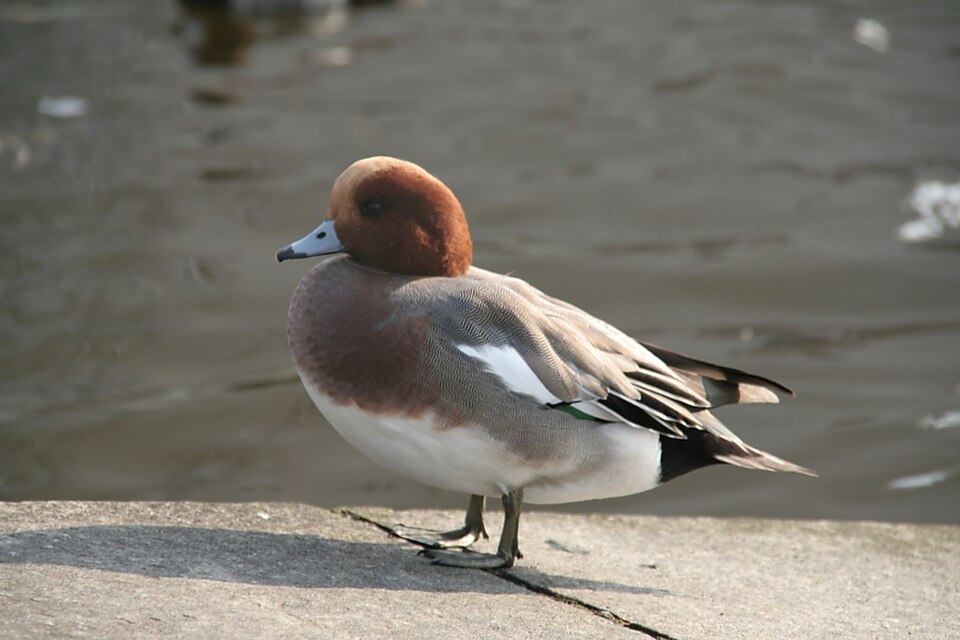
Eurasian Wigeon, adult male, eclipse adult male, eclipse
Photo: Maga-chan · CC BY-SA

Bird 4 of 7

Eurasian Wigeon

Mareca penelope

How to recognise it

  • In eclipse: dark rufous-brown, with a rounder, rusty head
  • A white patch on the forewing, still showing
  • A short, blue-grey bill with a black tip
eclipse The dull, female-like plumage that male ducks wear for a couple of months after breeding. The wing stays male.

Where and when

UK, IE, NL, BE, DE, FR, DK: common from September, when the first males are still in eclipse. SE, FI, NO: breeds in the north. The drakes moult into breeding plumage again in September to October.

Call A soft, quiet “whee” from the male. Recording: David Darrell-Lambert · xeno-canto

A male Wigeon in September is half and half: the grey and the pink are coming back, patch by patch.

Don’t confuse with: Eurasian Wigeon female (week 21): a grey forewing, with no white patch.

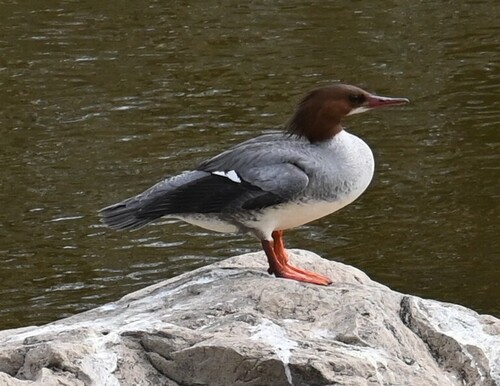
Goosander, adult female adult female
Photo: motherearthsfeathers · CC BY

Bird 5 of 7

Goosander

Mergus merganser

How to recognise it

  • A sawbill with a long, thin red bill with a hooked tip
  • A chestnut head, with a sharp, white chin patch and a clear edge to the white neck
  • Grey body and a white belly, with a shaggy rear crown
sawbill A fish-eating duck (Goosander, merganser, Smew) with a thin bill with tooth-like edges.
chin patch A white patch on the chin and throat. A female Goosander has a sharp-edged one.

Where and when

UK, DE, NO, SE, FI: fairly common on rivers and lakes. IE, NL, BE, FR, DK: scarce in winter. The commonest sawbill on fresh water, and it breeds in holes in trees.

Call Silent in winter; a low, harsh croak. Recording: Jarek Matusiak · xeno-canto

A big, sleek, fish-eating duck. A sharp line between the brown head and the white neck is the key mark.

Don’t confuse with: Red-breasted Merganser (this week): a shaggy crest and a blurred edge between the head and neck.

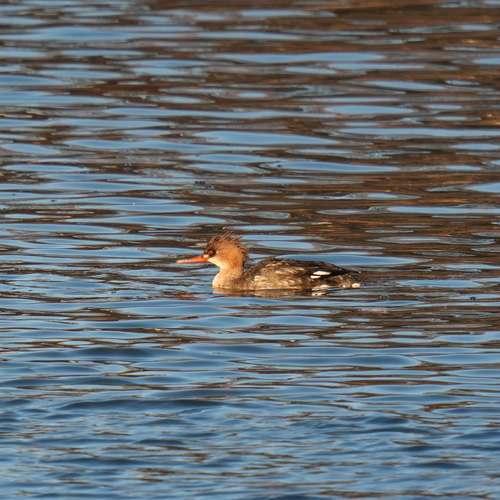
Red-breasted Merganser, adult female adult female
Photo: foxsu · CC BY-NC

Bird 6 of 7

Red-breasted Merganser

Mergus serrator

How to recognise it

  • A sawbill with a shaggy crest on a brown head
  • A blurred, not sharp, line between the head and the white neck
  • A thin red bill, and a greyer, slimmer look than a Goosander
sawbill A fish-eating duck (Goosander, merganser, Smew) with a thin bill with tooth-like edges.
crest A tuft of long feathers on the head. The female Red-breasted Merganser has a shaggy one.

Where and when

UK, IE, NO, SE, FI, DK: common on the coast and on lakes. NL, BE, DE, FR: fairly common in winter on the sea and the coast. A bird of the sea in winter.

Call Silent in winter; a low, hoarse croak in display. Recording: Astrid Cervantes · xeno-canto

More coastal than a Goosander. The shaggy crest gives a punk look, and the dull head merges into the neck.

Don’t confuse with: Goosander (this week): a smoother head, a sharp white chin and a thicker bill.

Goosander or Red-breasted Merganser, female?

GoosanderGoosander
Red-breasted MerganserRed-breasted Merganser

Look at the line between the brown head and the white neck. In a Goosander it is sharp, with a clean white chin. In a Red-breasted Merganser it is blurred, and the head has a shaggy crest. The Goosander is bigger, with a heavier bill, and prefers fresh water; the merganser is more often on the sea.

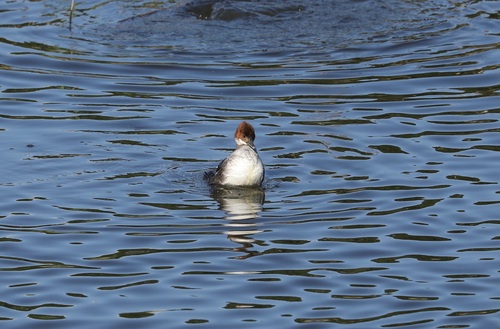
Smew, adult female adult female
Photo: se1 · CC BY

Bird 7 of 7

Smew

Mergellus albellus

How to recognise it

  • A small, neat sawbill with a chestnut cap and white cheeks
  • A short, grey bill, and a grey body with a white belly
  • Often called a 'redhead', and it dives in small groups
sawbill A fish-eating duck (Goosander, merganser, Smew) with a thin bill with tooth-like edges.

Where and when

NL, DE, DK, BE, UK: uncommon in winter, mainly in cold weather, on lakes and ponds. FR, IE, NO, SE, FI: scarce. Breeds in the Arctic forest and winters in the south and west.

Call Silent in winter; a low, soft croak in display. Recording: Lars Edenius · xeno-canto

The female Smew is a small, neat duck. In very cold winters, groups of redheads fly west from the Baltic.

Don’t confuse with: Red-breasted Merganser (this week): bigger, with a shaggy head and a long, thin bill.

Quiz

12 questions, with birds you have to repeat mixed in. Your answers decide when each bird comes back.

Out and about this week

In winter, scan a lake or an estuary for sawbills. Look for the sharp border on a Goosander female and a shaggy head on a merganser. In July to September, look at the drakes of the commonest ducks on a pond: how many are in eclipse?