Motmot

Advanced birding · Lesson 24 · 22 minutes

Geese and swans

White-fronted, both Bean Geese, Pink-footed, Lesser White-fronted, Red-breasted, Whooper and Bewick's

Winter in north-west Europe is goose time. From October to March, flocks from Siberia, Greenland, Iceland and Svalbard feed on grassland and fields. The grey geese (white-fronted, bean, pink-footed) look alike at a distance, and they differ in the bill, the legs, and the voice. A flock of thousands of geese is a good place to look for the rarer species.

Learn the bill: the black-and-orange bill of the Bean Goose, the white blaze of the White-fronted, the small pink-banded bill of the Pink-footed. Then the legs: orange (White-fronted, Bean) or pink (Pink-footed). Finally the shape: Taiga Bean is long-necked and long-billed, Tundra Bean is more compact.

The two white swans are a classic pair: the Whooper Swan, with its big, yellow, wedge-shaped bill patch, and the Bewick's, smaller, with a rounder yellow patch. Both come from the north in late autumn. In winter listen: swans call across the fields at dusk.

Today: 8 birds

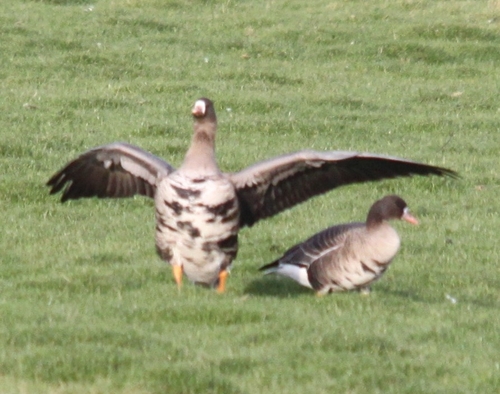
Greater White-fronted Goose, adult adult
Photo: Richard Shirky · CC BY

Bird 1 of 8

Greater White-fronted Goose

Anser albifrons

How to recognise it

  • A white blaze at the base of a pink bill, and orange legs
  • Irregular black belly bars, different on every bird
  • A grey-brown body with white edges on the flank feathers
blaze The white patch at the base of the bill, as on the White-fronted Goose.
belly bars The black bars on the belly of an adult White-fronted Goose. No two birds are the same.

Where and when

NL, DE, DK, UK: common to abundant in winter, from October, on grassland and fields. BE, FR: fairly common. IE: uncommon (Greenland race). NO, SE, FI: passage birds. About a million winter in Europe.

Call A high, laughing, musical “kyow-yow-yow”, quite shrill, from a flock. Recording: David Darrell-Lambert · xeno-canto

Flocks of thousands graze on Dutch and German grassland. Juveniles have no white on the face and no black belly bars, so they are harder.

Don’t confuse with: Greylag Goose (beginners): bigger, a pale, heavy, orange bill and a plain belly.

Taiga Bean Goose, adult adult
Photo: andrewbazdyrev · CC BY

Bird 2 of 8

Taiga Bean Goose

Anser fabalis

How to recognise it

  • A long, deep bill with a long orange band, and an orange leg
  • Long, slim neck and a long, flat head, a lanky shape
  • Dark brown head and neck, and a dark, scaly back

Where and when

SE, FI, NO: breeds in the taiga from May. SE, DK, DE: scarce in winter, with a small flock in the south of Sweden. UK: very rare, a few in Scotland and Norfolk. NL, BE, FR, IE: rare. A declining bird.

Call A deep, nasal “ung-ank” or “ka-yak”, lower than a White-fronted. Recording: Scott Wotherspoon · xeno-canto

A rare bird in winter, and a tall, lanky goose with a long bill. The orange band along the bill is longer and brighter than on the Tundra Bean Goose.

Don’t confuse with: Tundra Bean Goose (this week): shorter, with a compact bill with a narrow orange band.

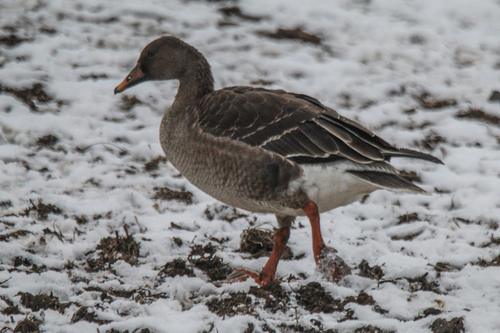
Tundra Bean Goose, adult adult
Photo: Mike King · CC BY-NC

Bird 3 of 8

Tundra Bean Goose

Anser serrirostris

How to recognise it

  • A shorter, stockier shape, with a bill that is mostly black with a narrow orange band
  • A short neck, rounded head and a heavy body
  • Orange legs and a brownish, scaly back

Where and when

NL, DE, BE, DK: common in winter, on fields and grassland, mostly in NL and DE. UK: scarce. FR, SE: uncommon. NO, FI: breeds in the north. The Bean Goose of the north-west European winter.

Call A deep, nasal “ung-unk” or “ka-yak”, a bit higher than a Taiga Bean. Recording: brickegickel · xeno-canto

A compact grey-brown goose. The bill is the key: black with a thin orange band across.

Don’t confuse with: Taiga Bean Goose (this week): taller, a longer bill with a longer orange band.

Taiga or Tundra Bean Goose?

Taiga Bean GooseTaiga Bean Goose
Tundra Bean GooseTundra Bean Goose

Look at the bill and the neck. A Taiga Bean Goose is tall, with a long neck and a long, deep bill with a long orange band, and it looks rather flat-headed. A Tundra Bean Goose is stocky and short-necked, with a short, mostly black bill with a thin orange band. The Tundra is by far the commoner in the Netherlands and Germany.

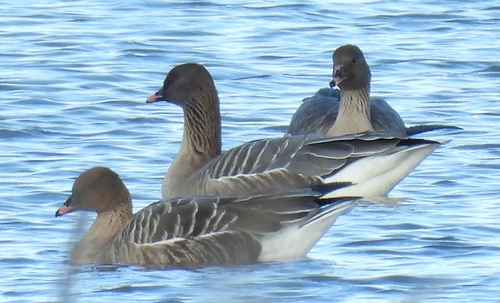
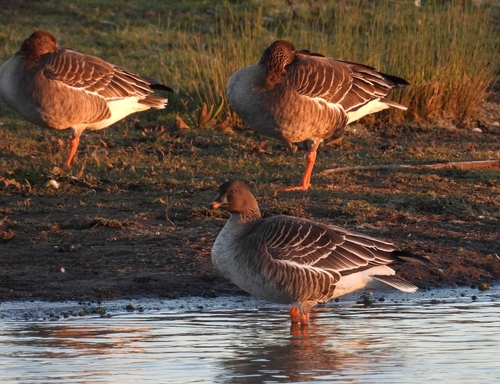
Pink-footed Goose, adult adult
Photo: wyvern63 · CC BY

Bird 4 of 8

Pink-footed Goose

Anser brachyrhynchus

How to recognise it

  • A small, round head and a short, dark bill with a pink bill band
  • Pink legs and a pale blue-grey forewing, and a clean, uniform look
  • A dark head and neck contrasting with a pale breast
bill band A coloured band across the bill. The Pink-footed Goose has a pink one; Bean Geese have an orange one.

Where and when

UK, NL, DK, BE: common in winter, with a huge number in Norfolk, Lancashire and Scotland (hundreds of thousands). DE, NO: uncommon. IE, FR: rare. Arrives from Iceland and Svalbard in October.

Call A high, lively, “wink-wink” or “ahng-ahng”, higher than other grey geese. Recording: David Darrell-Lambert · xeno-canto

They roost on estuaries and fly out at dawn in big skeins. The high calls are the sound of autumn in East Anglia.

Don’t confuse with: Tundra Bean Goose (this week): orange legs, a bigger bill and a longer neck.

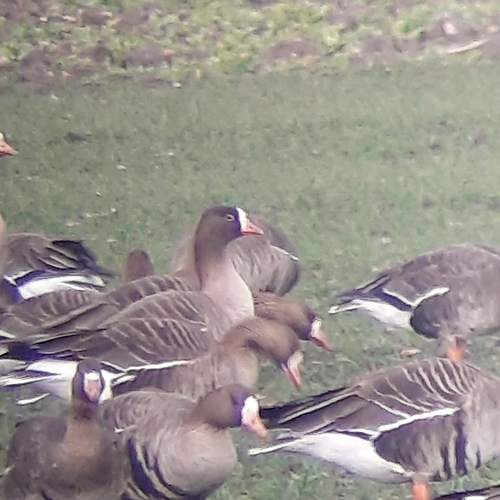
Lesser White-fronted Goose, adult adult
Photo: migru · CC BY

Bird 5 of 8

Lesser White-fronted Goose

Anser erythropus

How to recognise it

  • Small, with a white blaze that reaches up to the forehead
  • A yellow eye ring, a short, pink bill and a short neck
  • The folded wing tips project beyond the tail
blaze The white patch at the base of the bill, as on the White-fronted Goose.
wing tips The ends of the folded wings. In a Lesser White-fronted Goose they project beyond the tail.

Where and when

SE, FI, NO: very rare breeders, and almost gone, with a few in winter in Sweden and Finland. DE, DK, NL, UK: very rare. FR, BE, IE: almost never. A critically endangered bird, with a few reintroduced in Sweden.

Call A high, squeaky “kyu-yu-yu”, higher than a White-fronted. Recording: Lars Edenius · xeno-canto

A bird to look for in every flock of White-fronted Geese. The yellow eye ring and the white blaze that reaches the forehead are the marks.

Don’t confuse with: Greater White-fronted Goose (this week): bigger, a blaze that stops below the forehead, and no yellow ring.

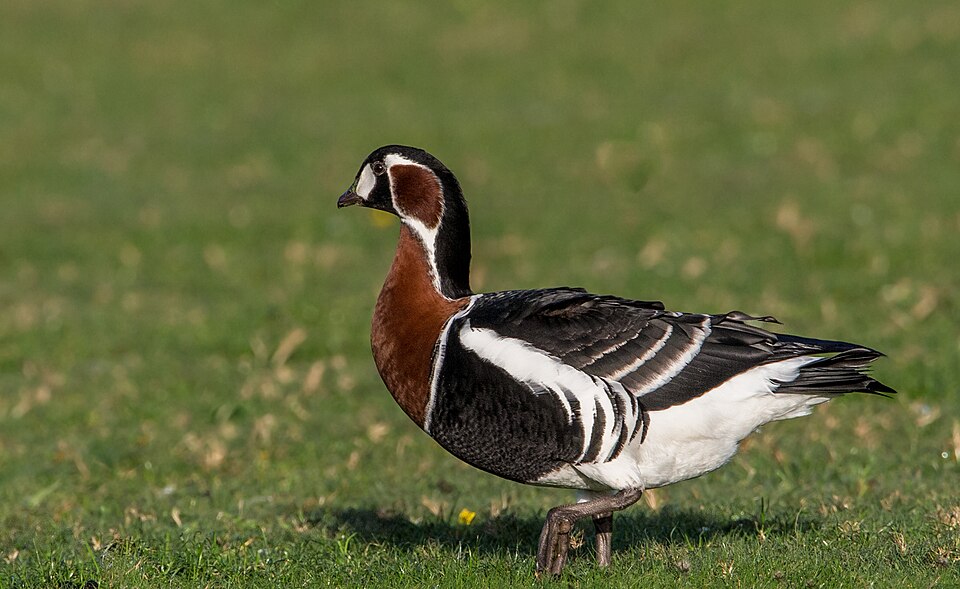
Red-breasted Goose, adult adult
Photo: Andy Morffew · CC BY

Bird 6 of 8

Red-breasted Goose

Branta ruficollis

How to recognise it

  • A small, neat goose, with a chestnut breast and white patches on a black head
  • A very short, small bill and a round head
  • A bold white line along the flank, and a black belly

Where and when

UK, NL, DE, DK, BE, FR: very rare, often with Brent Geese in winter. SE, FI, NO: almost never. IE: almost never. Breeds in Siberia and winters on the Black Sea. Some are escapes.

Call A high, shrill “kik-yoik”, a sharp squeak. Recording: Michel Veldt · xeno-canto

The most colourful goose of the Palearctic. A single bird among a flock of dark-bellied Brent Geese is a classic find.

Don’t confuse with: Brent Goose (beginners): a bigger black head, no chestnut breast.

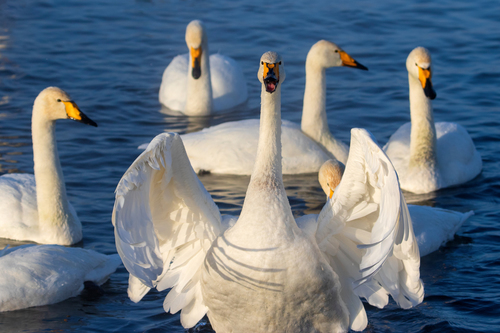
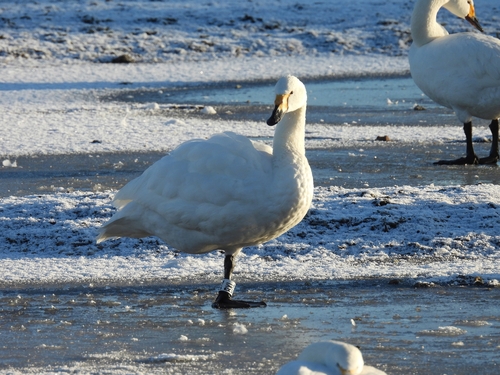
Whooper Swan, adult adult
Photo: siburhan · CC BY

Bird 7 of 8

Whooper Swan

Cygnus cygnus

How to recognise it

  • A long, straight neck and a long, flat head, with a wedge-shaped yellow patch on the bill
  • The yellow patch comes to a point, below the nostril, on a black tip
  • Loud, bugling calls from a flock, often at dusk

Where and when

UK, IE, NL, DK, DE: fairly common in winter, with Icelandic birds in the UK and IE. NO, SE, FI: breeds in the north and the lakes. BE, FR: scarce. A bird of fields and lakes, from October.

Call A loud, bugling “whoop-whoop”, deeper than a Mute Swan, from a flock. Recording: Paul Kelly · xeno-canto

The wild swan of the north. It holds its neck straight, unlike a Mute Swan's curved neck, and calls constantly.

Don’t confuse with: Bewick's Swan (this week): smaller, with a rounder, smaller yellow patch.

Bewick's Swan, adult adult
Photo: Mike King · CC BY-NC

Bird 8 of 8

Bewick's Swan

Cygnus columbianus

How to recognise it

  • Smaller than a Whooper Swan, with a shorter neck and a rounder head
  • A rounded yellow patch on a mostly black bill
  • Goose-like in size and shape, in small family groups

Where and when

NL, DE, UK, DK, BE: uncommon in winter, from November, with its best-known flock at Slimbridge. FR, IE: rare. NO, SE, FI: rare. Declining a lot over the last 20 years.

Call A soft, goose-like, yelping “wow-wow-woo”, higher than a Whooper. Recording: Michel Veldt · xeno-canto

A small swan from the Siberian tundra. Each one has a unique bill pattern, and the Slimbridge researchers have named hundreds of them.

Don’t confuse with: Whooper Swan (this week): bigger, a long, straight neck and a pointed yellow patch.

Quiz

12 questions, with birds you have to repeat mixed in. Your answers decide when each bird comes back.

Out and about this week

In winter, find a flock of geese in a field and scan it, one bird at a time. Look first for the bill, then the legs. A good goose-spotting walk can include a Whooper or a Bewick's Swan too: check the yellow on the bill.