Motmot

Advanced birding · Lesson 18 · 20 minutes

Auks and divers

Guillemot, Razorbill, Puffin, Black Guillemot, Little Auk and the three divers

Auks and divers are the diving birds of the sea. Auks (guillemots, Razorbills, Puffins) fly low with a fast whirr of wings, and breed on cliffs in summer. In winter they are at sea, and you often see them in winter plumage with white faces. Divers (loons) breed on lakes in the far north and spend the winter at sea.

Most auks pass any sea-watch point from July to October as they leave the colonies, and in winter large numbers sit offshore. The Little Auk is a bird of north Atlantic winters: the species is nowhere near as common as Guillemots, but gales in November can push thousands past the east coast.

The three divers are the real test. Red-throated is slim with an up-tilted bill; Black-throated is mid-sized, with a straight bill and a neat flank patch; Great Northern is huge, with a thick bill and a dark head.

Today: 8 birds

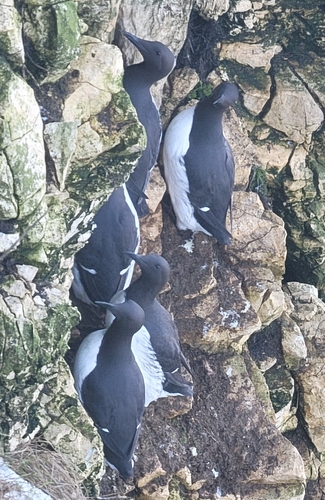
Common Guillemot, adult, non-breeding adult, non-breeding
Photo: Amaël Borzée · CC BY-NC

Bird 1 of 8

Common Guillemot

Uria aalge

How to recognise it

  • In winter plumage: dark brown above, a white face and a dark line behind the eye
  • A long, thin, pointed bill, and a slim shape on the water
  • A fast, direct flight, low over the waves, with a whirr of wings
winter plumage The plain plumage seen outside the breeding season. Auks have white faces and divers a white throat in winter.

Where and when

UK, IE, NO, DK: common at colonies in summer, and fairly common offshore in winter. NL, BE, DE, FR, SE: fairly common to scarce offshore. FI: very rare. Pairs of adults and chicks leave the colonies in July.

Call At the colony a loud, growling “aaarrr” and a purr. Recording: David Darrell-Lambert · xeno-canto

The cliff-ledge breeder. In summer the face is dark brown, in winter it is white with a thin dark line behind the eye.

Don’t confuse with: Razorbill (this week): a black head, a deeper, blunt bill and a thick neck.

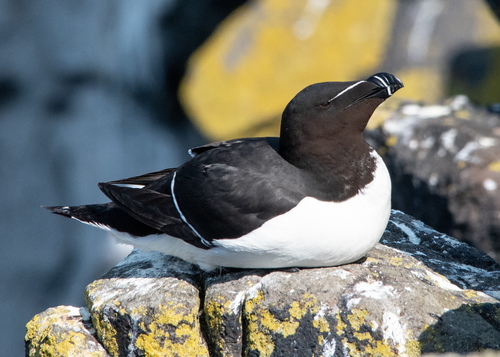
Razorbill, adult, non-breeding adult, non-breeding
Photo: dloarie · CC BY

Bird 2 of 8

Razorbill

Alca torda

How to recognise it

  • Black above and white below, with a heavy, deep bill with a white line
  • A black head and neck, without the white face of the Guillemot
  • Pointed tail, held cocked when swimming

Where and when

UK, IE, NO: common at colonies in summer, and fairly common offshore in winter. DK, NL, BE, DE, FR, SE: scarce to fairly common offshore. FI: very rare.

Call At the colony, a low, growling purr. Recording: Rombout de Wijs · xeno-canto

A guillemot's cousin, with the sharper-looking, blunt bill and the black, not brown, upperparts. It cocks its tail when swimming.

Don’t confuse with: Common Guillemot (this week): brown, a thin pointed bill and a white face in winter.

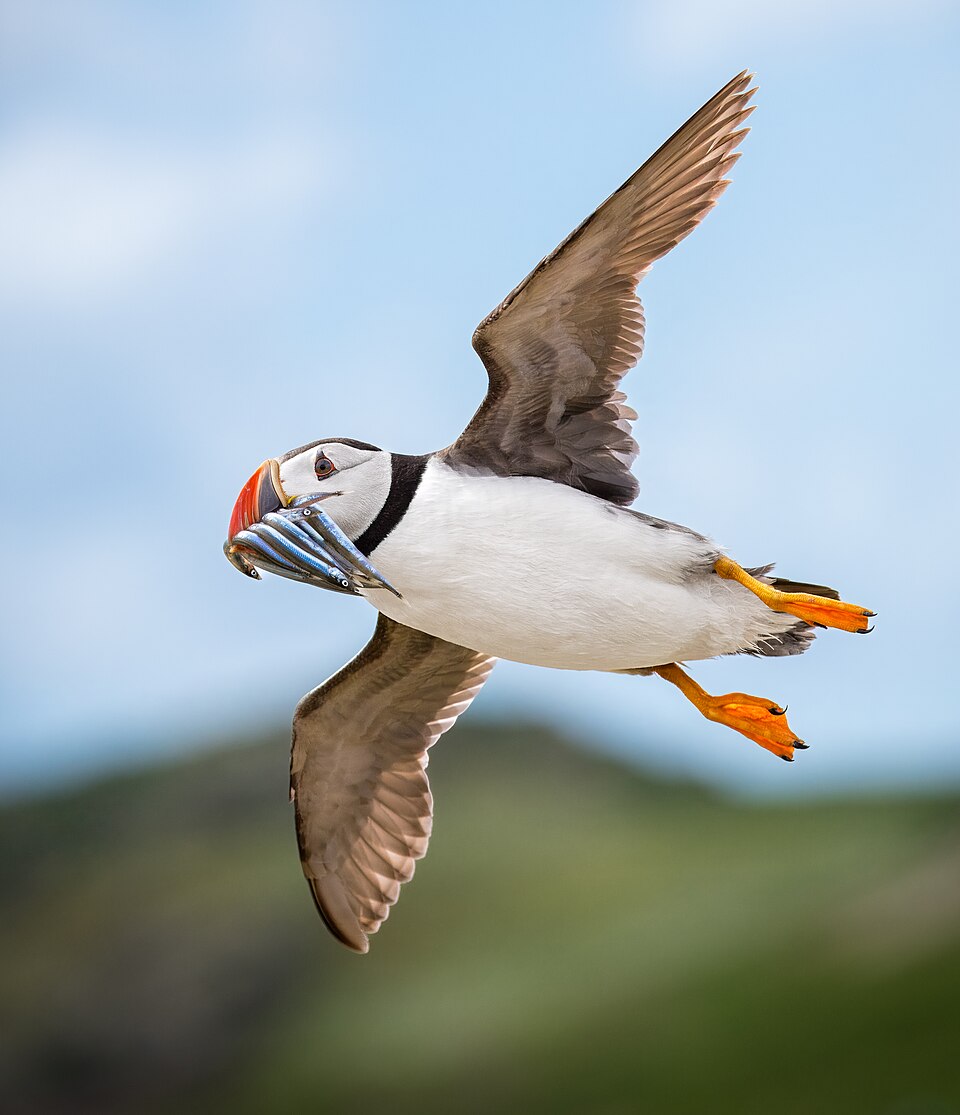
Atlantic Puffin, adult, non-breeding adult, non-breeding
Photo: Chris Down · CC BY

Bird 3 of 8

Atlantic Puffin

Fratercula arctica

How to recognise it

  • Small and plump, with a grey face and a dull, smaller bill in winter
  • Black above and white below, with orange feet
  • A fast, whirring flight on small wings

Where and when

UK, IE, NO: common at colonies in April to August, and far out at sea in winter. FR, DK, NL, BE, DE, SE: rare offshore, in winter. FI: very rare. In summer the bright bill is unmistakable, but in winter the bird is plain and drab.

Call At the burrow a low, growling “arrr”. Recording: david m · xeno-canto

Seabird photos show the bright summer Puffin, but a bird seen from land in October is likely to be a dull, grey-faced one. Look at the small size and the stubby bill.

Don’t confuse with: Little Auk (this week): even smaller, with a very short bill and a white throat.

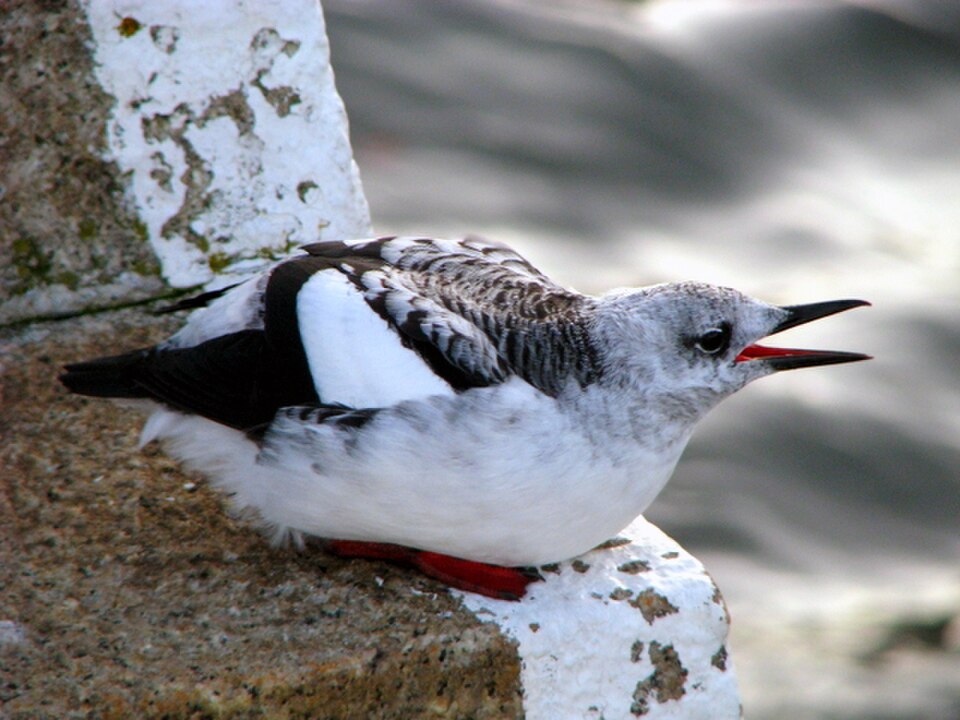
Black Guillemot, adult, non-breeding adult, non-breeding
Photo: Ross · CC BY-SA

Bird 4 of 8

Black Guillemot

Cepphus grylle

How to recognise it

  • Mostly white in winter, with a grey-barred back and black wings with a white patch
  • Bright red legs and a thin black bill
  • A white wing patch that stands out on the dark wing

Where and when

UK (Scotland), IE, NO, SE, FI, DK: fairly common around rocky coasts and harbours all year. NL, BE, DE, FR: very rare. It does not migrate far.

Call A high, thin, whistling “peeeee”. Recording: Anthony McGeehan · xeno-canto

A resident of rocky coasts, easy to see from a harbour wall. The white wing patch and red legs are the signs.

Don’t confuse with: Common Guillemot (this week): dark brown, with no white wing patch.

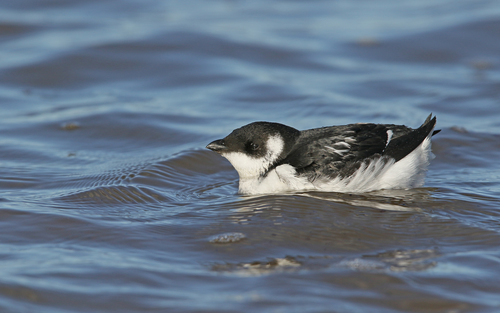
Little Auk, adult, non-breeding adult, non-breeding
Photo: christoph_moning · CC BY

Bird 5 of 8

Little Auk

Alle alle

How to recognise it

  • Tiny, the size of a Starling, with a very short, stubby bill
  • Black above and white below, with a white throat and dark cap
  • A fast whirr of wings, in flocks, low over the waves

Where and when

UK, NO, DK, NL, DE, FR, SE: scarce to rare, mostly in November to February, with big flocks in northerly gales on the east coast. IE: rare. FI: very rare. Breeds in Greenland and Svalbard.

Call A high, trilling, chattering “kree-ee-ee”. Recording: Jacob Lotz · xeno-canto

A tiny seabird that arrives with northerly gales. A wreck can strand dozens inland after a winter storm.

Don’t confuse with: Atlantic Puffin (this week): bigger, with a deeper bill and orange feet.

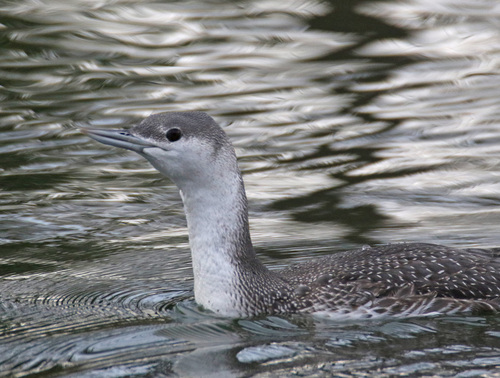
Red-throated Diver, adult, non-breeding adult, non-breeding
Photo: dimitriskokkinidis · CC BY-NC

Bird 6 of 8

Red-throated Diver

Gavia stellata

How to recognise it

  • Slim, with a pale, speckled grey back and a white face
  • A thin, up-tilted bill, held a bit upwards
  • Often flies fast and low, with a hunched look, in a line
up-tilted A bill pointing slightly upwards, as in the Red-throated Diver.

Where and when

UK, IE, NO, SE, FI: breeds on small lakes in the north, April to August. DK, NL, BE, DE, FR, UK: common in winter offshore, from October to March. Large numbers pass in the North Sea.

Call In flight, a goose-like, rapid “kak-kak-kak”. At the lake, a wailing cry. Recording: Grégoire Chauvot · xeno-canto

The commonest diver at sea. The thin, upturned bill and the pale, speckled back are the marks.

Don’t confuse with: Black-throated Diver (this week): a straight, stout bill, a darker head and a neat flank patch.

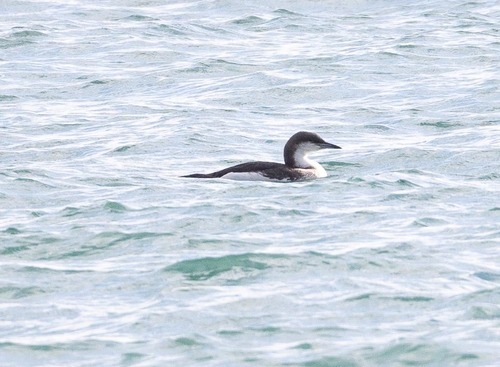
Black-throated Diver, adult, non-breeding adult, non-breeding
Photo: Сергей Красноперов · CC BY-NC

Bird 7 of 8

Black-throated Diver

Gavia arctica

How to recognise it

  • A straight, stout dagger of a bill, with a dark crown and a clean, white throat
  • A white flank patch that shows when it is on the water
  • A sharp line between the dark nape and the white throat
flank patch A white patch on the rear flank, near the water line. Black-throated Diver has a neat one that shows when it swims.

Where and when

NO, SE, FI: breeds on larger lakes, May to August. UK: scarce on the coast in winter, with a few breeding in Scotland. DK, DE, NL, BE, FR, IE: scarce to rare in winter. Winter flocks can include hundreds in Danish waters.

Call A rarely heard, loud, mournful wail. Recording: Lars Edenius · xeno-canto

Compare with the other divers in poor light: it is the bird in the middle. The neat black-and-white line between neck and throat is the mark.

Don’t confuse with: Red-throated Diver (this week): a thin, up-tilted bill and a paler look. Great Northern Diver: bigger, a heavy bill.

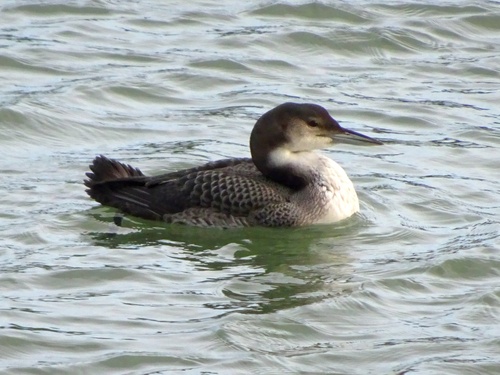
Great Northern Diver, adult, non-breeding adult, non-breeding
Photo: swimjamie · CC BY

Bird 8 of 8

Great Northern Diver

Gavia immer

How to recognise it

  • Large and heavy, with a thick, strong, dagger-like bill
  • A dark head and a pale half-collar on the neck
  • A square, flat-backed profile, with a flat forehead
collar A band round the neck. A Great Northern Diver in winter has a pale half-collar.

Where and when

UK, IE, NO: fairly common in winter off the north and west coasts, from October to April. DK, NL, BE, DE, FR, SE: rare to scarce. FI: very rare. Breeds in Iceland and North America.

Call Silent in winter; a loud, yodelling wail in summer. Recording: Stanislas Wroza · xeno-canto

The biggest diver, and a bird that dives for minutes. Look for the flat forehead and the heavy bill.

Don’t confuse with: Black-throated Diver (this week): smaller, a slimmer bill and a rounder head.

Quiz

12 questions, with birds you have to repeat mixed in. Your answers decide when each bird comes back.

Out and about this week

In winter, look for divers off a headland or in a sheltered bay. Compare them in the same view: size, bill, forehead. In October to November, check the flocks of auks passing for a Little Auk.