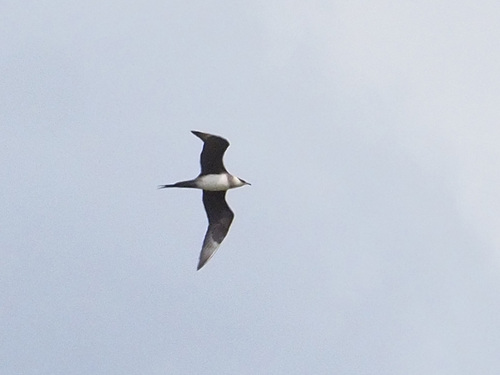
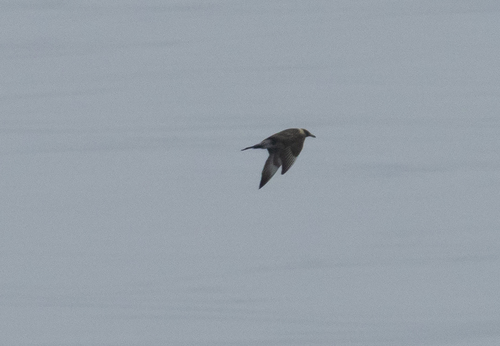
Motmot

Advanced birding · Lesson 17 · 20 minutes

Skuas, Gannet and Kittiwake

The four skuas, and the young seabirds that fly with them

Skuas are the pirates of the sea. They chase gulls, terns and gannets until they drop their catch. Four species pass the coasts of north-west Europe: Great Skua (bonxie), Arctic, Pomarine and Long-tailed. Which one you see depends on the season: Arctic Skuas are the commonest, Pomarines pass in October and the big autumn storms, and Long-tailed Skuas pass in May and September.

Identification starts with size and flight: a Great Skua is a heavy, bull-necked brown bird with a white flash, an Arctic is like a dark falcon, a Pomarine is a big, broad, barrel-chested bird, and a Long-tailed is slim and tern-like. Colour varies (pale and dark morphs), and the juveniles are barred and hard. Do not be disappointed if you cannot name each one: the pros leave many as "skua sp.".

With them we take two other birds you see at the same time on a sea-watch: a young Gannet, which is dark brown and speckled, and a juvenile Kittiwake, which has a black W across its wings.

Today: 6 birds

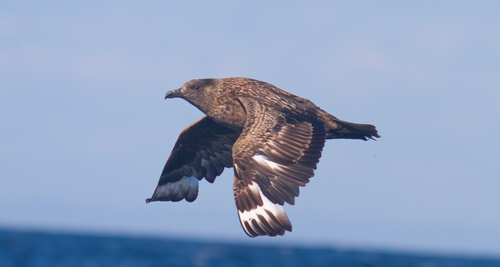
Great Skua, adult adult
Photo: guimendes · CC BY-NC

Bird 1 of 6

Great Skua

Stercorarius skua

How to recognise it

  • Heavy, dark brown and bull-necked, the size of a big gull
  • A bold white flash at the base of the primaries
  • A short, wedge-shaped tail, and a determined, powerful flight
white flash A white patch at the base of the primaries, on the upperwing of a flying skua. Big in Great Skua, small in Arctic.

Where and when

UK (Shetland, Orkney, Hebrides), IE, NO: breeds in colonies, from April to August. NL, BE, DE, DK, FR, SE: scarce on passage in autumn, August to October. FI: almost never. Locally known as the bonxie.

Call At colonies a hoarse, repeated “uk-uk-uk”. Recording: Andrew Harrop · xeno-canto

A bird that will chase anything, from Gannets to Peregrines. If a gull is forced to drop its fish, look for this bird.

Don’t confuse with: Great Black-backed Gull (week 1): white head and a pale underwing, no white flash.

Arctic Skua, adult adult
Photo: gwynmwilliams · CC BY

Bird 2 of 6

Arctic Skua

Stercorarius parasiticus

How to recognise it

  • Slim and falcon-like, with pointed wings and a fast, agile flight
  • Occurs in pale, intermediate and dark morphs, with a small white flash
  • Short, pointed central tail feathers, sticking out a little
morph A colour form within one species. Arctic Skuas occur as pale, intermediate and dark morphs.
central tail feathers The two middle tail feathers. They are pointed in Arctic Skua and very long in an adult Long-tailed Skua.

Where and when

UK (Scotland), NO, SE, FI, IE: breeds in the north, from May to August. NL, BE, DE, DK, FR: scarce to fairly common on passage, especially from August to October. The skua you are most likely to see from any coast.

Call A short, mewing “ka-aaow” and a nasal wail. Recording: Peter Stronach · xeno-canto

Skuas are best told by the way they hunt: the Arctic Skua chases terns with a fast, twisting pursuit, like a falcon after a swallow.

Don’t confuse with: Pomarine Skua (this week): bigger and heavier. Long-tailed Skua: slimmer, with a lighter flight.

Great Skua or Arctic Skua?

Great SkuaGreat Skua
Arctic SkuaArctic Skua

Size, then flight. A Great Skua is as big as a Herring Gull, bull-necked, brown and heavy, and has a very bold white flash. An Arctic Skua is slimmer, falcon-shaped, with pointed wings and a small flash, and flies fast and agile. Only the Arctic comes in pale, intermediate and dark morphs.

Pomarine Skua, adult adult
Photo: william_stephens · CC BY

Bird 3 of 6

Pomarine Skua

Stercorarius pomarinus

How to recognise it

  • Heavy, broad-winged and barrel-chested, with a thick, deep-based bill
  • Pale morph shows a dark breast band and a dark cap; the tail has twisted spoons
  • A slow, powerful, steady flight and strong wingbeats
spoons The blunt, twisted ends of the two central tail feathers of a Pomarine Skua.

Where and when

UK, IE, NL, BE, DE, DK, FR, NO, SE: scarce to rare on passage, mainly in autumn (October, in gales) and in May. FI: almost never. A bird that breeds on the Siberian tundra.

Call Silent at sea; a harsh “which-yew” on the breeding grounds. Recording: Benjamin Drillat · xeno-canto

A big, heavy skua, often compared with a Herring Gull. The twisted spoons are not always visible, so look at the barrel-chested shape.

Don’t confuse with: Arctic Skua (this week): smaller and slimmer, and a fast, agile flight.

Long-tailed Skua, juvenile juvenile
Photo: cback · CC BY

Bird 4 of 6

Long-tailed Skua

Stercorarius longicaudus

How to recognise it

  • Slim, tern-like, with a light, buoyant flight
  • Barred grey-brown, with a pale head and a dark cap in the pale morph
  • Little or no white flash, and short, blunt central tail feathers
white flash A white patch at the base of the primaries, on the upperwing of a flying skua. Big in Great Skua, small in Arctic.
central tail feathers The two middle tail feathers. They are pointed in Arctic Skua and very long in an adult Long-tailed Skua.

Where and when

UK, IE, NL, BE, DE, DK, FR, NO, SE: rare on passage in September and October (juveniles), and adults in May. FI: breeds on the northern tundra, from June. A bird that breeds in the High Arctic.

Call Normally silent; a short, hoarse “kreek” at the colony. Recording: Fernand DEROUSSEN · xeno-canto

A juvenile Long-tailed is a delicate, tern-like bird that flies by gracefully. The grey, barred look and the small size help tell it from the Arctic.

Don’t confuse with: Arctic Skua (this week): stronger, a falcon-like flight, a more extensive white flash.

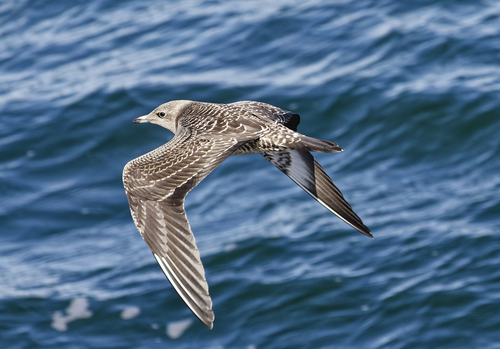
Northern Gannet, juvenile juvenile
Photo: tomkennedy · CC BY

Bird 5 of 6

Northern Gannet

Morus bassanus

How to recognise it

  • Dark brown with white speckles, and very large
  • Long, pointed wings and a long, wedge-shaped tail
  • Plunge-dives from a height of 30 metres, folding its wings

Where and when

UK, IE, NO, FR: common at colonies, from February to October. NL, BE, DE, DK, SE: scarce to fairly common offshore, with a peak in autumn. FI: rare. Young birds disperse south as far as West Africa.

Call At the colony, a loud, rhythmic “arrrah-arrrah”. Recording: David Darrell-Lambert · xeno-canto

A gannet takes five years to become white. Juveniles are brown and spangled, then pied, and eventually white with a yellow head.

Don’t confuse with: Great Skua (this week): a bull-necked, brown bird with a white wing flash, with no speckles.

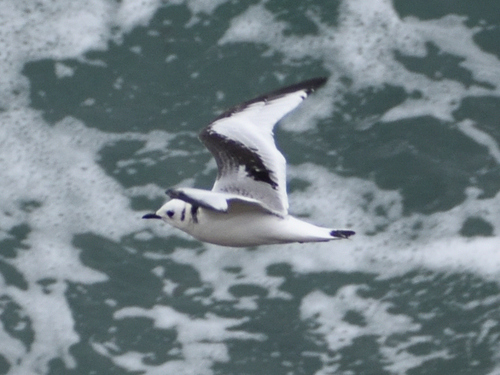
Black-legged Kittiwake, juvenile juvenile
Photo: bitsnbirds · CC BY

Bird 6 of 6

Black-legged Kittiwake

Rissa tridactyla

How to recognise it

  • A clear black W across the open wing, formed by dark outer primaries and the dark carpal bar
  • A black half-collar on the neck, and a black tip to the tail
  • A small, tern-like, buoyant flight, and a short black bill

Where and when

UK, IE, NO, DK, FR: common offshore, mainly from August to March. NL, BE, DE: fairly common. SE, FI: rare. In winter it is the commonest gull far offshore.

Call A high, nasal “kitti-waaake” and a whining begging call. Recording: Arjun Dutta · xeno-canto

A juvenile Kittiwake is a high-contrast black-and-white gull. It is one of the first birds you see from a seawatch.

Don’t confuse with: Little Gull (week 3): smaller, with a black W but a dark cap and a very dark underwing in adults.

Quiz

12 questions, with birds you have to repeat mixed in. Your answers decide when each bird comes back.

Out and about this week

Seawatch on a windy day in August to October. Watch a flock of gulls or terns: look for a dark bird that turns and chases one of them. Decide if it is heavy (Great Skua) or light (Arctic). Write down what you think and why.