Motmot

Advanced birding · Lesson 19 · 20 minutes

Seaduck, Shag and Cormorant

Eider, Common, Velvet and Surf Scoter, Long-tailed Duck, King Eider, Shag and Cormorant

Offshore ducks gather in rafts on the sea, and in winter they are a big part of every seawatch from the east coast of Britain to Denmark. Most are dark, far away and in poor light, so the group works with silhouettes: the size of the raft, the shape of the head, whether there is white on the head or wing.

The big numbers come from the Baltic and the Arctic: hundreds of thousands of Eiders and scoters winter in Danish and German waters, in the Wadden Sea and off the east coast of Scotland. Common Scoters pass in huge flocks in spring and autumn. A Velvet Scoter or a Surf Scoter is a matter of scanning a raft for one with a white head patch or wing patch.

In the same view you usually find a Cormorant or a Shag sitting on a post or a rock. They are not ducks but they belong to the same coastal list: the Shag is smaller, slimmer, and has a thinner neck and bill.

Today: 8 birds

Common Eider, adult male adult male
Photo: christoph_moning · CC BY

Bird 1 of 8

Common Eider

Somateria mollissima

How to recognise it

  • Large and heavy, in big rafts, with a white back and breast and a black belly and cap
  • A long, sloping profile, with a bill that continues in line with the forehead
  • A pale green nape patch, visible close up
raft A flock of ducks sitting together on the sea.

Where and when

UK (Scotland, north-east), IE, NO, SE, DK, FI: common at colonies and in winter. NL, DE: common in winter in the Wadden Sea. BE, FR: scarce. Breeds in the north from April.

Sound A soft, moaning, crooning “aah-oooh”, like someone shocked, from a raft. Recording: Thomas Bergman · xeno-canto

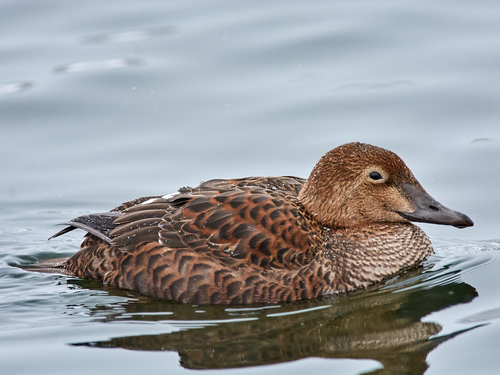
The big, chunky duck of the sea, often in lines or in rafts of hundreds. The females are brown and barred, and many in a raft are young or female.

Don’t confuse with: King Eider (this week): a more orange bill, a black back, and a rounded head.

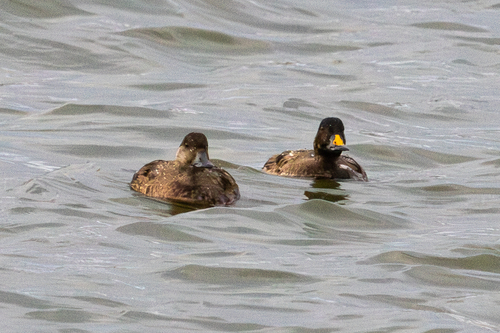
Common Scoter, adult male adult male
Photo: diegodgd · CC BY

Bird 2 of 8

Common Scoter

Melanitta nigra

How to recognise it

  • All black, with a bright yellow-orange bill knob
  • Smaller and neater than a Velvet Scoter, with no white at all
  • Flies in long lines low over the sea, and sits in huge rafts
bill knob A lump at the base of the bill. A male Common Scoter has a yellow-orange knob.

Where and when

UK, IE, NL, BE, DE, DK, FR: common offshore, with massive numbers in Liverpool Bay, Carmarthen Bay and Denmark, mostly in winter. NO, SE, FI: breeds in the north. Passes in spring and autumn.

Call A soft, piping whistle, a melancholic “cour-lou”, from rafts. Recording: Jarek Matusiak · xeno-canto

The ducks in a long dark line flying past are Common Scoters. A female has a pale cheek and a dark cap, and it is dark brown, not black.

Don’t confuse with: Velvet Scoter (this week): bigger, with a white **wing patch** and a white eye mark.

Velvet Scoter, adult male adult male
Photo: Fyodor Pudovikov · CC BY

Bird 3 of 8

Velvet Scoter

Melanitta fusca

How to recognise it

  • Bigger and heavier than a Common Scoter, with a thick bill
  • A white wing patch, visible on the water or in flight
  • A small white mark beneath the eye, and a bright, orange-red bill
wing patch A patch of white on the wing. A Velvet Scoter shows a white wing patch when it flaps, and a Common Scoter does not.

Where and when

UK, IE, NL, BE, DE, DK, FR, NO, SE, FI: scarce to uncommon in winter, mostly in the east, with big numbers in the Baltic. Often a single bird among Common Scoters.

Call A hoarse, low “rrrrr”, rarely heard except in spring. Recording: Patrik Åberg · xeno-canto

A scoter with a white wing. A single bird in a raft of Common Scoters is easy to find if you scan for white.

Don’t confuse with: Common Scoter (this week): all black, a yellow knob and no white. Surf Scoter: white patches on the head.

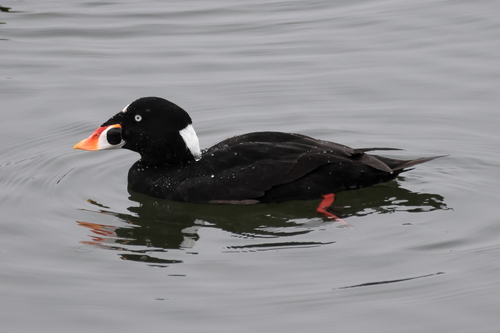
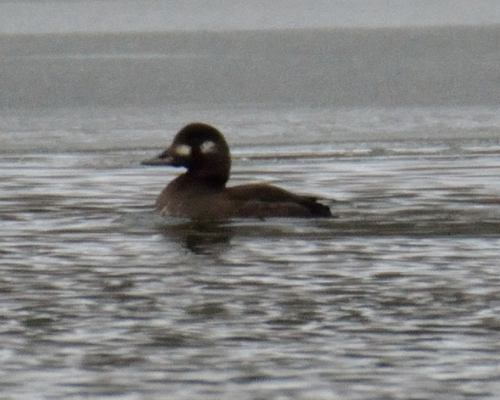
Surf Scoter, adult male adult male
Photo: Mary Fenwick · CC BY-NC

Bird 4 of 8

Surf Scoter

Melanitta perspicillata

How to recognise it

  • A black duck with white patches on the forehead and nape
  • A big, colourful bill, with white, orange and black
  • A heavy, wedge-shaped bill, which makes it look large-headed

Where and when

UK, IE: rare but regular, in winter and autumn. NL, BE, DE, DK, FR, NO, SE: very rare to rare. FI: very rare. A North American duck that overshoots in autumn.

Call Silent on its wintering grounds. Recording: Stanislas Wroza · xeno-canto

A scoter with a clown's face: white patches on the head and a multicoloured bill. One of the rarer ducks, found by scanning flocks of Common Scoters.

Don’t confuse with: Common Scoter (this week): all black with a yellow knob. Velvet Scoter: white wing patch.

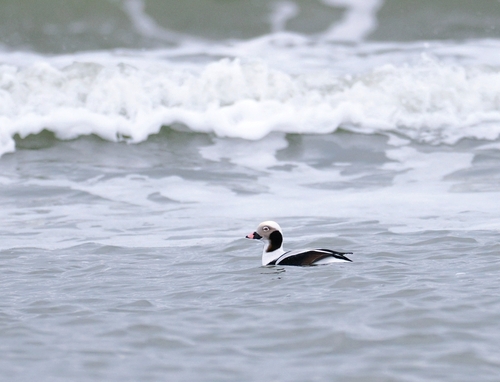
Long-tailed Duck, adult male adult male
Photo: caxora · CC BY-NC

Bird 5 of 8

Long-tailed Duck

Clangula hyemalis

How to recognise it

  • A very long, thin tail, and a pied, black-and-white pattern in winter
  • A pale head with a dark cheek patch, and a short, bicoloured bill
  • A buoyant, bobbing habit on the sea, and fast, whirring flight, with black wings

Where and when

DK, SE, FI, NO: common in winter in the Baltic and on the coast. UK: fairly common in winter in the north-east. DE, NL: uncommon. IE, BE, FR: rare. Breeds on the arctic tundra, from June.

Call A yodelling, musical “ow-ow-owdle-ow” from a raft, quite loud. Recording: Terje Kolaas · xeno-canto

The call is the best clue, and it carries over the waves. It is the noisiest duck on the sea in winter, and one of the most beautiful.

Don’t confuse with: Common Eider (this week): much bigger, with no long tail and a different shape.

King Eider, adult male adult male
Photo: sneckl · CC BY

Bird 6 of 8

King Eider

Somateria spectabilis

How to recognise it

  • A black back and white breast, with a rounded orange-red frontal shield
  • A pale blue head with a green cheek and a black, white and pink pattern
  • A shorter, rounder head than the Common Eider

Where and when

NO, SE, FI, UK (Scotland), IE, DK, NL, DE: very rare, with a few every year. FR, BE: almost never. It is an Arctic species that winters off Norway and sometimes joins a flock of Eiders.

Call A crooning “ah-oo”, deeper than the Common Eider. Recording: Stein Ø. Nilsen · xeno-canto

A rare bird in a flock of Common Eiders. Look for the black back, which stands out in profile, and the rounded head.

Don’t confuse with: Common Eider (this week): a white back, a long, sloping bill and a flat head.

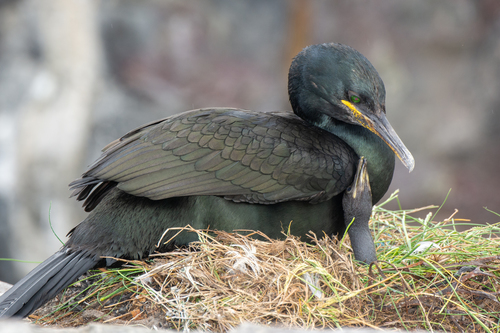
European Shag, adult adult
Photo: william_stephens · CC BY

Bird 7 of 8

European Shag

Gulosus aristotelis

How to recognise it

  • A slim, glossy dark green bird with a thin neck and a thin bill
  • A small curly crest in spring and a steep forehead
  • Often seen diving or perched on rocks, holding its wings out to dry
crest A tuft of feathers on the head. Shags grow a curly crest in spring.

Where and when

UK, IE, NO, FR, DK: common on rocky coasts all year, with breeding colonies on cliffs. SE: scarce. NL, BE, DE: scarce in winter. FI: almost never. A seabird, not a bird of rivers and lakes.

Call A hoarse, grunting “arrk” at the colony, and a hissing croak. Recording: Sean Morris · xeno-canto

It is the Cormorant's smaller, slimmer, sea-going cousin. It rarely goes inland and it does not have a white thigh patch.

Don’t confuse with: Great Cormorant (this week): bigger, a thick neck, a heavy bill with a yellow face patch.

Great Cormorant, adult adult
Photo: unknown

Bird 8 of 8

Great Cormorant

Phalacrocorax carbo

How to recognise it

  • Big, heavy and dark, with a thick neck and a stout, hooked bill
  • A yellow face patch and a white chin, and a white thigh patch in spring
  • Often seen standing with wings spread, on a post or a rock

Where and when

All ten countries. UK, IE, NL, BE, DE, DK, FR, NO, SE, FI: common to abundant on the coast, lakes and rivers, all year. Many from northern Europe winter along the coast.

Call A hoarse, guttural “gorrk” at the colony. Recording: Sonothèque ADVL · xeno-canto

A familiar bird, but the pale-faced adult and the first-winter, with its white belly, can look different from each other.

Don’t confuse with: European Shag (this week): smaller, with a thin neck and a thin, dark bill.

Quiz

12 questions, with birds you have to repeat mixed in. Your answers decide when each bird comes back.

Out and about this week

On a winter walk on a coast with a big bay, scan a raft of seaduck for a duck with a white patch on its wing or head. Look at the bill first: the one with a bright yellow knob is the Common Scoter.