Motmot

Advanced birding · Lesson 16 · 22 minutes

Seawatching: shearwaters and petrels

How to watch the sea from land, and the tubenoses that pass in autumn gales

Seawatching is birding without the bird being close. You sit on a headland, facing the sea, with a telescope, and birds pass you a kilometre out, low over the waves, for hours. You rarely see colours. You learn to read the bird by size, shape and the way it flies, which is the best training in jizz there is.

The best time is autumn, from late August to November, after a deep Atlantic low-pressure system has passed and the wind turns north-west. Birds that have been blown into the North Sea or the Irish Sea are pushed back past headlands. Go at dawn, dress for the wind, count everything, and write down the times. Good places: the south-west coast of the UK and IE, the east coast of England and Scotland, the Dutch and Danish North Sea coast, and Brittany.

Today's birds are the tubenoses: Fulmar, Manx, Balearic, Sooty, Great and Cory's Shearwater and the two storm petrels. Look at the flight first. Shearwaters shear: they glide low, tilting from side to side on stiff wings, and flap in short bursts. Petrels flutter.

Today: 8 birds

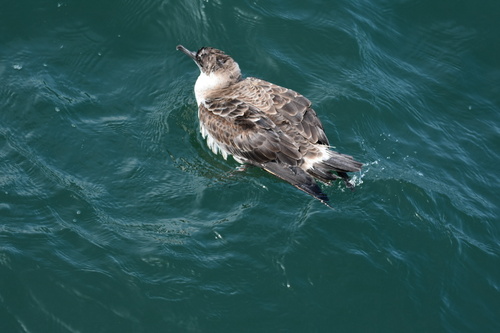
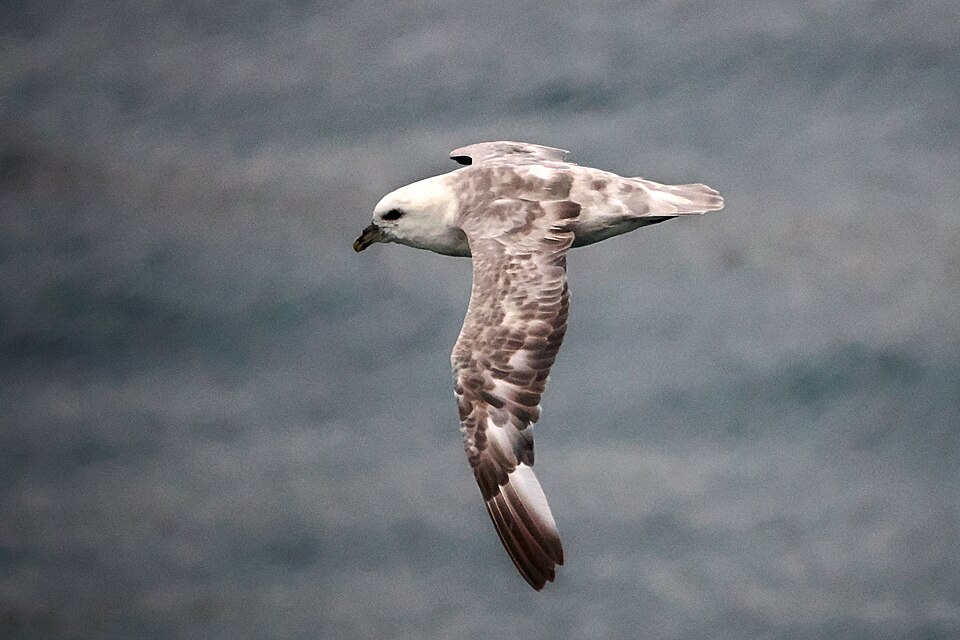
Northern Fulmar, adult adult
Photo: no rights reserved · CC0

Bird 1 of 8

Northern Fulmar

Fulmarus glacialis

How to recognise it

  • Gull-like, but with a thick neck and a short, tubular bill
  • Glides on stiff-winged, straight wings with few wingbeats
  • Pale grey above and white below; darker birds from the far north
stiff-winged Gliding on straight, stiff wings with few wingbeats, like a Fulmar.

Where and when

UK, IE, NO, DK: common at colonies on cliffs, all year (back at the cliffs in November). NL, BE, DE, FR, SE, FI: rare to scarce offshore, mainly in autumn. The bird that follows boats and eats fish offal.

Call At the colony a harsh, cackling “ag-ag-ag-aaar”, a hoarse chuckle. Recording: Meena Haribal · xeno-canto

It looks like a gull, but is not related to one: the stiff wings, thick neck and tubular nostrils give it away. It can spit stinking oil at intruders.

Don’t confuse with: Herring Gull (week 1): floppy wing-beats, a yellow bill and a black wing tip.

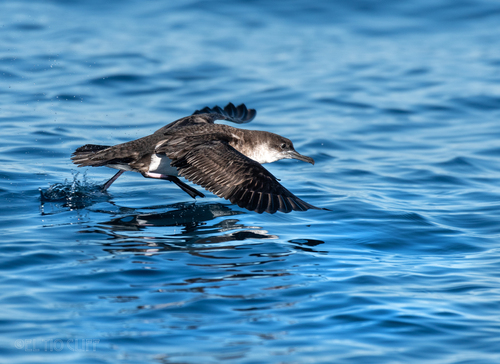
Manx Shearwater, adult adult
Photo: Gonzalo · CC BY-NC

Bird 2 of 8

Manx Shearwater

Puffinus puffinus

How to recognise it

  • Black above and white below, clear black-and-white in the way it tilts
  • Shearing low over the water, a few flaps and a long glide
  • Slim, long, narrow wings and a thin dark bill
shearing The way a shearwater glides low over the waves on stiff wings, tilting from side to side so that one wing tip nearly touches the water.

Where and when

UK, IE: common offshore from March to October, with breeding colonies on islands off Wales, Scotland and Ireland. FR: fairly common. NL, BE, DE, DK, NO, SE: scarce to rare, in autumn in North Sea gales. FI: almost never.

Call At the colony at night, a wild, crowing, cackling “kaah-kok-kok-aah”. Recording: Stanislas Wroza · xeno-canto

The commonest shearwater in the region. Flocks of thousands pass headlands in July and August. A big flock appears black, then white, as they tilt.

Don’t confuse with: Balearic Shearwater (this week): brown above, dirty white below, and a heavier flight.

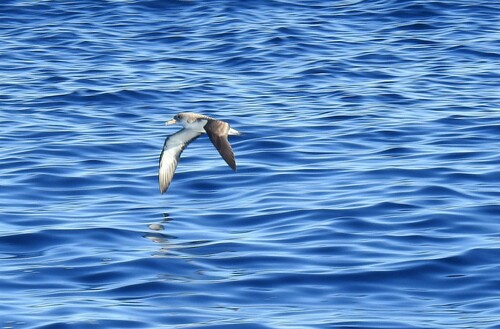
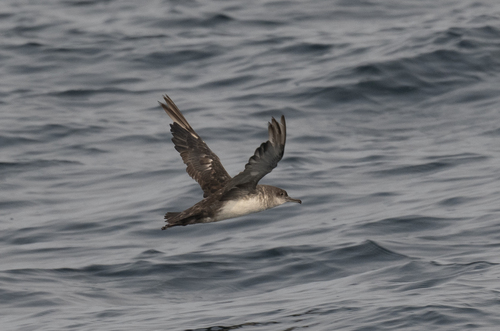
Balearic Shearwater, adult adult
Photo: littleitaly · CC BY-NC

Bird 3 of 8

Balearic Shearwater

Puffinus mauretanicus

How to recognise it

  • Dusky brown above and dirty-white below, with a brown underwing
  • Heavier and slower than a Manx Shearwater, with a more laboured flight
  • A bill that is a bit thicker, and no sharp contrast between back and belly

Where and when

UK: scarce, from July to October, mainly off the south-west and south coast. FR: fairly common in autumn in the Bay of Biscay and off Brittany. IE, NL, BE, DE, DK: rare. Critically endangered; breeds only in the Balearic Islands.

Call Rarely heard at sea; a hoarse, rolling cackle at the colony. Recording: Maties · xeno-canto

A critically endangered bird that moves north in late summer to feed off the western coasts of Europe, with a peak in August and September.

Don’t confuse with: Manx Shearwater (this week): black and white, narrower wings, and a quicker flap.

Manx or Balearic Shearwater?

Manx ShearwaterManx Shearwater
Balearic ShearwaterBalearic Shearwater

Contrast. A Manx is clean black and white, with a thin dark bill and a quick flap-and-glide. A Balearic is dusky brown above and dirty white below, with a dark underwing, heavier and slower. In poor light look at the underwing and at the speed of the wingbeats.

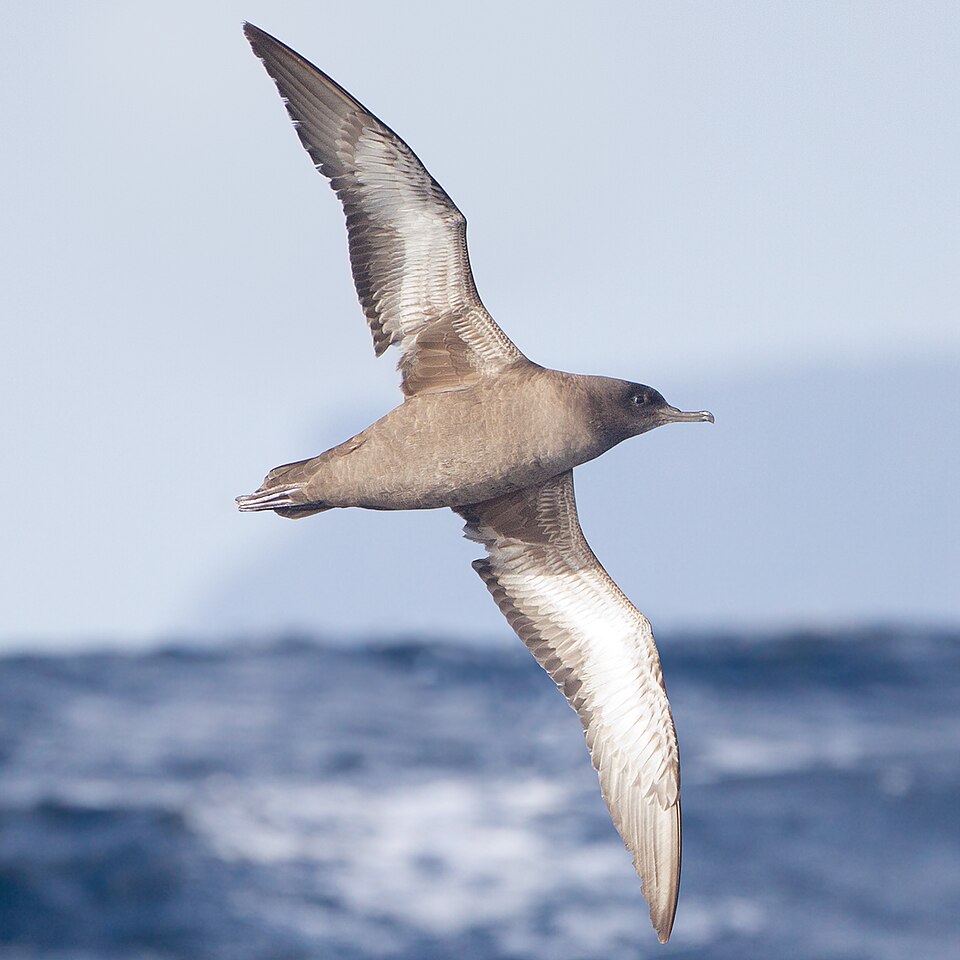
Sooty Shearwater, adult adult
Photo: JJ Harrison · CC BY-SA

Bird 4 of 8

Sooty Shearwater

Ardenna grisea

How to recognise it

  • Dark chocolate brown all over, with long, narrow wings
  • A silvery-white stripe down the centre of the underwing
  • A fast, powerful, direct flight, quite high above the waves
underwing The underside of the wing. Its colour (white, grey or dark) is a fast way to name a shearwater.

Where and when

UK, IE, NO, DK: scarce, on passage in August to October, with peaks in autumn gales. FR: scarce. NL, BE, DE, SE: rare. FI: almost never. It breeds in the southern hemisphere and spends the northern summer in the Atlantic.

Call Silent at sea; rarely recorded. Recording: Jenna Hoverd/David Boyle · xeno-canto

A bird that has made a figure-of-eight over the Atlantic, from New Zealand and Chile. The silver stripe under the wing is the best mark.

Don’t confuse with: Manx Shearwater (this week): smaller, with a white belly. Great Skua (week 17): a white flash on the wing, and heavier.

Great Shearwater, adult adult
Photo: Brandon Long · CC BY-NC

Bird 5 of 8

Great Shearwater

Ardenna gravis

How to recognise it

  • A dark cap, a white collar and a white band across the rump patch
  • Brown above, white below, with a dark patch on the belly
  • Large, with a long, straight-winged, effortless glide
rump patch A white patch on the lower back, just above the tail. Both storm petrels have one.

Where and when

UK, IE: rare, mostly off the south-west in August and September in strong gales. FR: rare. NL, BE, DE, DK, NO, SE: very rare. It breeds on Tristan da Cunha in the South Atlantic.

Call Silent at sea. Recording: Sven Normant · xeno-canto

Another visitor from the South Atlantic. If you see a dark-capped, white-collared shearwater, check the white rump band.

Don’t confuse with: Cory's Shearwater (this week): paler head, a yellow bill and a slower, floppier flight.

Cory's Shearwater, adult adult
Photo: imbeaul · CC BY

Bird 6 of 8

Cory's Shearwater

Calonectris borealis

How to recognise it

  • Large and heavy-winged, with a slow, floppy, almost gull-like glide
  • Brown above and whitish below, with a pale, yellowish bill
  • A pale, grey-brown head, with no dark cap, and white on the sides of the rump

Where and when

UK, IE: rare, with annual sightings off the south-west from July to October. FR: scarce, in the Bay of Biscay. NL, BE, DE, DK, NO, SE: very rare. It breeds on the Azores and Canaries.

Call Silent at sea; a loud, wailing “kee-aw” at the colony. Recording: Rubén Barone · xeno-canto

The big, heavy one. The wings are broad and the glide is slow and relaxed, like a large gull with a different bill.

Don’t confuse with: Great Shearwater (this week): a dark cap, a white collar and a rump band.

European Storm Petrel, adult adult
Photo: Steve Baines · CC BY-NC-SA

Bird 7 of 8

European Storm Petrel

Hydrobates pelagicus

How to recognise it

  • Tiny and dark, with a clean white rump patch
  • Flutters over the waves like a swallow, often pattering on the water
  • A white bar under the wing, and a square-ended tail
rump patch A white patch on the lower back, just above the tail. Both storm petrels have one.

Where and when

UK, IE, NO: common at island colonies at night from May to September. FR: fairly common offshore. NL, BE, DE, DK, SE: rare, in autumn gales. FI: almost never. Rarely seen from the land, except in gales.

Call At the colony at night, a purring trill that ends in a hiccup, “prrrr-chikka”. Recording: Tristan Guillebot de Nerville · xeno-canto

Tiny, black, with a white rump. It dances over the wave tops like a bat in daytime, and it is the smallest seabird in the north Atlantic.

Don’t confuse with: Leach's Storm Petrel (this week): bigger, a forked tail, a bounding flight and a rump patch divided by a thin line.

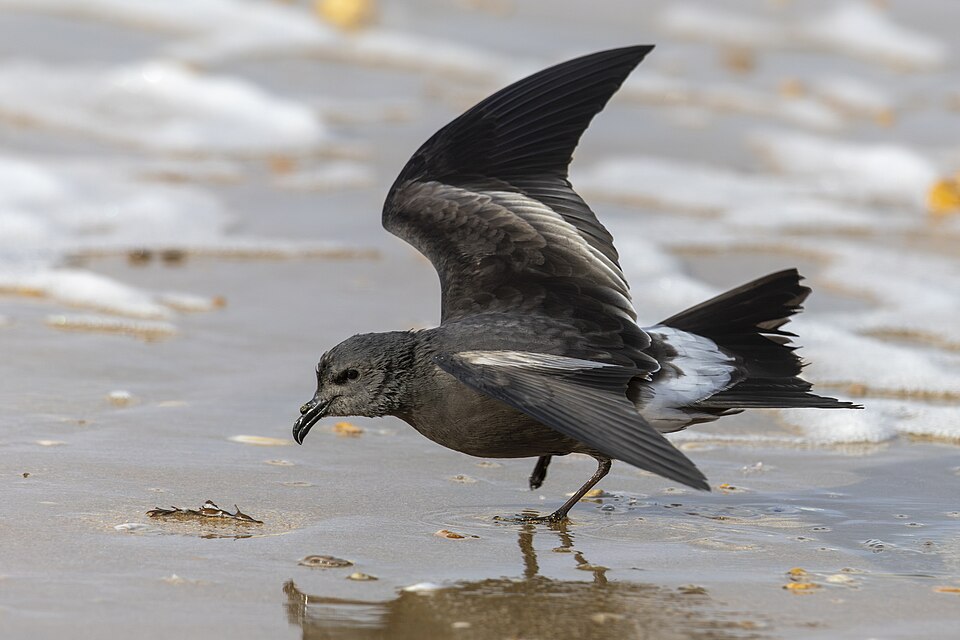
Leach's Storm Petrel, adult adult
Photo: Alexis Lours · CC BY

Bird 8 of 8

Leach's Storm Petrel

Hydrobates leucorhous

How to recognise it

  • Larger than a European Storm Petrel, with long, angled wings
  • A white rump patch divided by a thin dark line, and a forked tail
  • A buoyant, bounding, tern-like flight, quite different from a storm petrel's flutter
rump patch A white patch on the lower back, just above the tail. Both storm petrels have one.

Where and when

UK, IE, FR: rare in autumn gales (September to November), usually after westerlies, with big wrecks sometimes. NL, BE, DE, DK, NO, SE: rare. It breeds on remote islands (St Kilda, Faroes) and winters at sea.

Call At the colony at night, a purring chatter ending in a crooning “oo-ah”. Recording: Steph · xeno-canto

The seawatching bird of autumn gales. It can appear in inland places after a strong storm, exhausted.

Don’t confuse with: European Storm Petrel (this week): smaller, a square tail and a flutter.

Quiz

12 questions, with birds you have to repeat mixed in. Your answers decide when each bird comes back.

Out and about this week

Pick the next day with a strong north-west wind after a deep low, between August and November, and spend two hours at a headland or a sea wall. Count every bird and note the time. Do not worry about naming everything: write "small dark shearwater" and look it up later.