Motmot

Advanced birding · Lesson 13 · 22 minutes

Plovers, godwits and Whimbrel

Ringed, Little Ringed, Kentish, Grey and Golden Plover, both godwits and the Whimbrel

Plovers run, stop and look. Their eyes are big, their bills are short and they feed by sight. Godwits and curlews have long bills and probe the mud. Between them the group has some of the most confusing pairs in the field: Ringed and Little Ringed Plover, Grey and Golden Plover, Bar-tailed and Black-tailed Godwit, and Whimbrel and Curlew.

Season: Ringed Plovers are on the coast all year, with huge numbers of Arctic breeders passing in May and August. Little Ringed Plovers arrive in late March and breed on gravel pits. Golden Plovers come south in autumn to ploughed fields and stay until March, Grey Plovers do the same on the estuaries. Whimbrels pass in April and May and again in July to September.

Pairs and tools: for each pair we use one fast clue (leg colour for the ringed plovers, armpit colour for the big plovers, wing bar for the godwits) and one slow one (the voice).

Today: 8 birds

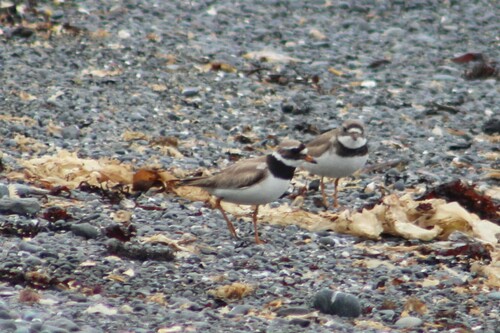
Common Ringed Plover, adult adult
Photo: bobbyblackmore · CC BY

Bird 1 of 8

Common Ringed Plover

Charadrius hiaticula

How to recognise it

  • A complete black breast band and a white collar, and a black mask
  • Orange legs and an orange bill with a black tip
  • A bold white wing bar in flight
wing bar A pale line along the folded or open wing. Ringed Plover has a bold white one; Little Ringed Plover has none.
breast band A dark band across the breast of a plover.

Where and when

All ten countries. UK, IE, NL, BE, DE, DK, FR: common on shingle and sandy shores all year. NO, SE, FI: breeds from May. Arctic breeders pass in May and August.

Call A soft, fluty “tu-li” or “too-li”, rising at the end. Recording: Simon Elliott · xeno-canto

The ringed plover of the beach. Its call, a soft double note, is quite different from the Little Ringed Plover's “pew”.

Don’t confuse with: Little Ringed Plover (this week): yellow legs, a thin dark bill, a yellow eye ring and no wing bar.

Little Ringed Plover, adult adult
Photo: timur_kalininsky · CC BY

Bird 2 of 8

Little Ringed Plover

Thinornis dubius

How to recognise it

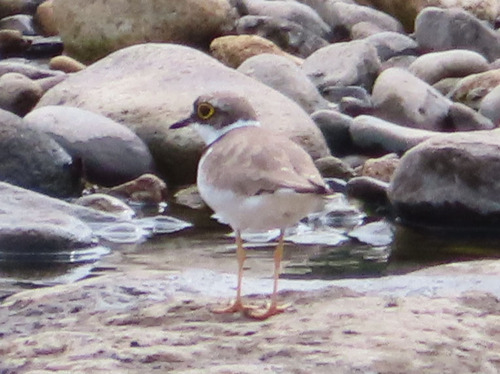
  • Yellow-pink legs, a thin dark bill and a bright yellow eye ring
  • No wing bar in flight, and a slim, small shape
  • A black band on the breast and a white band above the black forehead
eye ring A ring of bare skin around the eye. Bright yellow in Little Ringed Plover.
wing bar A pale line along the folded or open wing. Ringed Plover has a bold white one; Little Ringed Plover has none.

Where and when

UK, NL, BE, DE, DK, FR: fairly common on gravel pits and shingle banks, from late March to August. IE, NO, SE, FI: very rare. A bird of inland freshwater, not the coast.

Call A short, clear, falling “pee-oo”, less musical than the Ringed Plover. Recording: Regina Eidner · xeno-canto

It arrives in spring weeks before most summer migrants and breeds on gravel pits and shingle. The yellow eye ring is the first thing you see.

Don’t confuse with: Common Ringed Plover (this week): orange legs and bill, a wing bar and a rising call.

Ringed or Little Ringed Plover?

Common Ringed PloverCommon Ringed Plover
Little Ringed PloverLittle Ringed Plover

Look at the legs and eye ring first: Ringed has orange legs, Little Ringed yellow-pink. Little Ringed has a bright yellow eye ring, a thin dark bill and no white wing bar. In flight, the Ringed Plover shows a bold white stripe along the wing. The call is different too: a soft fluting double note for Ringed, a sharp, falling “pew” for Little Ringed.

Kentish Plover, adult adult
Photo: diegodgd · CC BY

Bird 3 of 8

Kentish Plover

Anarhynchus alexandrinus

How to recognise it

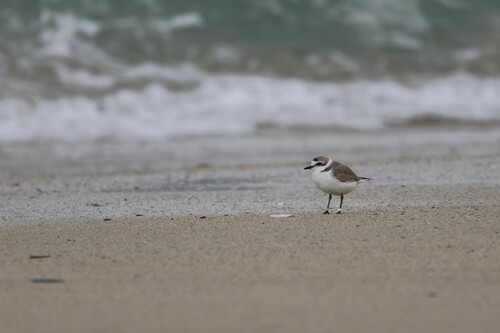
  • Pale sandy above and white below, with a thin black bill and dark legs
  • Dark patches on the sides of the breast, not a full breast band
  • Male: a rusty cap and a thin black eye line
breast band A dark band across the breast of a plover.

Where and when

FR: uncommon breeder on the Atlantic and Mediterranean coasts. DE, NL, BE, DK, UK: rare to very rare overshoots, mostly in spring. IE, NO, SE, FI: almost never. A species of sandy and salty places, once a British breeder.

Call A short, soft “wit” and a hard, rapid “prrrp”. Recording: Jack Berteau · xeno-canto

A pale, small plover with a small head. Incomplete breast patches and dark legs are the marks.

Don’t confuse with: Common Ringed Plover (this week): orange legs, a complete breast band and a black-tipped orange bill.

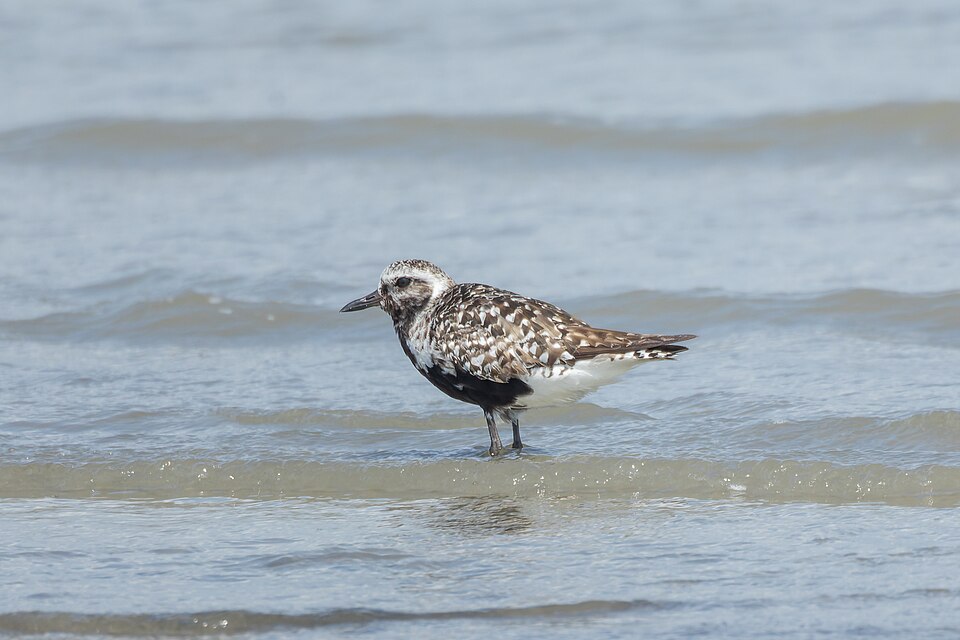
Grey Plover, adult, non-breeding adult, non-breeding
Photo: Tisha Mukherjee · CC BY-SA

Bird 4 of 8

Grey Plover

Pluvialis squatarola

How to recognise it

  • Silver-grey, spangled, with a black eye in a pale face
  • Black axillaries in flight, plus a white rump and a wing bar
  • A heavy black bill and a hunched posture
axillaries The "armpit" feathers under the wing. Black in Grey Plover, white in Golden Plover.

Where and when

UK, IE, NL, BE, DE, DK, FR: fairly common on estuaries, from August to May. NO, SE, FI: passage. It breeds in the Arctic tundra, and in summer is black below with a silvery back.

Call A plaintive, three-note “tlee-oo-ee”, melancholic and clear. Recording: Irish Wildlife Sounds · xeno-canto

The black armpits are the thing: the biggest difference to the Golden Plover, which has white ones. It is a coastal bird, rarely seen on fields.

Don’t confuse with: European Golden Plover (this week): golden spangles and white armpits, and a smaller, rounder head.

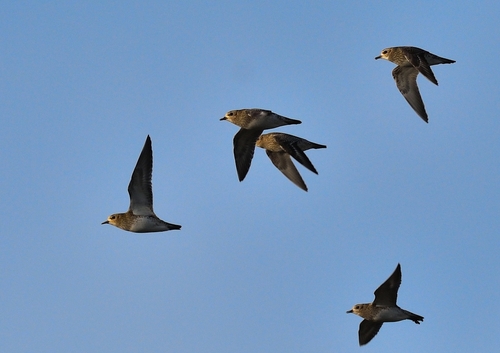
European Golden Plover, adult, non-breeding adult, non-breeding
Photo: Luca Sattin · CC BY-NC

Bird 5 of 8

European Golden Plover

Pluvialis apricaria

How to recognise it

  • Gold-spangled brown above and a pale, buff-yellow breast
  • White axillaries and a plain white underwing
  • A small, round head and a short bill
axillaries The "armpit" feathers under the wing. Black in Grey Plover, white in Golden Plover.

Where and when

UK, IE, NL, BE, DE, DK, FR: fairly common on fields and moors from October to March. NO, SE, FI: breeds on moors from May. A bird of open ground, not the shore.

Call A clear, mournful “tlu-ee”, one or two notes, from a flock in flight. Recording: Simon Elliott · xeno-canto

A flock of Golden Plovers on a ploughed field is a good sight, often with Lapwings. The white armpits are the best way to separate it from a Grey Plover.

Don’t confuse with: Grey Plover (this week): black armpits, and a heavier, shorter, greyer look.

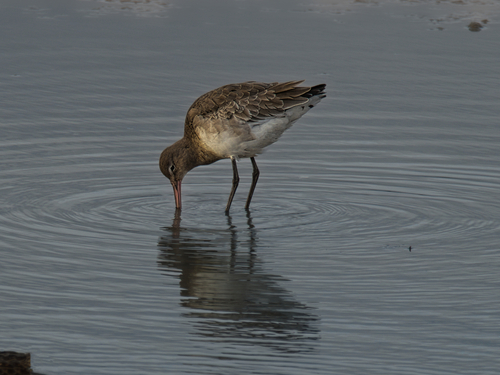
Black-tailed Godwit, adult adult
Photo: angus_w · CC BY-NC

Bird 6 of 8

Black-tailed Godwit

Limosa limosa

How to recognise it

  • A long, straight bill and long legs, a tall, upright bird
  • A black tail band and a broad white wing bar in flight
  • In summer: orange-chestnut neck and breast; in winter: plain grey
wing bar A pale line along the folded or open wing. Ringed Plover has a bold white one; Little Ringed Plover has none.

Where and when

NL: common breeder in wet meadows. IE, UK: common on estuaries in winter, with Icelandic birds. BE, DE, DK, FR: fairly common on passage. NO, SE, FI: uncommon breeders. It arrives in March in NL.

Call A ringing “wicka-wicka-wicka” in the display flight, and a short “weet” in flocks. Recording: Romuald Mikusek · xeno-canto

The wet meadow bird of the Netherlands. Its bold white wing bar sets it apart from every other wader in flight.

Don’t confuse with: Bar-tailed Godwit (this week): shorter legs, a slightly upturned bill, and no wing bar.

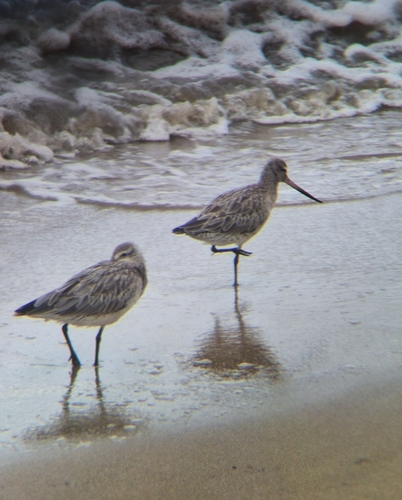
Bar-tailed Godwit, adult, non-breeding adult, non-breeding
Photo: Sam · CC BY-NC

Bird 7 of 8

Bar-tailed Godwit

Limosa lapponica

How to recognise it

  • A long, slightly upturned bill with a pinkish base
  • Shorter legs and a barred tail, with no wing bar
  • Streaked grey-brown above and pale buff below
wing bar A pale line along the folded or open wing. Ringed Plover has a bold white one; Little Ringed Plover has none.

Where and when

UK, IE, NL, BE, DE, DK, FR: fairly common on estuaries and sandy shores, August to May, with huge numbers in the Wadden Sea. NO, SE, FI: passage. A bird from Siberia and Lapland.

Call A hard, yapping “kirruc” and a short “wik-wik”. Recording: Martin Sutherland · xeno-canto

The estuary godwit, as the Black-tailed is the meadow one. The shorter legs and the uptilted bill make it look compact.

Don’t confuse with: Black-tailed Godwit (this week): taller, longer-legged, and a bold white wing bar.

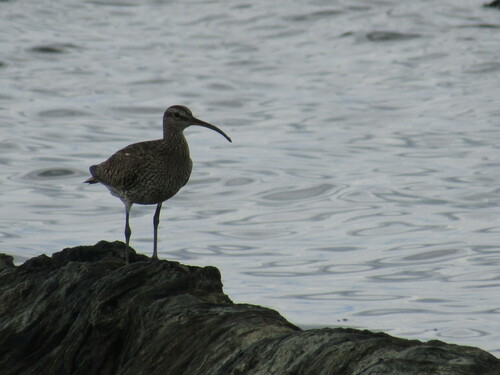
Eurasian Whimbrel, adult adult
Photo: stevem4560 · CC BY

Bird 8 of 8

Eurasian Whimbrel

Numenius phaeopus

How to recognise it

  • Smaller than a Curlew, with a bill that bends sharply near the tip
  • Dark crown with a pale central stripe and a pale eyebrow
  • A rippling, trilling whistle of seven notes

Where and when

UK, IE, NL, BE, DE, DK, FR: scarce on passage in April to May and July to September. NO, SE, FI: breeds on moors and bogs from May, and is common there. A few remain in winter in IE and the south-west UK.

Call A rapid, rippling series of seven notes, “pi-pi-pi-pi-pi-pi-pi”. Recording: guus van duin · xeno-canto

The call is the best clue: seven even whistles, quite different from the sad, bubbling “cur-lee” of a Curlew.

Don’t confuse with: Eurasian Curlew (beginners): bigger, a longer, smoothly curved bill, and a plain head.

Quiz

12 questions, with birds you have to repeat mixed in. Your answers decide when each bird comes back.

Out and about this week

Visit a beach or shingle bank in May or an estuary in winter and compare as many plovers as you can. Learn the three calls: Ringed (“too-li”), Grey (“tlee-oo-ee”) and Golden (“tlu”). If you can, find a flock of Golden Plovers on a field and look for the white armpits.