Redshank, Spotted Redshank, Greenshank, Green, Wood and Common Sandpiper, and Turnstone
The medium waders are the ones most often confused in flight. The key is the rump and the wing: a white rump patch, a white trailing edge, a white wedge up the back. All seven birds in this lesson show a different pattern when they fly up, and a different call.
Season: adults of most of these leave their northern breeding grounds as early as late June, so July and August are good months, and the juveniles follow in September. Common Sandpipers breed along rivers in the north and west and return in April and again in the autumn. Spotted Redshanks pass in spring in their black summer plumage, and in autumn they are pale grey.
Look and listen: the calls of these waders are some of the easiest to learn, and they work better than the plumages. Try to say the call out loud when you hear it.
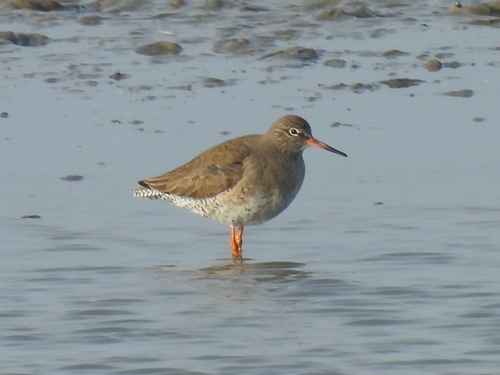
Orange-red legs and an orange-red base to the bill
A broad white trailing edge to the wing in flight
A loud, yelping alarm: “tu-hu-hu”, the sentry of the marsh
trailing edge The back edge of the wing. A broad white one shows in flight in the Redshank.
Where and when
UK, IE, NL, BE, DE, DK, FR: common on estuaries and wet meadows. NO, SE, FI: breeds in the south, May to July. Winters on the coast. It is the first wader to give the alarm when anything disturbs the marsh.
Call A loud, ringing “tyu-hu-hu”, and a yodelling song in the display flight.
Recording: Irish Wildlife Sounds · xeno-canto
The bird everyone else listens to. The white trailing edge and the red legs are enough, and you hear it long before you see it.
Don’t confuse with: Spotted Redshank (this week): a longer bill, a long white eyebrow, no white trailing edge and a very different call.
adult, non-breeding
Photo: Savi.odl · CC BY-SA
Bird 2 of 7
Spotted Redshank
Tringa erythropus
How to recognise it
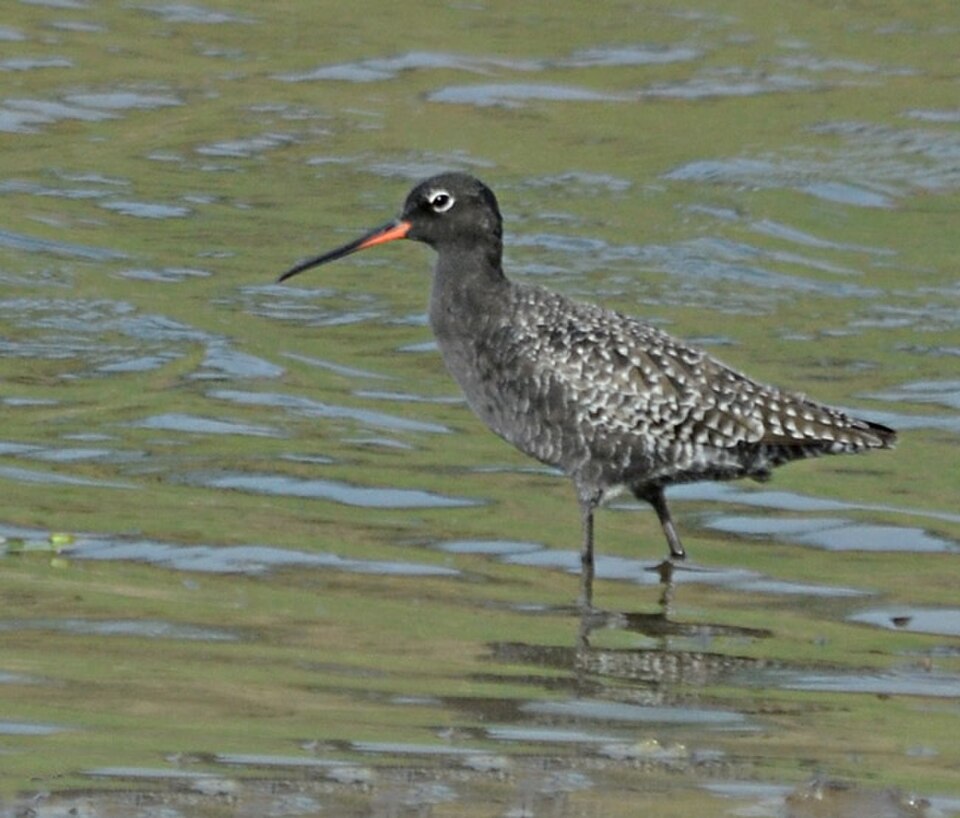
Pale grey above and white below, with a long white supercilium
A long, thin bill with a red base, and long red legs
A white rump patch, and no white trailing edge to the wing
supercilium The pale stripe above the eye. Long in Wood Sandpiper and Spotted Redshank.
Where and when
UK, NL, BE, DE, DK, FR: scarce on passage, in autumn (July to October) and spring, when adults are black. NO, SE, FI: breeds in the north from May. IE: rare. A few overwinter on the south coast.
Call A clear, ringing “chu-it!”, quite unlike a Redshank.
Recording: Stanislas Wroza · xeno-canto
A tall, elegant wader that likes to swim and upend like a duck. In winter it is a ghostly pale grey; in May it is jet black with white spots.
Don’t confuse with: Common Redshank (this week): brown, with orange-red legs, a thick bill, a white trailing edge and a yelping call.
adult
Photo: lava_chen · CC BY-NC
Bird 3 of 7
Common Greenshank
Tringa nebularia
How to recognise it
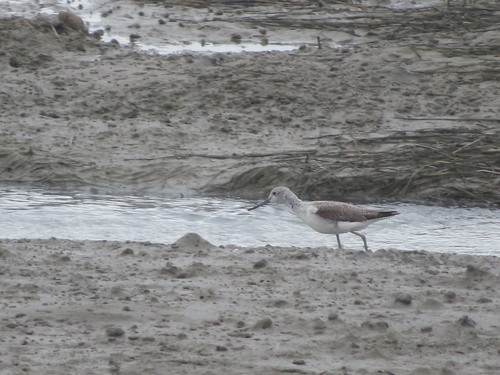
Long, greenish legs and a thick, slightly upturned bill
Pale grey above and white below, and a white wedge up the back in flight
A loud, ringing three-note flight call: “tew-tew-tew”
flight call The call a bird gives when it takes off or flies over. For many waders this is the best way to identify them.
Where and when
UK, NL, BE, DE, DK, FR, IE: uncommon on passage from July to October and in April and May. NO, SE, FI: breeds on bogs and in forests from May. A few stay for the winter in the UK, IE and FR.
Call A loud, ringing, rapid “tew-tew-tew”, always three notes, and carries a long way.
Recording: W. Agster · xeno-canto
A tall, pale wader. The three-note call is the easiest way to know it and you hear it before you see the bird.
Don’t confuse with: Spotted Redshank (this week): a slender red-based bill and red legs. Common Redshank: shorter, brown, orange-red legs.
adult
Photo: Gabriele Vaudano · CC BY
Bird 4 of 7
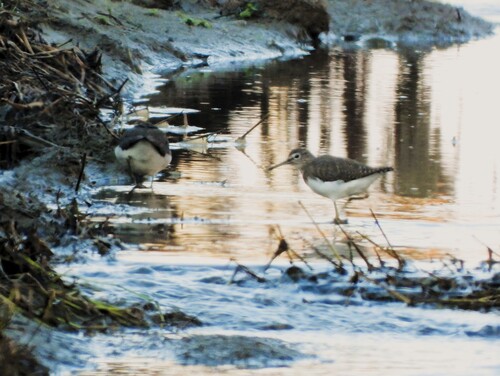
Green Sandpiper
Tringa ochropus
How to recognise it
Dark, almost black above with fine white speckles, white below
A bold white rump and black underwings in flight
Bobs its tail, and flies up from a ditch with a ringing call
rump The lower back, just above the tail. White in Green and Wood Sandpipers, and in Greenshank a white wedge runs up the back.
Where and when
UK, NL, BE, DE, DK, FR: uncommon passage migrant, from July to October, with a few that winter in the UK, IE, NL and FR. NO, SE, FI: breeds in forest bogs, in May to August, nesting in old thrush nests in trees.
Call A ringing, rising “tluit-weet-weet” as it flies off.
Recording: Xavier Riera · xeno-canto
The bird you flush from a ditch, with a ringing call and a flash of white rump on a black bird. It nests in old thrush nests, not on the ground.
Don’t confuse with: Wood Sandpiper (this week): paler and browner, with a long pale eyebrow and a paler underwing.
adult
Photo: shajanshaki · CC BY-NC
Bird 5 of 7
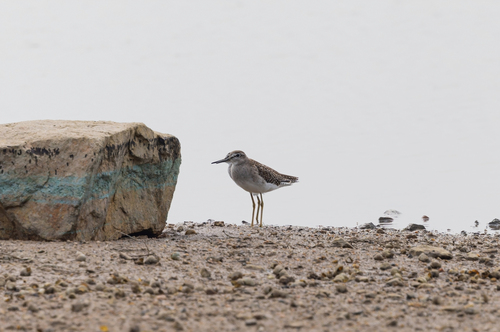
Wood Sandpiper
Tringa glareola
How to recognise it
Paler and browner than a Green Sandpiper, with golden spots on the back
A long, pale supercilium that extends behind the eye, and yellowish legs
A white rump and a pale underwing, with a high “chiff-iff-iff” flight call
rump The lower back, just above the tail. White in Green and Wood Sandpipers, and in Greenshank a white wedge runs up the back.
supercilium The pale stripe above the eye. Long in Wood Sandpiper and Spotted Redshank.
flight call The call a bird gives when it takes off or flies over. For many waders this is the best way to identify them.
Where and when
UK, NL, BE, DE, DK, FR: scarce on passage from July to September, and in May. NO, SE, FI: breeds on bogs and marshes from May. IE: rare. In autumn, on pools, with a few at a time.
Call A high, rapid, rather sharp “chiff-iff-iff”, always three notes.
Recording: AUDEVARD Aurélien · xeno-canto
A very pretty, slim, elegant wader. The long white eyebrow and the pale underwing say it is not a Green Sandpiper.
Don’t confuse with: Green Sandpiper (this week): darker, with black underwings. Common Sandpiper: shorter-legged, bobbing.
Green or Wood Sandpiper?
Green Sandpiper
Wood Sandpiper
Green Sandpiper: dark, almost black above with fine speckles, black underwing, short supercilium, and a loud, ringing call. Wood Sandpiper: paler brown, golden spots, a long supercilium behind the eye, a pale underwing, longer, yellowish legs and a high, rapid, three-note call.
adult
Photo: johnallcock · CC BY-NC
Bird 6 of 7
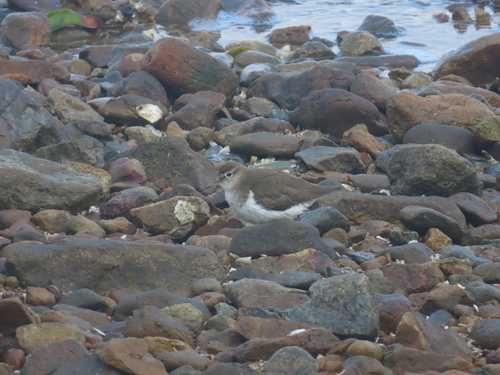
Common Sandpiper
Actitis hypoleucos
How to recognise it
Brown above and white below, with a white wedge in front of the folded wing
Short legs, and a constant bobbing of the tail and rear
Flies low over water on stiff, flickering wings, with a high, thin call
Where and when
UK, IE, NO, SE, FI: common on rivers and lake shores, April to August. NL, BE, DE, DK, FR: passage migrant, April to May and July to September. A few overwinter in the south of the UK, IE and FR.
Call A high, thin, piping “tswee-wee-wee”, repeated.
Recording: Peter Boesman · xeno-canto
A bobbing wader of rivers and reservoir edges. The flight is distinctive: low over the water, with shallow, flickering wingbeats and a white wing bar.
Don’t confuse with: Green Sandpiper (this week): darker, with a white rump and black underwings.
adult, non-breeding
Photo: Peter Wallack · CC BY-SA
Bird 7 of 7
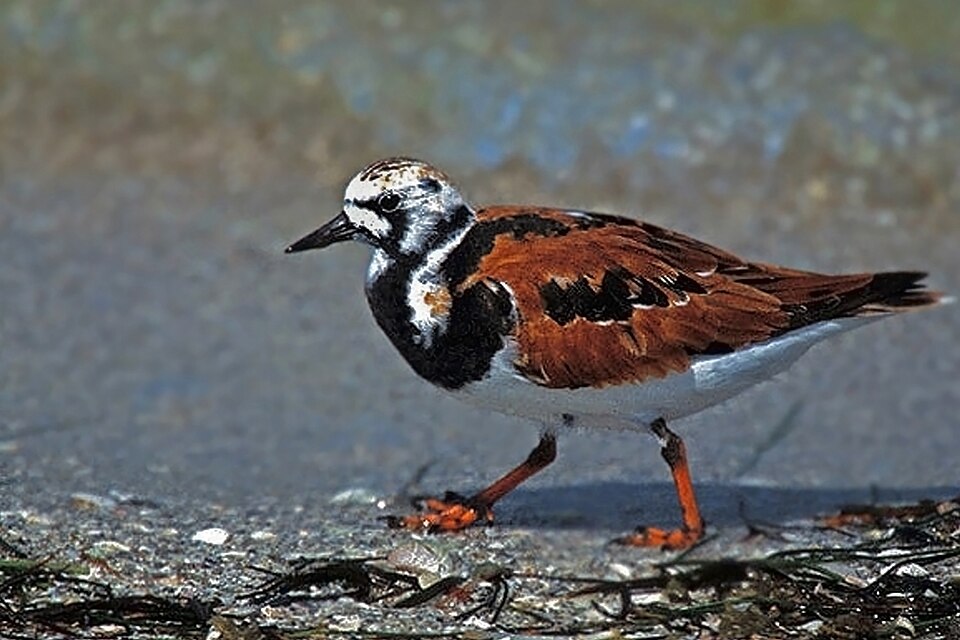
Ruddy Turnstone
Arenaria interpres
How to recognise it
Short, bright orange legs and a short, stout, wedge-shaped bill
Dark brown upper breast, like a bib, and a white belly
In flight a bold pattern of black and white, with white on the back and tail
Where and when
UK, IE, NL, BE, DE, DK, FR: fairly common on rocky and stony shores, from July to May. NO, SE, FI: breeds on coasts and islands, from late May. A bird that flips pebbles and seaweed for food.
Call A hard, rattling “tuk-a-tuk” and a clear “kyu”.
Recording: Krzysztof Deoniziak · xeno-canto
It turns stones. In winter it is a dark, chunky wader of rocky shores and harbours. In May it is a harlequin, with a chestnut back and a black-and-white head.
Don’t confuse with: Purple Sandpiper (week 14): dusky, with a drooping bill, and orange at the base only.
Quiz
12 questions, with birds you have to repeat mixed in. Your answers decide when each bird comes back.
Out and about this week
In July or August, look for a Green Sandpiper at a muddy ditch or sewage pond. Practise the calls on a recording: Redshank, Greenshank, Green, Wood and Common Sandpiper are all different and very distinct.