Motmot

Advanced birding · Lesson 14 · 22 minutes

Phalaropes, Ruff, Knot and snipe

Red-necked and Grey Phalarope, Ruff, Knot, Purple Sandpiper, both snipes and the Avocet

The odd ones out. Phalaropes swim, snipes skulk, a Purple Sandpiper sits on a rock in the surf. Each of the eight birds in this lesson is a specialist, so each has a trick or a habit that gives it away.

Red-necked Phalarope breeds on a few pools in the north of the UK, Ireland and Scandinavia, and passes in autumn on its way to the Arabian Sea. The Grey Phalarope is a seabird that you meet on land only after autumn gales. Ruff pass in huge numbers in spring and autumn, with the juveniles being the most distinctive. Knots gather in tens of thousands on a few estuaries in winter, and Purple Sandpipers keep to rocky coasts from October to April.

Snipes and the Avocet finish the lesson. A Jack Snipe is a small, secretive winter bird that sits tight until you almost step on it.

Today: 8 birds

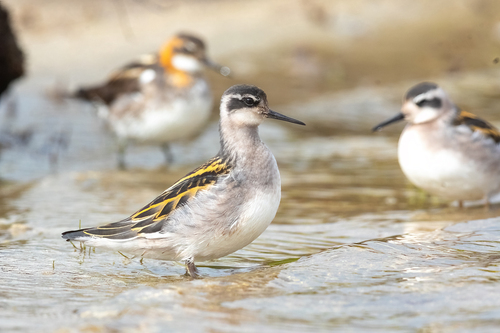
Red-necked Phalarope, juvenile juvenile
Photo: egorbirder · CC BY

Bird 1 of 8

Red-necked Phalarope

Phalaropus lobatus

How to recognise it

  • Swims by spinning in tight circles on lobed toes, like a tiny duck
  • Dark brown back with golden-buff lines, a black eye-patch and a white belly
  • A needle-fine black bill and a calm, tame manner
lobed toes Toes with a flap of skin on each side, like a paddle. Phalaropes have them and swim.
spinning The way a phalarope swims in tight circles to stir up food.

Where and when

UK, IE, NO, SE, FI: scarce breeders in the north and west, from late May to August. Passage in August and September: NL, BE, DE, DK, FR rare. Very rare in autumn on reservoirs after gales.

Call A short, hard “twit” or “krit”, low and often repeated. Recording: Tomek Tumiel · xeno-canto

A phalarope is a small wader that swims. In breeding plumage the female is brighter than the male, and it is the male that incubates.

Don’t confuse with: Grey Phalarope (this week): paler, a stouter bill and a plain grey back in winter.

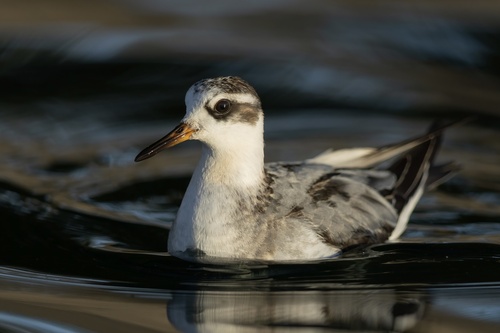
Grey Phalarope, adult, non-breeding adult, non-breeding
Photo: mattyfelp · CC BY

Bird 2 of 8

Grey Phalarope

Phalaropus fulicarius

How to recognise it

  • Pale grey back, white underparts and a black patch through the eye
  • A short, stout bill, with a yellowish base, and a dark crown
  • Sits on the sea and the water surface, tame and spinning, on lobed toes
lobed toes Toes with a flap of skin on each side, like a paddle. Phalaropes have them and swim.

Where and when

UK, IE, FR: scarce, in September to November, mostly after Atlantic gales on the west coast. NL, BE, DE, DK: rare, in autumn. NO, SE, FI: rare. It breeds in the High Arctic and spends the winter at sea.

Call A short, sharp “twit”, a bit like a Sanderling. Recording: Paul Coiffard · xeno-canto

A true seabird that is blown ashore in storms. In winter plumage it looks like a tiny, pale gull sitting on the water.

Don’t confuse with: Red-necked Phalarope (this week): a thinner bill, a darker back and a darker look.

Ruff, juvenile juvenile
Photo: unknown

Bird 3 of 8

Ruff

Calidris pugnax

How to recognise it

  • A scaly buff back, with pale feather edges, and a buff breast
  • A small head, a long neck and a slightly drooping short bill
  • White ovals on each side of the tail in flight, and orange-buff legs
scaly With pale edges to each feather on the back, giving a scale-like pattern. Typical of juveniles.

Where and when

UK, NL, BE, DE, DK, FR: fairly common to scarce on passage in autumn, juveniles from late July to September. Passage in spring, March to May. NO, SE, FI: breeds on marshes. IE: uncommon. A few overwinter in the UK, NL and FR.

Call Normally silent. A low “tu-wit” when flushed. Recording: Tomek Tumiel · xeno-canto

The juvenile has a buff scaly back and long legs, quite unlike the male in spring, with a ruff of feathers that can be orange, black or white.

Don’t confuse with: Pectoral Sandpiper (week 11): a streaked breast with a sharp edge, and yellow legs. Common Redshank (week 12): red legs.

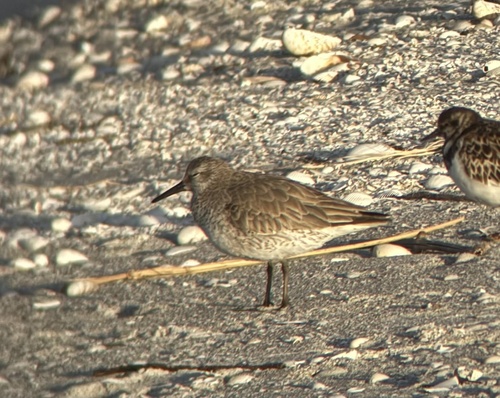
Red Knot, adult, non-breeding adult, non-breeding
Photo: Mark Edlund · CC BY-NC

Bird 4 of 8

Red Knot

Calidris canutus

How to recognise it

  • Stocky and plain pale grey, with a short, straight, dark bill
  • Short, greenish legs, and a pale, barred rump in flight
  • In flocks of thousands that turn in unison, showing grey, then white

Where and when

UK, NL, DE, DK, FR, IE, BE: abundant on a few big estuaries and the Wadden Sea, from August to April. NO, SE, FI: passage. Numbers: the Wash and the Wadden Sea each hold over 100,000.

Call A low, soft, nasal “knut”, a rough, growling sound in a flock. Recording: Irish Wildlife Sounds · xeno-canto

A bird of enormous flocks. Individually it is a plain, round grey wader, far less interesting than its group behaviour.

Don’t confuse with: Dunlin (week 11): smaller, with a drooping bill and a darker look. Bar-tailed Godwit (week 13): a long bill.

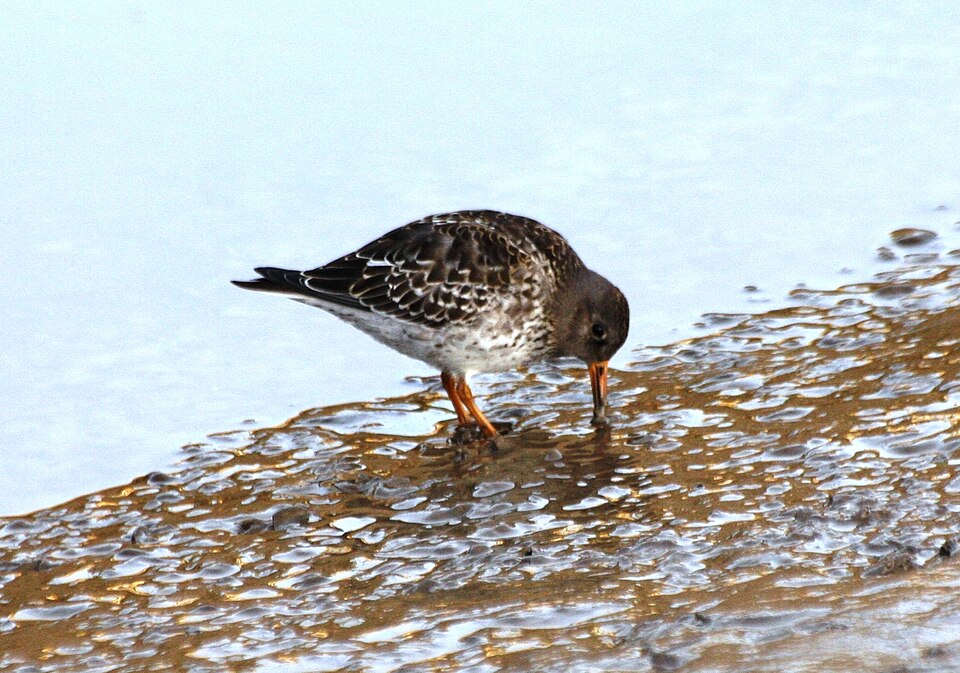
Purple Sandpiper, adult, non-breeding adult, non-breeding
Photo: Bjoertvedt · CC BY-SA

Bird 5 of 8

Purple Sandpiper

Calidris maritima

How to recognise it

  • Dark slate-grey, with a dull purple gloss in good light
  • Orange-yellow legs and an orange base to a slightly drooping bill
  • On rocks and breakwaters, close to the waves, often very tame

Where and when

UK, IE, NO, DK, SE: uncommon on rocky shores, October to April. NL, BE, DE, FR: scarce, on breakwaters and groynes. FI: rare. It breeds in the Arctic and on Fennoscandian mountains.

Call A short, quiet “weet” or “twit”, higher than a Turnstone. Recording: Stanislas Wroza · xeno-canto

The wader that walks into the surf and runs back. It is easily overlooked on dark rocks, until a wave makes it fly.

Don’t confuse with: Ruddy Turnstone (week 12): shorter legs, a brighter orange, a white belly, and a wedge-shaped bill.

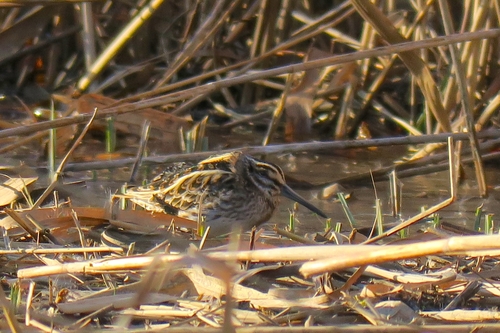
Jack Snipe, adult adult
Photo: Victor B · CC BY-NC

Bird 6 of 8

Jack Snipe

Lymnocryptes minimus

How to recognise it

  • Small, with a short bill and a dark crown with no pale crown stripe
  • Two pale golden stripes down the back, and a bobbing, bouncing feeding action
  • Sits tight until almost trodden on, then flies off silently and drops
crown stripe A pale line along the middle of the crown. A Common Snipe has one; a Jack Snipe does not.

Where and when

UK, IE, NL, BE, DE, DK, FR: uncommon winter visitors, October to March, in wet marshes. NO, SE, FI: breeds in northern bogs, from May. It sits so still that it is easily missed.

Call Usually silent in winter; a low, weak “gah” when flushed. On the breeding grounds, a galloping, hollow “kloppa-kloppa”. Recording: Jarek Matusiak · xeno-canto

A tiny, secretive, bobbing snipe. Look for the dark crown, the short bill and the lack of a stripe on the crown.

Don’t confuse with: Common Snipe (this week): a longer bill, a pale crown stripe, and a loud call when flushed.

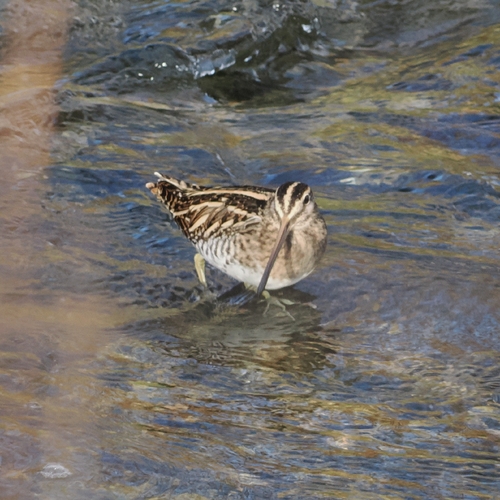
Common Snipe, adult adult
Photo: Alexander Pohle · CC BY

Bird 7 of 8

Common Snipe

Gallinago gallinago

How to recognise it

  • A very long, straight bill and a striped head with a pale crown stripe
  • Striped, camouflaged back, and a quick zig-zag flight
  • A harsh “scaap” when flushed
crown stripe A pale line along the middle of the crown. A Common Snipe has one; a Jack Snipe does not.

Where and when

UK, IE, NL, BE, DE, DK, FR, SE, FI, NO: fairly common in wet meadows, bogs and marshes, all year, with passage birds in spring and autumn. Its display flight produces a drumming noise.

Call A harsh, rasping “scaap” when it flies up, and a loud “chip-per, chip-per” in display. Recording: Simon Elliott · xeno-canto

In spring the male flies in circles and dives, with the tail feathers producing a drumming or bleating sound.

Don’t confuse with: Jack Snipe (this week): small, short bill, no crown stripe, and silent.

Jack Snipe or Common Snipe?

Jack SnipeJack Snipe
Common SnipeCommon Snipe

Jack Snipe is smaller, with a short bill and a dark crown with no pale stripe down the middle. It bobs as it feeds, sits very tight, and flies off without a call. Common Snipe is bigger, with a long bill, a clear pale crown stripe, and a loud 'scaap' when flushed.

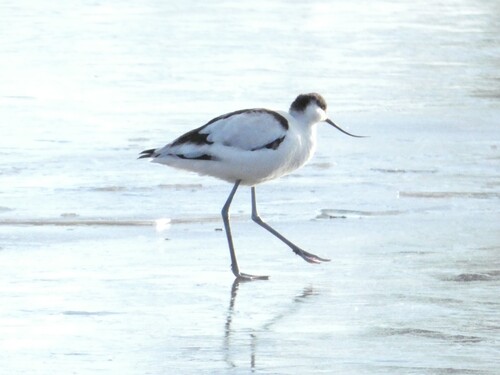
Pied Avocet, adult adult
Photo: tcoldwell · CC BY-NC

Bird 8 of 8

Pied Avocet

Recurvirostra avosetta

How to recognise it

  • Black and white, with a slender, upturned bill
  • Long blue-grey legs and an elegant, slender shape
  • Sweeps the bill from side to side through shallow water

Where and when

UK, NL, BE, DE, DK, FR: fairly common on coastal lagoons and estuaries, March to September, and increasingly in winter. IE: scarce. NO, SE, FI: rare. The symbol of the RSPB.

Call A clear, ringing “kluit-kluit”, quite loud. Recording: David Bissett · xeno-canto

A comeback story: it disappeared from Britain in the 1840s and returned in the 1940s on the Suffolk coast. Today large numbers breed in the Netherlands, Germany and Denmark.

Don’t confuse with: Black-winged Stilt (a rarity, block 7): far longer legs, a straight bill, and a black back.

Quiz

12 questions, with birds you have to repeat mixed in. Your answers decide when each bird comes back.

Out and about this week

In winter, find a rocky shore or breakwater and look for Purple Sandpipers and Turnstones. In autumn, check a wet meadow edge for a Ruff among other waders. If you see a snipe, try to decide if it is a Jack or a Common.