Motmot

Advanced birding · Lesson 11 · 20 minutes

Dunlin, stints and small sandpipers

Dunlin, Little and Temminck's Stint, Curlew Sandpiper, Sanderling and Pectoral Sandpiper

You know a Dunlin from a Little Stint. Now we put the whole small-wader family in order, and look at the plumages you really meet. In spring the adults are in breeding colours and most of the birds pass through in a hurry in May. In autumn, from late July, the adults return in worn plumage and the juveniles follow in August and September, and the juveniles are the key: fresh, neat and easy to separate.

The method is the same for every small wader: size and shape first (bill length and curve, leg colour), then the pattern on the back, then the head, then the voice. A Little Stint in September has a pale V on the back and a split eyebrow. A Curlew Sandpiper is taller, with a long curved bill and peachy breast. A Pectoral Sandpiper stands upright, with a sharp line between its streaked breast and white belly.

Where to look: muddy edges of reservoirs and pits, brackish pools, and estuaries at high tide. The Dunlin is the standard. Everything else is compared with it.

Today: 6 birds

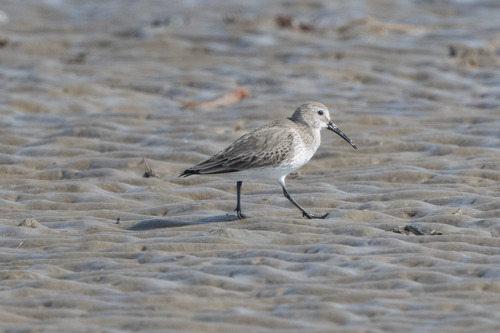
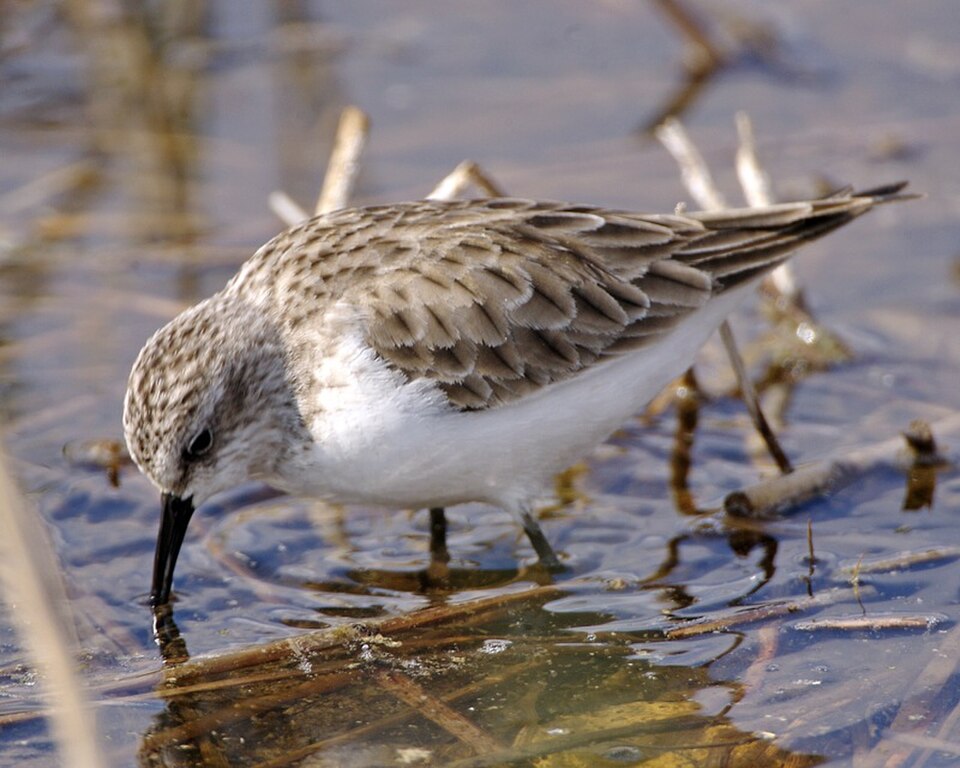
Dunlin, adult, non-breeding adult, non-breeding
Photo: Ryan Lobb · CC BY-NC

Bird 1 of 6

Dunlin

Calidris alpina

How to recognise it

  • Grey-brown above and white below, with a grey wash across the breast
  • A long black bill with a slight droop at the tip, and black legs
  • Rolling, buzzing “treeep” from a flock; the flock itself twists and wheels

Where and when

All ten countries. UK, IE, NL, BE, DE, DK, FR: abundant on estuaries from September to March. NO, SE, FI: breeds on tundra and bogs in summer and passes in autumn. Mid-winter flocks run into the tens of thousands.

Call A rough, rolling “treeep” or “kree”, always from a flock. Recording: Michele Peron · xeno-canto

Everything else is compared with the Dunlin. In summer a black belly patch and a chestnut back make it easy; in winter it is a plain grey-brown wader.

Don’t confuse with: Sanderling (this week): paler, a straight bill, and running at the water's edge. Curlew Sandpiper (this week): a longer, more curved bill, and a white rump.

Little Stint, juvenile juvenile
Photo: Lip Kee Yap · CC BY-SA

Bird 2 of 6

Little Stint

Calidris minuta

How to recognise it

  • Tiny: a pale, split supercilium and a clean white mantle V on a rusty back
  • Short, straight black bill, black legs and a white belly
  • Restless, picking quickly like a mouse at the mud's edge
mantle V A pale V on the back of a juvenile Little Stint or Sanderling, made by pale edges on the back feathers.
supercilium The pale stripe above the eye. On Little Stint it is often split in two in front of the eye.

Where and when

UK, NL, BE, DE, DK, FR: scarce passage migrant, in August to October (juveniles from mid-August) and in May. IE: rare. NO, SE, FI: passes in autumn, with breeding on the far north tundra. A few overwinter in southern UK and FR.

Call A short, sharp “tit” or “stit”, quite unlike the Dunlin. Recording: Terje Kolaas · xeno-canto

A juvenile in September is one of the most attractive waders, with rusty edges and a clean V. The size is the key: the size of a House Sparrow, not a Starling.

Don’t confuse with: Temminck's Stint (this week): plain brown with no V, and yellow-green legs. Dunlin: bigger, with a longer bill.

Little or Temminck's Stint?

Little StintLittle Stint
Temminck's StintTemminck's Stint

Temminck's is plain and cold brown-grey above and across the breast, with yellow-green legs and no pale V on the back. Little Stint has black legs and (in juvenile) a rusty back with a clean white V. In flight Temminck's shows white outer tail feathers, and its call is a dry trill, not a sharp 'tit'.

Temminck's Stint, adult adult
Photo: Wa'el Almatni · CC BY-NC-ND

Bird 3 of 6

Temminck's Stint

Calidris temminckii

How to recognise it

  • Plain brownish-grey above and across the breast, with no mantle V
  • Yellow-green to olive legs, and a short, fine bill
  • White outer tail feathers show when it flies, and it often creeps along a pool's edge
mantle V A pale V on the back of a juvenile Little Stint or Sanderling, made by pale edges on the back feathers.

Where and when

FI, NO, SE: scarce breeders in the north, from June. UK, NL, BE, DE, DK, FR, IE: rare, on passage in May and from late July to September. It prefers freshwater edges to the open mud.

Call A dry, high trill, “tirrr-rr”, often given as it flies up and away, like a tiny ringing bell. Recording: Stanislas Wroza · xeno-canto

It sits in a crouch, creeps like a mouse, and often flushes to a rattling call. A grey-brown stint with yellow-green legs is it.

Don’t confuse with: Little Stint (this week): brighter, a pale V on the mantle, and black legs.

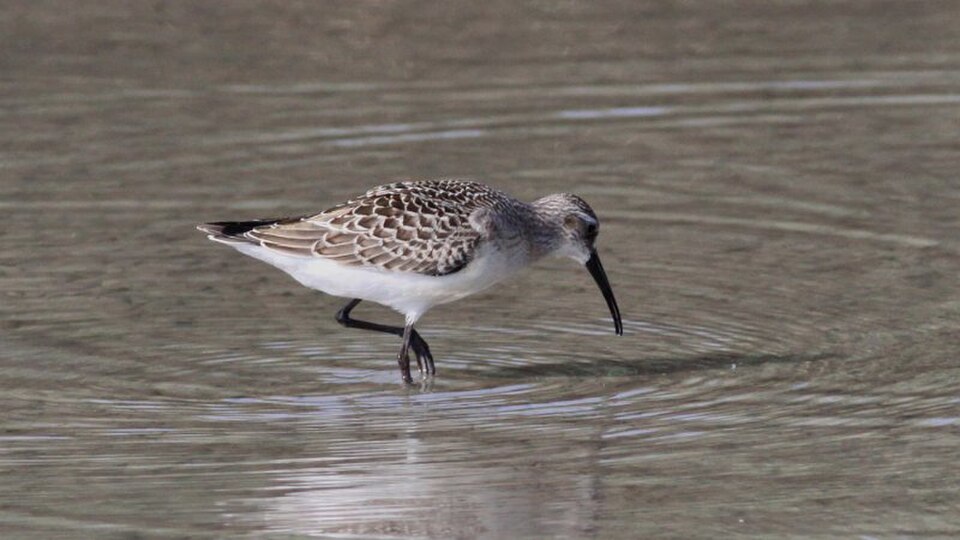
Curlew Sandpiper, juvenile juvenile
Photo: Ken Billington · CC BY-SA

Bird 4 of 6

Curlew Sandpiper

Calidris ferruginea

How to recognise it

  • A long, downcurved black bill and long black legs, a taller bird than a Dunlin
  • A scaly brown back and a peach-buff wash on the breast
  • A clean white rump in flight and a clear white supercilium
supercilium The pale stripe above the eye. On Little Stint it is often split in two in front of the eye.

Where and when

UK, NL, BE, DE, DK, FR: scarce passage migrant, mostly juveniles in August to October. IE: rare. NO, SE, FI: rare. Numbers vary greatly from year to year, depending on lemming cycles in Siberia.

Call A soft, rippling “chirrup” or “chirri”, more liquid than the Dunlin. Recording: David Darrell-Lambert · xeno-canto

A juvenile Curlew Sandpiper is a stunner. Its numbers swing wildly: a good year is when the Siberian lemmings crash.

Don’t confuse with: Dunlin (this week): a smaller bird, a shorter bill and a dark centre to the rump. Little Stint: much smaller.

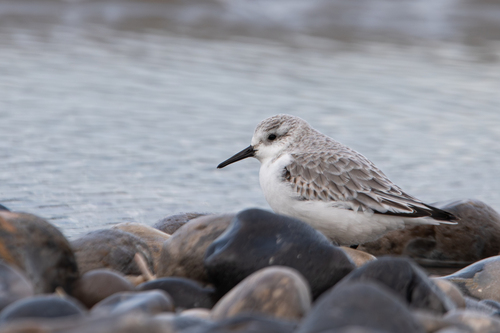
Sanderling, adult, non-breeding adult, non-breeding
Photo: Tobias Polzer · CC BY-NC

Bird 5 of 6

Sanderling

Calidris alba

How to recognise it

  • Very pale: silver-grey above and snow-white below, with a dark wing edge
  • A short, straight black bill and black legs with no hind toe
  • Runs along the waves like a clockwork toy
hind toe The small toe at the back of the foot. Sanderling has none, which is why it runs so smoothly.

Where and when

UK, IE, NL, BE, DE, DK, FR: fairly common on sandy beaches, from August to May, with big flocks on the Wadden coast. NO, SE, FI: passage birds. A few stay in summer.

Call A short, hard “twick” or “tchik”. Recording: Lionel FREDERIC · xeno-canto

A beach bird more than a mud bird. The black shoulder patch and the pale look are the features, and it runs in and out with the waves.

Don’t confuse with: Dunlin (this week): browner, a drooping bill, and prefers mud. Little Stint: smaller, with a V on the back.

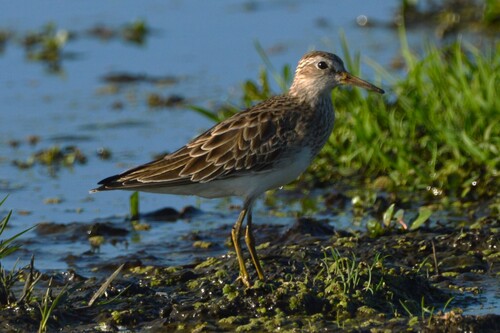
Pectoral Sandpiper, juvenile juvenile
Photo: Santiago Mailhos · CC BY-NC

Bird 6 of 6

Pectoral Sandpiper

Calidris melanotos

How to recognise it

  • A streaked breast band that ends sharply against a white belly
  • Yellow-green legs, a long neck and an upright stance
  • A scaly brown back with a pale mantle V, and a bill with a yellow base
mantle V A pale V on the back of a juvenile Little Stint or Sanderling, made by pale edges on the back feathers.
breast band A band of streaks across the breast, which ends sharply against the white belly, as in the Pectoral Sandpiper.

Where and when

UK, IE: scarce but annual in September and October, with a few most years in each. NL, BE, DE, DK, FR: rare. NO, SE, FI: very rare. A visitor from Siberia and North America.

Call A low, reedy “krrrk”, a bit like a grasshopper. Recording: Irish Wildlife Sounds · xeno-canto

A juvenile Pectoral is a classic autumn rarity. It stands higher than a Dunlin and stretches its neck up, and it hides in the grass at the edge of a pool.

Don’t confuse with: Ruff (week 14) juvenile: a smaller head, a browner back, buff breast. Dunlin: a streaked breast, a darker belly, and short legs.

Quiz

12 questions, with birds you have to repeat mixed in. Your answers decide when each bird comes back.

Out and about this week

Between mid-August and early October, visit a reservoir with muddy edges or a brackish pool. Scan the Dunlins for a tiny, rusty, quick bird: that is a Little Stint. If you see a Curlew Sandpiper, notice that it is taller than every Dunlin around it.