

white-throated honeyeater vs black-headed honeyeater
Melithreptus albogularis versus Melithreptus affinis
Jogue um quiz com white-throated honeyeater e black-headed honeyeater
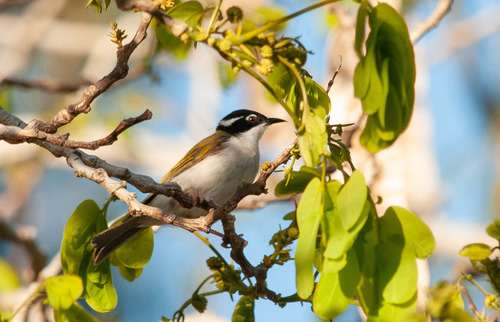 white-throated honeyeater
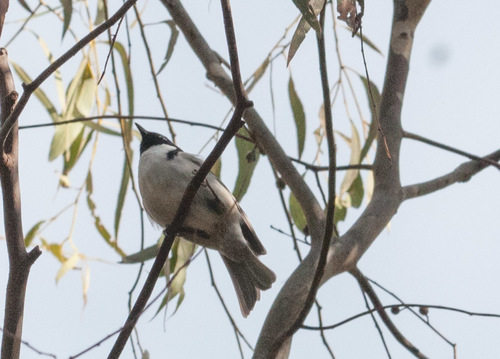 black-headed honeyeater
Em resumo
The most reliable way to separate White-throated Honeyeater from Black-headed Honeyeater is by range: White-throated occurs in northern and eastern Australia and New Guinea, while Black-headed is endemic to Tasmania. If seen outside Tasmania, it is almost certainly White-throated. In direct comparison, both are small Melithreptus honeyeaters with black heads and white underparts, but White-throated shows a diagnostic white nape stripe and a pale (blue-white) patch over the eye, while Black-headed lacks the nape stripe and has a plain black head. Both species are similar in size and structure, so plumage details and location are key. Immature and adult birds are not described as differing in upperwing pattern, so focus on head and nape markings.
Dicas de identificação
- Range is the first check: If you are in Tasmania, expect Black-headed Honeyeater; if you are in northern or eastern mainland Australia or New Guinea, expect White-throated Honeyeater.
- White nape stripe (White-throated only): Look for a crisp white stripe across the nape—this is absent in Black-headed Honeyeater. Works for all ages and sexes.
- Eye patch color: White-throated shows a pale blue-white patch of bare skin above the eye; Black-headed has a plain black head without a contrasting eye patch.
- Head pattern: Black-headed Honeyeater's black head merges smoothly into the white throat and underparts, lacking the nape stripe and eye patch of White-throated.
- Upperparts color: White-throated has olive-green or yellow-green upperparts with a yellower rump; Black-headed is not described as having this coloration—look for a more neutral-toned back in Black-headed.
- Bill, legs, and eyes: Both species have black bills. White-throated has red-brown eyes and purple-brown legs, but these are subtle and not easily seen in the field.
- No useful wing or flight pattern: Neither species is described as having distinctive upperwing or flight marks at any age. Do not rely on wing pattern for separation.
- Juvenile/immature confusion: There is no evidence of age-specific differences that would confuse these two species in immature or juvenile plumage.
- Foraging behavior: Both forage in foliage and may hang upside down, so behavior is not a reliable separator.
- Habitat context: In sclerophyll forests and savannah of the mainland, expect White-throated; in Tasmanian temperate forests, expect Black-headed.
- Flock size: White-throated may be seen in larger flocks; Black-headed also forms groups, but this is not a strong separator.
- Similar species confusion: If you see a Melithreptus honeyeater with a red eye patch, it is neither of these species (likely White-naped Honeyeater). If you see a white eye patch but no nape stripe and you are in Western Australia, consider Gilbert's Honeyeater, but ranges do not overlap with these two.
- Do not use song or call: No diagnostic vocal differences are described in available sources.
- Size is not reliable: Both are small honeyeaters with similar proportions; do not use size as a separator.
- Sex and season: No seasonal or sexual differences are described for either species that would affect identification.
Tamanho
Both species are similar in overall size and structure, typical of Melithreptus honeyeaters. The Black-headed Honeyeater has a reported average body mass of 15.4 g [wikidata], while the White-throated Honeyeater's mass is not specified but is within the same small honeyeater range (length 11.5–14.5 cm for White-throated [wikipedia]). In the field, neither species is noticeably larger or bulkier than the other, and size is not a reliable separator.
Plumagem
Plumage differences are subtle but diagnostic. The White-throated Honeyeater of all ages and sexes shows a clear white stripe across the nape (back of the neck), a white or pale blue patch of bare skin over the eye, and olive-green to yellow-green upperparts with a yellower rump. Its throat and underparts are white. The Black-headed Honeyeater, in contrast, lacks the white nape stripe and the pale eye patch, presenting a plain black head that merges smoothly into the white throat and underparts. Its upperparts are not described as olive or yellow-green, and there is no mention of a yellow rump. Juvenile and immature plumages are not detailed for either species in the sources, and there is no mention of distinctive upperwing or flight marks for any age, so these are not useful for separation.
Comportamento
Both species forage actively in foliage, often in flocks. The Black-headed Honeyeater specializes in searching among leaves and sometimes hangs upside down while foraging. White-throated Honeyeaters also forage in the canopy or foliage, not on bark, and are known to gather in larger flocks. In the field, their foraging behavior is quite similar and not reliably diagnostic.
Habitat
Habitat is a strong separator. White-throated Honeyeater is found in open, dry sclerophyll forests, savannah, and woodlands of northern and eastern Australia and New Guinea. Black-headed Honeyeater is restricted to Tasmania, inhabiting temperate forests and Mediterranean-type shrublands. If you are outside Tasmania, you are extremely unlikely to encounter Black-headed Honeyeater. Within Tasmania, only Black-headed is expected, as White-throated does not occur there.
Voz
Both species have recorded calls, but no distinguishing vocalizations are described in the available sources. Voice is not a reliable field mark for separation based on current information.
white-throated honeyeater · black-headed honeyeater · Minhas aves difíceis