

southern tchagra vs crimson-breasted gonolek
Tchagra tchagra versus Laniarius atrococcineus
Jogue um quiz com southern tchagra e crimson-breasted gonolek
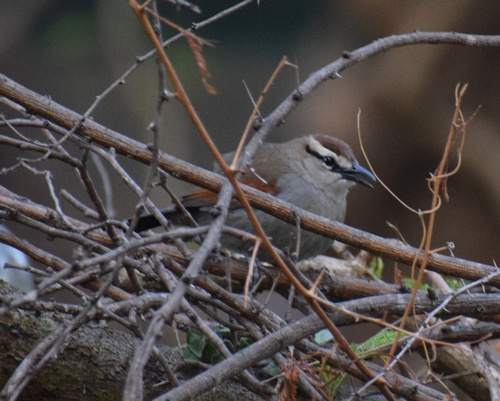 southern tchagra
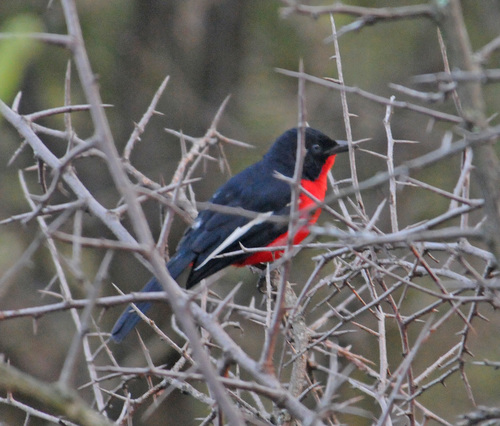 crimson-breasted gonolek
Em resumo
The most reliable field mark between Southern Tchagra and Crimson-breasted Gonolek is the underpart color in adults: Southern Tchagra shows pale grey underparts, while Crimson-breasted Gonolek has vivid scarlet underparts. Juvenile birds are trickier, but the Gonolek juvenile is mottled and barred buff-brown with a pale bill, whereas young Tchagra are duller versions of the adult, with a buff eye-stripe. In all plumages, the Gonolek has a broad white wing bar and black upperparts, while the Tchagra has chestnut wings, a brown crown, and a striking white supercilium. Both are similar in size and can overlap in southern Africa, but their coloration and head patterns are distinct with careful observation.
Dicas de identificação
- Underpart color in adults: Southern Tchagra always shows pale grey underparts; Crimson-breasted Gonolek is vivid scarlet below. This is the fastest and most reliable check for adults.
- Upperpart color: Gonolek adults are entirely black above, including wings and tail, with a broad white wing bar. Tchagra has pale brown upperparts, chestnut wings, and a black tail with a white tip.
- Head pattern: Tchagra has a brown crown, broad white supercilium, and black eye-stripe; Gonolek has an all-black head with no supercilium or contrasting crown.
- Wing pattern (adults): Gonolek shows a broad white wing bar on otherwise black wings. Tchagra's wings are chestnut with no white bar.
- Tail pattern: Tchagra's tail is black with a white tip; Gonolek's tail is black without a white tip.
- Bill color and shape: Both have dark bills as adults, but Tchagra's is described as longish and black; Gonolek juveniles have a pale bill.
- Juvenile plumage: Gonolek juveniles are mottled and barred buff-brown with a pale bill, lacking adult contrast. Tchagra juveniles are duller than adults but still show a buff eye-stripe and brown crown.
- Facial markings in juveniles: Tchagra juveniles retain the supercilium and eye-stripe; Gonolek juveniles lack these facial contrasts.
- Underpart color in juveniles: Gonolek juveniles are buff-brown below, not pale grey or scarlet; Tchagra juveniles are pale greyish, like adults but duller.
- Sex differences: Both species are similar between sexes; do not rely on sex for ID.
- Subspecies variation: Tchagra subspecies vary in underpart darkness and crown color but never approach the Gonolek's scarlet or black.
- Song and calls: Tchagra's descending whistle and female trill are distinctive if heard; Gonolek's call is not described in detail here.
- Habitat overlap: Both can occur in bushy habitats in southern Africa; do not use habitat alone for separation.
- Size: Both are similar in size and mass; do not use size as a primary separator.
- Potential pitfalls: Be cautious with juvenile Gonolek, which can look drab and brownish, but lack the Tchagra's facial pattern and chestnut wings. Juvenile Tchagra never show a white wing bar or scarlet underparts.
Tamanho
Both species are close in size and mass, with Southern Tchagra averaging 46.8g and Crimson-breasted Gonolek 48.3g [wikidata]. In the field, size is not a reliable separator. The Tchagra is described as 17–21 cm in length, but this does not differ dramatically from the Gonolek. Structural differences such as bill length may be more useful than overall size.
Plumagem
- Juveniles/immatures: Juvenile Crimson-breasted Gonolek are mottled and barred buff-brown overall with a pale bill, lacking the adult's black upperparts and scarlet underparts. Juvenile Southern Tchagra are duller than adults, with a buff stripe through the eye, but retain the brown crown and chestnut wings. The Gonolek's juvenile plumage is much less contrasting and lacks the Tchagra's facial pattern.
- Adults: Southern Tchagra adults have a brown crown, broad white supercilium, black eye-stripe, pale grey underparts, pale brown upperparts, chestnut folded wings, and a black tail tipped white. Crimson-breasted Gonolek adults are strikingly black above (including wings and tail), with a broad white wing bar and vivid scarlet underparts. The head pattern is all-black without a supercilium. The Gonolek's underparts are never pale grey, and the Tchagra's are never scarlet.
- Sexes: Both species are sexually monomorphic in plumage.
- Subspecies: Variation in Tchagra underpart color and crown tone exists, but never approaches the Gonolek's scarlet.
Comportamento
No strong behavioral differences are noted in the sources. Both species are bush-dwelling and may be seen perched or moving through dense vegetation. The Tchagra may be more likely to display with a song flight, but this is not a reliable field mark for separation.
Habitat
Southern Tchagra is found in dense scrub and coastal bush in southern and southeastern South Africa and Eswatini [wikipedia]. Crimson-breasted Gonolek is also a southern African bird, but the notes do not specify its preferred habitat for contrast. Both can occur in bushy environments, so habitat alone is not diagnostic.
Voz
Southern Tchagra males give a descending whistling song ("ttttrtr te te te teuuu") from a perch or in display flight; females respond with a trilled "tzerrrrrrrr" [wikipedia]. The Gonolek's name is said to be imitative of its call, but no specific description is given in the notes. Vocalizations are not a reliable separator based on the provided information.
southern tchagra · crimson-breasted gonolek · Minhas aves difíceis