

pato-casarca vs marrequinha-formosa
Tadorna ferruginea versus Sibirionetta formosa
Jogue um quiz com pato-casarca e marrequinha-formosa
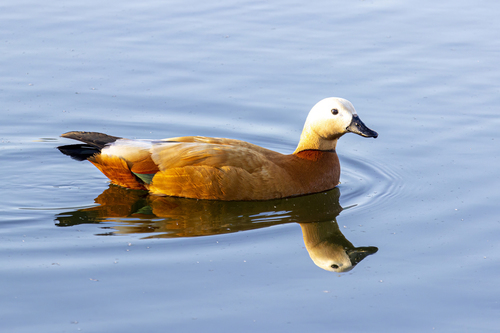 pato-casarca
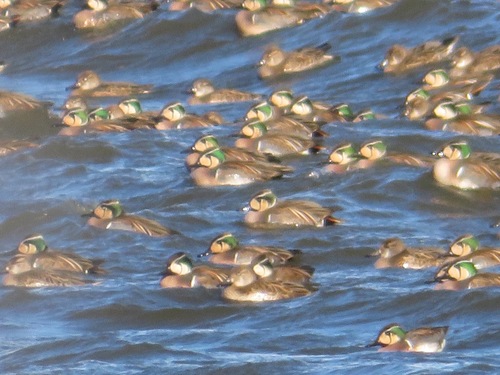 marrequinha-formosa
Em resumo
The most reliable way to separate Ruddy Shelduck from Baikal Teal is by size and overall structure: Ruddy Shelduck is much larger, with a robust, goose-like build and striking orange-brown plumage, while Baikal Teal is a small, compact dabbling duck with intricate facial and body patterns. In flight, Ruddy Shelduck shows broad white wing-coverts contrasting with black flight feathers, a feature visible in all ages but especially striking in adults. Baikal Teal, even in juvenile or eclipse plumage, never shows such bold white wing panels; instead, it has a more typical teal-like wing with a green speculum and subtler underwing contrasts. If seen perched, the shelduck's pale head and orange body stand out against the teal's patterned face and smaller, more delicate frame.
Dicas de identificação
- Size is the first check: Ruddy Shelduck is nearly twice the length and mass of Baikal Teal. If the bird looks goose-sized or towers over nearby ducks, it's a shelduck.
- Wing pattern in flight (all ages): Look for the broad, bright white upperwing-coverts of Ruddy Shelduck, sharply contrasting with black flight feathers and tail. Baikal Teal never shows this; its upperwing is more muted, with a green speculum and no large white panel.
- Body shape and posture: Ruddy Shelduck is long-necked, upright, and heavy-bodied, often standing tall on land. Baikal Teal is compact, short-necked, and sits low on the water.
- Head and face pattern: Ruddy Shelduck has a plain, pale orange or whitish head (female paler), with little pattern. Baikal Teal (female/juvenile) shows a distinctive white spot at the bill base, a white throat stripe to the eye, and a pale eyebrow, with a darker crown—very different from the shelduck's plain face.
- Adult male Baikal Teal: In full breeding plumage, the male Baikal Teal is unmistakable with a green nape, yellow and black face, and bold facial pattern. No confusion with the plain-headed shelduck.
- Adult male Ruddy Shelduck: Shows a narrow black collar (except in eclipse), never present on Baikal Teal.
- Female/juvenile confusion: If the bird is orange-brown overall with a pale, almost whitish head, it's a female or juvenile Ruddy Shelduck. If it's mottled brown with a patterned face and white throat, it's a Baikal Teal.
- Bill and leg color: Ruddy Shelduck has a black bill and dark grey legs; Baikal Teal's bill is dark but less robust, and legs are not as prominent.
- Tail length: Baikal Teal has a relatively longer tail for its size compared to other teals, but still much shorter than the shelduck's proportionally broad tail.
- Behavior on land: Ruddy Shelduck may be seen walking far from water, even nesting in dry places; Baikal Teal is almost always near water.
- Vocalization: If you hear loud, nasal honks, it's Ruddy Shelduck. Baikal Teal's calls are softer and less resonant.
- Habitat context: In open, dry, or upland settings, especially away from water, suspect Ruddy Shelduck. In dense flocks on shallow marshes, Baikal Teal is more likely.
- Seasonal variation: Male Ruddy Shelduck loses the black collar after breeding but regains it in a partial moult; Baikal Teal males in eclipse look more like females but are richer rufous, never orange-brown.
- Juvenile confusion: Juvenile Ruddy Shelduck is a darker brown version of the adult female, still lacking any facial pattern. Juvenile Baikal Teal resembles the female but has a pale loral spot and the same facial markings.
- Pitfalls: Distance and poor light can make Baikal Teal look warmer or larger, but the lack of a bold white wing panel and the patterned face are key. Conversely, a distant Ruddy Shelduck may seem plain-faced and orange—never patterned like a Baikal Teal.
Tamanho
Ruddy Shelduck is substantially larger, measuring 58–70 cm in length with a wingspan of 110–135 cm and an average mass of 1230 g [wikipedia][wikidata]. Baikal Teal is much smaller, at 39–43 cm in length and about 500 g in weight [wikipedia]. The shelduck appears almost goose-sized, while Baikal Teal is only slightly larger than a typical teal. This size gap is obvious when both are seen together or with other waterfowl for scale.
Plumagem
- Juvenile and non-breeding birds in flight: Ruddy Shelduck of all ages shows broad, bright white upperwing-coverts sharply set off by black flight feathers and tail; this white is especially obvious in flight and is diagnostic. Juvenile Baikal Teal, like the adult female, lacks any such bold white panel and instead shows a green speculum with a cinnamon-cream border and a darker leading edge to the underwing.
- Adult males (breeding): Ruddy Shelduck males have a uniform orange-brown body, paler head, and a narrow black neck collar (lost in eclipse). Baikal Teal males are unmistakable with a green nape, yellow and black face, dark crown, and spotted breast with grey flanks and white bars.
- Females and juveniles: Female Ruddy Shelduck is orange-brown with a paler, almost whitish head and no collar; female Baikal Teal is mottled brown, with a distinct white spot at the bill base, a white throat extending to the eye, and a pale eyebrow bordered by a darker crown. Juvenile Baikal Teal closely resembles the female but with a pale loral spot.
- Eclipse males: Baikal Teal males in eclipse resemble females but are richer rufous overall, never orange-brown like shelduck.
Comportamento
Ruddy Shelduck often stands tall, walks on land with a goose-like gait, and may be found well away from water, even nesting in crevices or trees. Baikal Teal behaves like a typical dabbling duck, feeding on the water surface or tipping up, and is rarely seen far from water. In flight, Ruddy Shelduck appears heavy and direct, with broad wings and slow wingbeats, while Baikal Teal is agile and quick, with rapid wingbeats typical of small ducks.
Habitat
Both species use wetlands, but Ruddy Shelduck favors larger, open inland waterbodies—lakes, reservoirs, and rivers—and can be found in drier or more open country, sometimes far from water. Baikal Teal is more restricted to marshes, shallow lakes, and flooded grassland, rarely venturing far from water. In winter, Baikal Teal flocks in large numbers on East Asian wetlands, while Ruddy Shelduck winters more widely, including in the Indian subcontinent.
Voz
Ruddy Shelduck gives loud, nasal honking calls, both on the ground and in flight, with some difference between male and female voices. Baikal Teal is known as the "squawk duck" but the notes do not provide a detailed description; in general, teal calls are softer and higher-pitched than the shelduck's honks.