

purple-throated mountain-gem vs white-throated mountain-gem
Lampornis calolaemus versus Lampornis castaneoventris
Jogue um quiz com purple-throated mountain-gem e white-throated mountain-gem
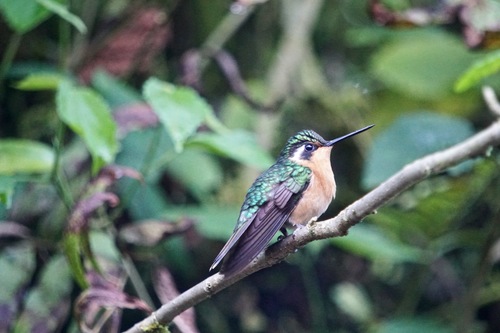 purple-throated mountain-gem
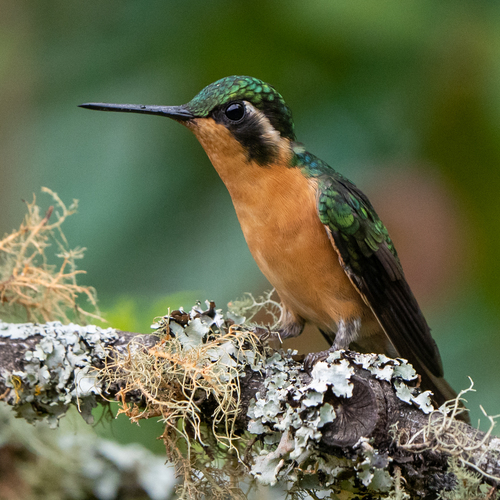 white-throated mountain-gem
Em resumo
The most reliable field mark between Purple-throated and White-throated Mountain-gems is the color of the throat and breast in adult males: Purple-throated males show a striking metallic violet or purple gorget, while White-throated males have a white throat and chin. Females are trickier, but Purple-throated females have a tawny yellow to buff underbody, whereas White-throated females show a much darker rufous underbody. Both species share a white post-ocular stripe and metallic green upperparts, but subtle differences in tail pattern and underpart color can help. Immatures of both species resemble females, so careful attention to underpart color and tail pattern is essential.
Dicas de identificação
- Adult male throat color is the single best field mark: Purple-throated males have a vivid metallic violet or purple gorget, while White-throated males have a clean white throat and chin. This is diagnostic in good light.
- Breast and belly color in males: Purple-throated males show a bright metallic green breast with bronzy or grayish flanks and belly. White-throated males have a bright green upper breast but a distinctly dark gray lower breast and vent.
- Female underparts: Purple-throated females have tawny yellow to buff throats, breasts, and bellies, while White-throated females are much darker below, with a deep rufous throat and belly. This contrast is subtle but reliable with good views.
- Undertail coverts: Purple-throated females have dull white to tawny buff undertail coverts; White-throated females have gray undertail coverts with white or buff edges. Immature Purple-throated males show brownish gray undertail coverts with dull white margins.
- Tail pattern: Both species have greenish central tail feathers, but Purple-throated females have black with pale gray tips on the outer tail feathers, while White-throated females have paler outer tail feathers. This is subtle and best seen on perched birds with spread tails.
- Crown and upperparts: Both species have metallic green crowns and upperparts, but Purple-throated males may show a more bluish or emerald forehead and crown. This is a supporting mark, not primary.
- Facial pattern: Both have a white to pale buff stripe behind the eye and a dark face. The face is mostly blackish in Purple-throated females, and dark cheeks are noted in White-throateds, so this is not a strong separator.
- Bill: Both species have a medium-length, straight black bill. Females of Purple-throated may have a slightly longer bill, but this is not useful in the field.
- Immature birds: Both species' immatures resemble adult females. For Purple-throated, look for a dusky chin/throat and brownish gray undertail coverts with dull white margins. For White-throated, expect a rufous underbody and gray undertail coverts with white/buff edges. No distinctive wing or flight pattern is described for either.
- Habitat and range: If seen in Nicaragua, it is Purple-throated. In western Panama and south-central Costa Rica, both can occur, so habitat is not diagnostic.
- Behavior: Both species are territorial at flowers, with males more aggressive. This is not a reliable separator.
- Voice: Only White-throated's call is described; if you hear a high 'ziit' or 'ziip', it may support White-throated, but absence of vocalization is not helpful.
- Season and context: Both species are year-round residents in their ranges, so season does not help.
- Size: Both are nearly identical in size and weight; do not use this for separation.
- Pitfalls: Immature and female birds are the most challenging; focus on underpart color and undertail covert pattern, and use throat color in males whenever possible.
Tamanho
Both species are very close in size and weight, with Purple-throated Mountain-gem measuring 10–11.5 cm and weighing 4.5–6 g, and White-throated Mountain-gem at about 12 cm and 5–6 g. In the field, this size difference is negligible and not a reliable separator. Both have a medium-length, straight black bill and similar overall proportions.
Plumagem
- Adult males: Purple-throated Mountain-gem males have a glittering emerald to bluish green crown and a metallic violet or purple gorget, with a bright metallic green breast and dull blue-black tail. White-throated Mountain-gem males have an emerald crown but a white chin and throat, with bright green sides of the neck and upper breast, and a dark gray lower breast/vent. Both have metallic green upperparts and a white stripe behind the eye.
- Adult females: Purple-throated females have bright metallic green upperparts, a mostly blackish face, and underparts that are tawny yellow to buff, with dull white to tawny buff undertail coverts. Their tail is greenish centrally with black and pale gray tips on the outer feathers. White-throated females have entirely bright green upperparts, a dark rufous throat and belly, and gray undertail coverts with white or buff edges. Their tail is metallic to bronze green centrally, paler on the outer feathers.
- Immatures: Immature Purple-throated males resemble adult females but have a dusky chin/throat and brownish gray undertail coverts with dull white margins. Immature White-throateds are not described in detail, but likely resemble their adult females. No distinctive juvenile upperwing or flight pattern is described for either species, so separation relies on underpart and tail coloration at all ages.
Comportamento
Both species feed on nectar and small arthropods, with males defending flower patches and being territorial. Purple-throated males are more aggressive, even excluding females after courtship, while White-throated males are dominant over smaller hummingbirds but subordinate to larger ones. Females of both species are less territorial and feed more widely. Foraging behavior is not reliably separable in the field.
Habitat
Both species occur in the highlands of Costa Rica and Panama, but Purple-throated Mountain-gem extends into Nicaragua, while White-throated is restricted to western Panama and south-central Costa Rica. Both inhabit oak forests, edges, shrubby clearings, and gardens at elevations from about 1,500 m to timberline. In areas of overlap, habitat is not a reliable separator.
Voz
Only the White-throated Mountain-gem's voice is described: high-pitched 'ziit' or 'ziip' calls and a sputtery, bubbly song. No vocal description is available for Purple-throated Mountain-gem, so voice is not a practical separator.
purple-throated mountain-gem · white-throated mountain-gem · Minhas aves difíceis