

pale-billed woodpecker vs pica-pau-de-banda-branca
Campephilus guatemalensis versus Dryocopus lineatus
Jogue um quiz com pale-billed woodpecker e pica-pau-de-banda-branca
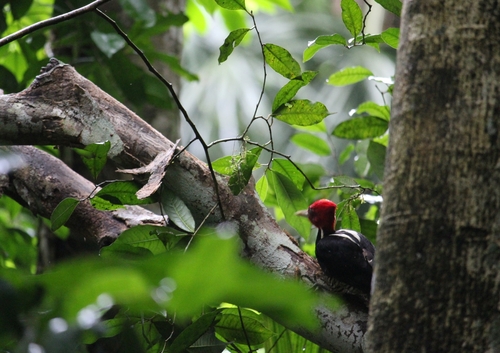 pale-billed woodpecker
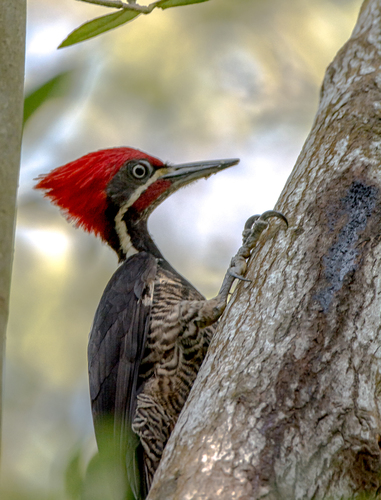 pica-pau-de-banda-branca
Em resumo
The most reliable field mark to separate Pale-billed and Lineated Woodpeckers is the color and shape of the bill: Pale-billed has a long, ivory-yellow chisel bill, while Lineated usually shows a dark bill, though some subspecies and individuals can have a pale bill. Both species are large, crested woodpeckers with black upperparts and bold white neck stripes, but Pale-billed’s neck stripes often form a near-complete 'V' on the back, while Lineated’s shoulder stripes are usually less extensive and may be absent in some populations. Underparts are also subtly different: Pale-billed is buffy with fine black barring, while Lineated is whitish with heavier black barring. In flight, Lineated shows white in the wings, which Pale-billed lacks. Careful attention to head pattern, bill color, and wing markings—especially in flight or on immatures—will help avoid confusion.
Dicas de identificação
- Bill color and shape: Pale-billed Woodpecker has a long, ivory-yellow chisel bill in all plumages; Lineated usually has a dark bill, but some subspecies (especially in Mexico and Central America) can show a pale or bluish bill. Use this mark with caution in those regions.
- Neck and back stripes: Pale-billed’s white or buffy neck stripes are bold and usually meet to form a 'V' on the back; Lineated’s white lines are thinner, often do not meet on the back, and may be absent or reduced in southern populations.
- Wing pattern in flight: Lineated Woodpecker shows white in the wings in flight (adults and likely immatures); Pale-billed’s wings are black above except for dull brown outer webs on the outer primaries, with no obvious white flash.
- Underparts barring: Pale-billed has light yellowish buff underparts with fine, narrow black bars; Lineated’s underparts are whiter and more heavily barred with black, giving a more contrasting and 'busy' look below.
- Head pattern (sex differences): Adult male Pale-billed has a fully red head and bushy crest; female has a black forecrown and throat. Lineated male has a red malar stripe and red forehead; female has these areas black. Both can show a prominent red crest, but the facial pattern is key.
- Juvenile confusion: Juvenile Pale-billed resembles adult female but with a darker bill and duller, mostly blackish head. Juvenile Lineated is not described in detail but likely follows adult female pattern; bill color may be variable in both, so use with caution.
- Tail color: Pale-billed’s tail is dull brown above, with dull olive-brown on the underside of the outer feathers; Lineated’s tail is not described in detail but is generally blackish, matching the upperparts.
- Bill size and structure: Pale-billed’s bill is noticeably longer and more robust than Lineated’s, especially when seen in profile or when both species are present.
- Size and bulk: Pale-billed is bulkier and heavier than Lineated, but this is subtle and not always reliable unless seen side by side.
- Habitat context: If seen in deep, mature forest interior, Pale-billed is more likely; at forest edges or open woodland, Lineated is more likely, though both can overlap in some areas.
- Voice: If a loud, ringing 'wic-wic-wic' is heard, Lineated is likely; Pale-billed’s voice is less well described and not a safe separator unless Lineated’s call is clearly heard.
- Subspecies pitfalls: In western and eastern Mexico and Central America, some Lineated subspecies (scapularis, similis) have pale bills, which can mimic Pale-billed; rely more on neck stripe pattern and wing markings in these regions.
- Sexing in the field: Both species show sexual dimorphism in head pattern; check for red malar/forehead (Lineated male) vs. all-red head (Pale-billed male) or black crown/throat (Pale-billed female).
- White scapular lines: Lineated’s white scapular lines are often reduced or absent in southern populations; Pale-billed’s neck stripes are consistently bold and more likely to form a 'V' across the back.
- Mixed flocks and foraging: Neither species joins mixed flocks, but Pale-billed may forage lower or on the ground at stumps, which can be a subtle behavioral clue if observed.
Tamanho
Pale-billed Woodpecker is the heavier and slightly longer of the two, with an average mass of about 242 g (range 205–282 g) and a length of 35.5–38 cm. Lineated Woodpecker averages 183.5 g (range 136–264 g depending on subspecies) and is 31.5–36 cm long. In the field, this size difference is subtle, but Pale-billed often appears bulkier and more robust, especially in the head and bill.
Plumagem
Juveniles of both species resemble adult females, but Pale-billed juveniles have a darker bill and a duller, mostly blackish head, while Lineated juveniles are not described in detail but likely follow the adult female pattern. For adults, Pale-billed shows black upperparts with bold, vertical white or buffy stripes along the neck that often meet to form a 'V' on the back, and a pale, ivory-yellow bill. Its underparts are light yellowish buff with narrow black bars. Adult males have a fully red head and bushy crest; females have a black forecrown, crown center, foreneck, and throat. Lineated adults are mainly black above, with a red crest and a whitish line from the bill down the neck and shoulders (often reduced or absent in some populations). Their underparts are whitish and heavily barred with black. Adult males have a red malar stripe and red forehead; females have these areas black. The bill is usually dark, but some subspecies (notably in Mexico and Central America) can have a pale or bluish bill, which can cause confusion. In flight, Lineated shows white in the wings, while Pale-billed does not.
Comportamento
Both species forage mainly on trunks and large limbs, excavating for insects, and are usually seen singly or in pairs. Pale-billed is more likely to forage in the mid- to upper canopy but will also come to the ground, while Lineated prefers forest borders and open woodland. Neither species is known to join mixed-species flocks. Both drum and excavate nest holes in dead trees, but behavioral differences are subtle and not reliably diagnostic in the field.
Habitat
Pale-billed Woodpecker favors interior and edge of lowland tropical evergreen forests, but also occurs in deciduous forest, mangroves, and locally in montane and pine-oak forests, generally avoiding heavily deforested areas. It ranges from sea level to 2,000 m depending on region. Lineated Woodpecker is more often found at forest borders, open woodland, and edges rather than deep forest, and is less tied to intact forest than Pale-billed. Overlap occurs in much of Mexico and Central America, but Pale-billed is more restricted to mature forest interiors.
Voz
Lineated Woodpecker gives a loud, ringing 'wic-wic-wic' call, which is distinctive if heard well. No detailed description of Pale-billed’s vocalizations is provided in the notes, so voice is not a reliable separator unless Lineated’s call is heard clearly.
pale-billed woodpecker · pica-pau-de-banda-branca · Minhas aves difíceis