

lesser greenlet vs juruviara-boreal
Pachysylvia decurtata versus Vireo olivaceus
Jogue um quiz com lesser greenlet e juruviara-boreal
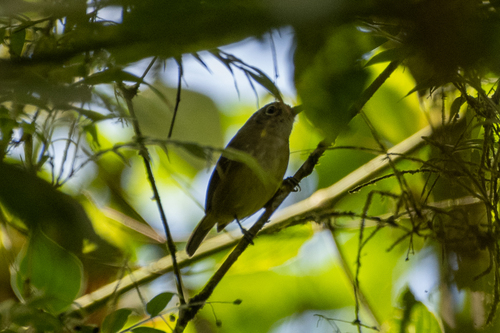 lesser greenlet
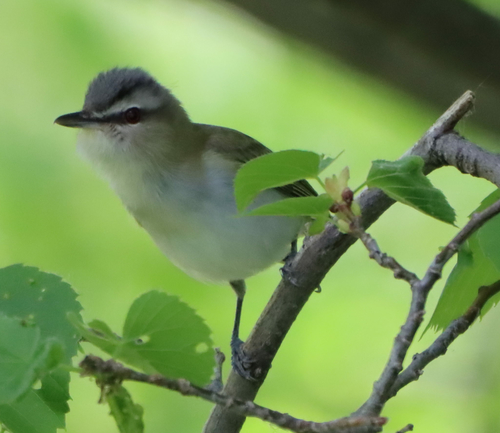 juruviara-boreal
Em resumo
The most reliable field mark to separate Lesser Greenlet from Red-eyed Vireo is the presence of a gray-blue or gray crown with a pale face and weak eye-ring in Lesser Greenlet, versus the Red-eyed Vireo's distinct gray crown edged with black, bold white supercilium, and strong blackish eye-stripe. Red-eyed Vireo is also significantly larger and bulkier, with a noticeably longer wingspan and heavier build. In all plumages, Lesser Greenlet is a compact, short-tailed bird with a greenish back and yellowish underparts, while Red-eyed Vireo is larger, longer-tailed, and has clean white underparts with only faint yellow on the flanks. Immature-specific wing or flight patterns are not described for either, so focus on head pattern, size, and structure. Both species can occur in Central America, but Red-eyed Vireo is only present as a migrant.
Dicas de identificação
- Head pattern is the most decisive mark: Red-eyed Vireo has a strong white supercilium (eyebrow), a blackish eye-stripe, and a gray crown bordered by black—this bold contrast is never matched by Lesser Greenlet, which has a gray-blue or gray crown blending softly into a pale face and weak eye-ring.
- Eye color: Adult Red-eyed Vireo has a red iris, but this is often hard to see in the field. Lesser Greenlet always has a dark brown iris.
- Size and structure: Red-eyed Vireo is much larger and bulkier, with a longer wingspan and tail. Lesser Greenlet is compact, short-tailed, and noticeably smaller. If seen with other small birds, this difference can be striking.
- Bill: Red-eyed Vireo has a stouter, more robust bill; Lesser Greenlet's bill is finer and less deep. This can be subtle unless seen well.
- Upperparts: Both have olive-green backs, but Lesser Greenlet is generally brighter and more uniform, while Red-eyed Vireo's olive is duller and restricted to the back, with a gray crown.
- Underparts: Lesser Greenlet shows pale lemon-yellow on the breast and greenish-yellow flanks and vent; Red-eyed Vireo has clean white underparts with only faint yellowish wash on the flanks and undertail coverts.
- Face and lores: Lesser Greenlet may show a pale stripe above the lores and a whitish eye-ring, but never the vireo's bold black-and-white facial pattern.
- Tail: Red-eyed Vireo has a proportionally longer tail; Lesser Greenlet's tail is short and square.
- Leg color: Both have blue-gray to pale gray legs, not a strong field mark.
- Behavior: Lesser Greenlet is more active, often in mixed flocks, and moves quickly through foliage. Red-eyed Vireo is more solitary and deliberate.
- Habitat and season: In Central America, Red-eyed Vireo is only present on migration or winter; Lesser Greenlet is resident. In dense forest, especially outside migration, Lesser Greenlet is more likely.
- Subspecies variation: Lesser Greenlet subspecies may vary in crown and back color, but none develop the sharply defined head pattern of Red-eyed Vireo.
- Juvenile/immature confusion: No distinctive upperwing or flight marks are described for either species, so rely on head pattern and size for all ages.
- Voice: Not described in the notes, so not reliable for separation here.
- Pitfalls: Poor views may make Red-eyed Vireo's head pattern seem less bold, but even in dull light, the supercilium and eye-stripe are usually visible. Lesser Greenlet never shows a strong black-and-white face.
Tamanho
Red-eyed Vireo is much larger, measuring 12–13 cm in length and weighing 12–26 g, with a wingspan of 23–25 cm [wikipedia][avonet]. Lesser Greenlet is notably smaller at 9.4–10.2 cm and 6.6–10.3 g [wikipedia][avonet]. In the field, Red-eyed Vireo appears bulkier and longer-winged, while Lesser Greenlet is compact and dainty. This size difference is usually obvious if seen together or with familiar reference birds.
Plumagem
There are no distinctive juvenile or immature upperwing patterns described for either species, so head and body coloration are key. Lesser Greenlet (all ages, sexes) shows a gray-blue to gray crown and upper face, a pale or whitish eye-ring, and a mostly olive-green back and wings with greenish outer webs. Underparts are pale lemon-yellow on the breast, whitish on the belly, and greenish-yellow on the flanks and vent. Red-eyed Vireo (adult) has a gray crown sharply bordered by a black line, a bold white supercilium above a blackish eye-stripe, olive-green upperparts, and white underparts with only faint yellowish flanks and undertail coverts. The iris is red in adults (not always visible in the field). Lesser Greenlet lacks the strong facial contrast and has a more uniformly pale face, while Red-eyed Vireo's face is crisply patterned. Subspecific variation in Lesser Greenlet can slightly alter crown and back tones but never produces the vireo's bold head pattern.
Comportamento
Both species forage in the canopy, but Lesser Greenlet is more likely to join mixed-species flocks and move quickly among foliage, often in pairs or small groups. Red-eyed Vireo tends to forage alone or in loose association, moving methodically through trees, often higher in the canopy. Red-eyed Vireo may appear more deliberate and less restless than the smaller, more active Lesser Greenlet.
Habitat
Lesser Greenlet is a resident of humid forests and edges from Mexico through northern South America, often in lowland and foothill forests. Red-eyed Vireo is a migrant in Central and South America, present only during migration and winter, and breeds in North America in open woodlands. In Central America, Red-eyed Vireo is seen mainly during migration, while Lesser Greenlet is present year-round. If seen in dense forest interior, especially outside migration periods, Lesser Greenlet is far more likely.