
garajau-pequeno vs garajau-de-bico-amarelo
Thalasseus bengalensis versus Thalasseus bergii
Jogue um quiz com garajau-pequeno e garajau-de-bico-amarelo
 garajau-pequeno
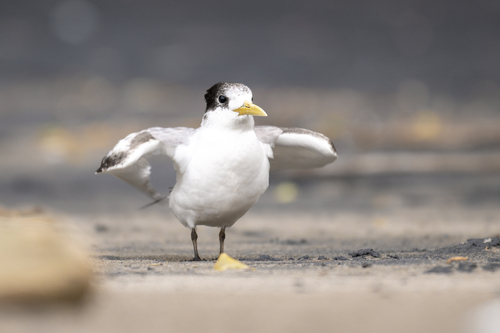 garajau-de-bico-amarelo
Em resumo
A marca de campo mais confiável para separar o garajau-pequeno do garajau-de-bico-amarelo é a cor do bico: o garajau-pequeno tem um bico laranja distinto, enquanto o garajau-de-bico-amarelo apresenta um bico mais longo e pesado, que é amarelo a amarelo-esverdeado. As aves juvenis e imaturas são melhor separadas pelos padrões das asas superiores e do manto—os juvenis do garajau-de-bico-amarelo são muito mais variados acima, com barras escuras na asa fechada, enquanto os juvenis do garajau-pequeno são mais claros, com apenas crescentes escuros fracos. Em voo, o garajau-pequeno mostra uma cauda cinza, enquanto o garajau-de-bico-amarelo é mais escuro acima no geral. O garajau-de-bico-amarelo também é visivelmente maior e mais robusto, mas o tamanho pode ser difícil de julgar, a menos que ambos estejam juntos.
Dicas de identificação
- Bill color is the most consistent field mark: garajau-pequeno has a long, sharp orange bill; garajau-de-bico-amarelo has a longer, heavier bill that is yellow to greenish-yellow. This is reliable in all plumages and ages.
- Juvenile/immature upperwing pattern: Juvenile garajau-de-bico-amarelo is strongly patterned above, with dark bars on the closed wings and a variegated mantle. Juvenile garajau-pequeno is much paler, with only faint dark crescents on the mantle feathers and a generally cleaner look. Use this in late summer and autumn when young birds predominate.
- Rump color in flight: garajau-pequeno shows a grey rump, which is a useful separator from garajau-de-bico-amarelo, whose rump and tail are not as distinctly grey and whose upperparts are darker overall. This is best seen in adults and older immatures.
- Overall upperpart tone: garajau-de-bico-amarelo is darker above, with battleship-grey upperparts, while garajau-pequeno is paler grey above. This is more obvious in direct comparison or good light.
- Size and structure: garajau-de-bico-amarelo is about 25% larger, with a bulkier body, longer and heavier head, and a proportionately longer bill. garajau-pequeno is slimmer and more delicate, but size is hard to judge unless both are together.
- Crest and forehead pattern: In breeding plumage, garajau-de-bico-amarelo has a shaggier black crest and a white forehead, while garajau-pequeno has a full black cap. In winter, both show white on the forehead, but garajau-de-bico-amarelo's crown becomes flecked or peppered with black, while garajau-pequeno's is more cleanly white.
- Leg color: Both have black legs, so this is not a useful separator.
- Bill shape: garajau-de-bico-amarelo's bill is not only longer but also heavier and slightly downcurved at the tip; garajau-pequeno's is finer and straighter.
- Juvenile bill color: Juvenile garajau-pequeno already shows a yellow-orange bill, while garajau-de-bico-amarelo juveniles have a yellowish bill, but the difference is less pronounced than in adults.
- Flight jizz: Both have long, pointed wings and a buoyant flight, but garajau-de-bico-amarelo appears heavier and more powerful in flight, while garajau-pequeno is more agile and delicate.
- Voice: Calls are similar—both loud and grating—but garajau-de-bico-amarelo's main call is described as more raucous and crow-like. Not always reliable without experience.
- Colony context: If seen in a mixed tern colony, check for size and bill color—garajau-de-bico-amarelo will stand out as the largest, with a yellowish bill; garajau-pequeno will be smaller, with an orange bill.
- Seasonal changes: In non-breeding (winter) plumage, both species develop white on the forehead, but garajau-de-bico-amarelo's entire crown becomes flecked, while garajau-pequeno's is more cleanly white-fronted.
- Potential confusion: Both can be confused with other orange/yellow-billed terns (e.g., garajau-real-africano, trinta-réis-de-bando), but within this pair, focus on bill color, size, and upperpart pattern.
- When in doubt: If the bird is large, dark above, with a yellowish bill and a white forehead (even in breeding), it's garajau-de-bico-amarelo. If it's smaller, paler above, with a clean orange bill and grey rump, it's garajau-pequeno.
Tamanho
O garajau-de-bico-amarelo é significativamente maior e mais pesado que o garajau-pequeno. O garajau-pequeno pesa em média cerca de 209 g, enquanto o garajau-de-bico-amarelo pesa cerca de 325–397 g (segundo a Wikipedia). Em comprimento, o garajau-pequeno mede 35–43 cm com uma envergadura de 88–105 cm, enquanto o garajau-de-bico-amarelo mede 46–49 cm de comprimento com uma envergadura de 125–130 cm. A diferença é de cerca de 25% em tamanho geral, com o garajau-de-bico-amarelo tendo uma cabeça e um bico mais longos e pesados, e um corpo mais robusto. No entanto, a menos que vistos lado a lado, isso pode ser sutil no campo.
Plumagem
As aves juvenis e imaturas são melhor separadas pelo padrão das asas superiores e do manto: o juvenil do garajau-de-bico-amarelo é fortemente padronizado acima, com barras escuras nas asas fechadas e uma aparência variada, enquanto o juvenil do garajau-pequeno é muito mais claro, com apenas crescentes escuros fracos nas penas do manto e uma aparência geralmente mais limpa. Nos adultos, o garajau-pequeno no verão tem uma touca negra completa, pernas pretas, bico laranja, asas superiores e cauda cinzas, e partes inferiores brancas; no inverno, a testa torna-se branca. Os adultos do garajau-de-bico-amarelo na plumagem de reprodução têm uma crista negra mais desgrenhada, testa branca (mesmo na reprodução), bico amarelo-esverdeado e partes superiores mais escuras, cinza-batalha. No inverno, o garajau-de-bico-amarelo torna-se mais claro acima e a coroa é manchada de branco. Em voo, a cauda cinza do garajau-pequeno é uma marca útil; a cauda e o rabo do garajau-de-bico-amarelo não são tão distintamente cinzas e as partes superiores são mais escuras no geral. A cor do bico é uma diferença chave durante todo o ano: laranja (garajau-pequeno) vs amarelo/amarelo-esverdeado (garajau-de-bico-amarelo).
Comportamento
Ambas as espécies se alimentam mergulhando para pegar peixes, mas o garajau-pequeno geralmente mergulha diretamente, enquanto o comportamento do garajau-de-bico-amarelo não é descrito como diferente nas fontes. Ambas as espécies se reproduzem em colônias densas nas costas e ilhas, muitas vezes em estreita proximidade. O cortejo no garajau-pequeno envolve o macho oferecendo peixes à fêmea. Ambos são altamente coloniais e podem ser vistos em bandos mistos, mas o garajau-de-bico-amarelo é mais robusto e pode dominar em grupos mistos.
Habitat
Ambas as espécies são costeiras e se reproduzem em ilhas e praias de areia, muitas vezes em colônias mistas. Há uma sobreposição significativa em suas áreas de distribuição, especialmente ao redor do Oceano Índico e Mediterrâneo para o garajau-pequeno, e mais amplamente para o garajau-de-bico-amarelo, que é encontrado da África do Sul à Austrália e ao Pacífico central. A preferência de habitat não é um separador confiável onde ambos ocorrem.
Voz
O garajau-pequeno emite um chamado alto e áspero semelhante ao trinta-réis-de-bando. O garajau-de-bico-amarelo é altamente vocal, com um 'kerrak' alto, rouco e semelhante ao de um corvo como seu chamado principal, e outras notas ásperas ('korrkorrkorr', 'wep wep'). Ambos podem ser barulhentos em colônias, mas os chamados não são descritos como separáveis de forma confiável no campo.
garajau-pequeno · garajau-de-bico-amarelo · Minhas aves difíceis