

hawaiian hawk vs red-tailed hawk
Buteo solitarius versus Buteo jamaicensis
Jogue um quiz com hawaiian hawk e red-tailed hawk
 hawaiian hawk
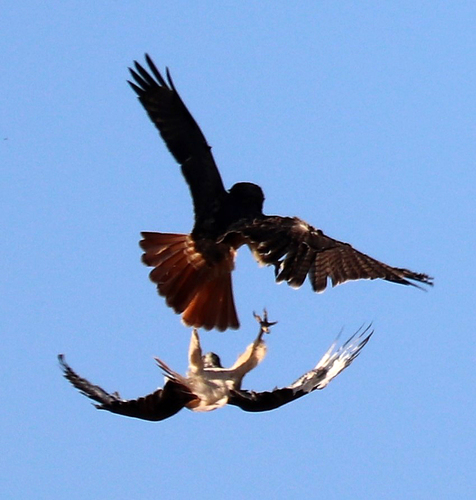 red-tailed hawk
Em resumo
A marca de campo mais confiável entre hawaiian hawk e red-tailed hawk é a cauda: os hawks red-tailed adultos apresentam uma cauda vermelha tijolo distinta (com uma única faixa escura), enquanto os hawks hawaiian nunca apresentam - independentemente da idade ou morfologia. Os hawks red-tailed juvenis têm caudas marrons, listradas, mas mesmo assim, seu tamanho geral, estrutura e padrão de faixa na barriga diferem do hawaiian hawk. O hawaiian hawk é menor, mais compacto e encontrado apenas na Ilha do Hawaiʻi, enquanto os hawks red-tailed são mais robustos, volumosos e amplamente distribuídos pela América do Norte. Ambas as espécies apresentam morfos escuros e claros, portanto, a cor sozinha não é segura para identificação; em vez disso, concentre-se na cor da cauda, tamanho e estrutura, especialmente em voo.
Dicas de identificação
- Cor da cauda (adultos): Os hawks red-tailed adultos têm uma cauda vermelha tijolo com uma única faixa escura na ponta - nunca vista em hawaiian hawk de qualquer idade ou morfologia.
- Padrão da cauda (juvenis): Os hawks red-tailed juvenis mostram uma cauda marrom com cerca de seis faixas escuras; os juvenis de hawaiian hawk nunca mostram esse padrão, e sua cauda é sempre marrom sem listras fortes.
- Faixa na barriga: A maioria dos hawks red-tailed (especialmente os morfos claros) mostra uma faixa escura na barriga de listras horizontais em uma barriga pálida, visível tanto em aves empoleiradas quanto em voo. Os hawks hawaiian não possuem essa característica em todas as plumagens.
- Tamanho e estrutura geral: Os hawks red-tailed são maiores, bulkier e blockier, com corpos grossos e asas largas. Os hawks hawaiian são menores, mais compactos e mais esguios, com uma cauda proporcionalmente mais longa.
- Formato das asas em voo: Os hawks red-tailed têm asas largas e arredondadas e uma cauda curta e larga, dando uma silhueta robusta. Os hawks hawaiian têm asas mais estreitas e pontiagudas e uma cauda mais longa e esguia, parecendo mais ágeis e menos massivos.
- Morfos de cor: Ambas as espécies podem ser escuras ou claras, portanto, a cor da plumagem sozinha não é confiável. Sempre verifique o padrão da cauda e a faixa na barriga.
- Cor das pernas (idade): Os juvenis de hawaiian hawk têm pernas esverdeadas, que se tornam amarelas nos adultos. Os hawks red-tailed têm pernas e pés amarelos em todas as idades.
- Capuz amarelo (reprodução): Durante a reprodução, um hawaiian hawk (provavelmente a fêmea) pode mostrar uma mancha amarela acima do bico; os hawks red-tailed nunca mostram essa característica.
- Habitat e localização: O hawaiian hawk é encontrado apenas na Ilha do Hawaiʻi, geralmente em florestas nativas. O red-tailed hawk é amplamente distribuído na América do Norte e pode ser encontrado em uma ampla gama de habitats abertos e semi-abertos.
- Comportamento de empoleiramento: Os hawks red-tailed frequentemente se empoleiram em postes expostos, fios ou árvores em áreas abertas. Os hawks hawaiian são mais propensos a serem vistos em áreas florestais e são menos tolerantes a habitats abertos ou alterados pelo homem.
- Estilo de voo: Os hawks red-tailed planam com batidas de asas lentas e pesadas e frequentemente deslizam com asas largas. Os hawks hawaiian são mais rápidos e mais leves em voo.
- Bico e cabeça: Os hawks red-tailed têm um bico curto, escuro e curvado e uma cabeça que pode parecer pequena em relação ao corpo grosso. Os hawks hawaiian têm uma cabeça proporcionalmente maior para seu tamanho.
- Cor da íris (idade): Os juvenis de hawks red-tailed têm íris amareladas que escurecem com a idade; essa não é uma característica notada em hawaiian hawk.
- Se em dúvida: Se você ver um rapinante com uma cauda vermelha, não é um hawaiian hawk. Se você ver um Buteo pequeno e compacto em uma floresta na Ilha do Hawaiʻi, é quase certamente um hawaiian hawk.
- Quando as marcas falham: Em luz fraca ou à distância, concentre-se na forma, tamanho e padrão da cauda em vez da cor geral.
Tamanho
O red-tailed hawk é visivelmente maior e mais robusto que o hawaiian hawk. O comprimento do red-tailed hawk é tipicamente de 45–65 cm (18–26 in), com as fêmeas sendo maiores, enquanto o hawaiian hawk é menor, com 40–46 cm (16–18 in) [wikipedia, avonet]. Os hawks red-tailed também parecem mais pesados e robustos, com um corpo grosso e asas largas, em comparação com o hawaiian hawk, que é mais compacto e esguio. Em mãos, as fêmeas de hawaiian hawk pesam em média cerca de 605 g, os machos 441 g; o red-tailed hawk é mais pesado em geral, mas pesos precisos não são detalhados aqui. No campo, os hawks red-tailed parecem mais volumosos e imponentes, especialmente quando empoleirados.
Plumagem
A plumagem juvenil e imatura é frequentemente a fonte de confusão. Os juvenis de hawks red-tailed não têm a cauda vermelha, mostrando em vez disso uma cauda marrom com várias faixas escuras (cerca de seis), e uma barriga pálida com uma distinta faixa escura formada por listras horizontais - essa faixa na barriga é uma marca chave na maioria dos morfos. Suas partes inferiores também podem ser fortemente manchadas. Os hawks red-tailed adultos desenvolvem a clássica cauda vermelha (vermelha tijolo acima, laranja claro abaixo) com uma única faixa escura na ponta. Os hawks hawaiian vêm em dois morfos de cor: escuro (cabeça, peito e asas inferiores marrons) e claro (cabeça escura, peito e asas inferiores pálidos). Eles nunca mostram uma cauda vermelha ou uma faixa na barriga. Os juvenis de hawaiian hawk têm pernas esverdeadas (adultos amarelas), e durante a reprodução, um pássaro (provavelmente a fêmea) pode mostrar um capuz amarelo acima do bico. Ambas as espécies podem parecer escuras ou claras, portanto, o morfo sozinho não é diagnóstico. Em voo, os hawks red-tailed têm asas mais largas e caudas mais curtas, enquanto os hawks hawaiian parecem mais compactos e menos volumosos.
Comportamento
Os hawks red-tailed frequentemente se empoleiram de forma conspícua em postes, árvores ou outros pontos altos, escaneando em busca de presas. Eles são tolerantes à presença humana e frequentemente vistos ao longo de estradas ou em áreas abertas. Os hawks hawaiian são mais restritos a áreas florestais na Ilha do Hawaiʻi e são menos propensos a serem vistos em habitats abertos ou perto de atividade humana. Em voo, os hawks red-tailed planam com asas largas e arredondadas e uma cauda relativamente curta e larga, frequentemente mostrando uma batida de asas lenta e pesada. Os hawks hawaiian são mais ágeis e compactos em voo, com um estilo de voo mais rápido e leve.
Habitat
O habitat é uma pista forte: o hawaiian hawk é endêmico à Grande Ilha do Hawaiʻi e se reproduz apenas lá, principalmente em florestas nativas de ʻōhiʻa lehua. Se você não está na Ilha do Hawaiʻi, não está vendo um hawaiian hawk. O red-tailed hawk é amplamente distribuído pela América do Norte e ocupa uma vasta gama de habitats, desde florestas e campos até desertos, montanhas e até áreas urbanas. Os hawks red-tailed são altamente adaptáveis e podem ser encontrados quase em qualquer lugar, exceto em florestas densas e ininterruptas ou no alto Ártico.