

Buse d'Hawaï vs Buse à queue rousse
Buteo solitarius contre Buteo jamaicensis
Faire un quiz avec Buse d'Hawaï et Buse à queue rousse
 Buse d'Hawaï
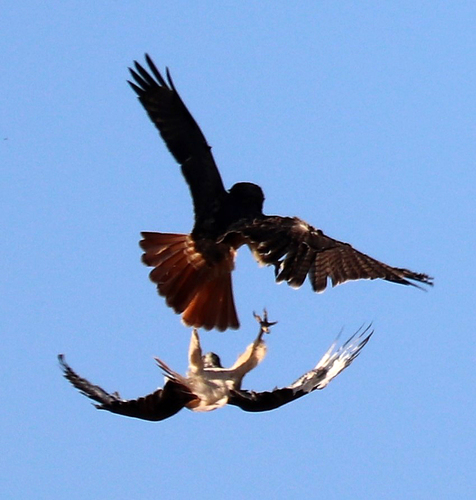 Buse à queue rousse
En bref
The most reliable field mark between Hawaiian Hawk and Red-tailed Hawk is the tail: adult Red-tailed Hawks show a distinctive brick-red tail (with a single dark band), while Hawaiian Hawks never do—regardless of age or morph. Juvenile Red-tailed Hawks have brown, banded tails, but even then, their overall size, structure, and belly band pattern differ from the Hawaiian Hawk. The Hawaiian Hawk is smaller, more compact, and only found on Hawaiʻi Island, while Red-tailed Hawks are bulkier, blockier, and widespread across North America. Both species show dark and light morphs, so color alone is not safe for identification; instead, focus on tail color, size, and structure, especially in flight.
Conseils d’identification
- Tail color (adults): Adult Red-tailed Hawks have a brick-red tail with a single dark band at the tip—never seen in Hawaiian Hawk of any age or morph.
- Tail pattern (juveniles): Juvenile Red-tailed Hawks show a brown tail with about six dark bands; Hawaiian Hawk juveniles never show this pattern, and their tail is always brown without strong banding.
- Belly band: Most Red-tailed Hawks (especially light morphs) show a dark belly band of horizontal streaks across a pale underbelly, visible in both perched and flying birds. Hawaiian Hawks lack this feature in all plumages.
- Overall size and structure: Red-tailed Hawks are larger, bulkier, and blockier, with thick bodies and broad wings. Hawaiian Hawks are smaller, more compact, and slimmer, with a proportionally longer tail.
- Wing shape in flight: Red-tailed Hawks have broad, rounded wings and a short, wide tail, giving a stocky silhouette. Hawaiian Hawks have narrower, more pointed wings and a longer, slimmer tail, appearing more agile and less massive.
- Color morphs: Both species can be dark or light, so plumage color alone is not reliable. Always check for tail pattern and belly band.
- Leg color (age): Juvenile Hawaiian Hawks have greenish legs, turning yellow in adults. Red-tailed Hawks have yellow legs and feet at all ages.
- Yellow forecap (breeding): During breeding, one Hawaiian Hawk (likely the female) may show a yellow patch above the bill; Red-tailed Hawks never show this feature.
- Habitat and location: Hawaiian Hawk is only found on Hawaiʻi Island, usually in native forest. Red-tailed Hawk is widespread in North America and can be found in a wide range of open and semi-open habitats.
- Perching behavior: Red-tailed Hawks often perch on exposed poles, wires, or trees in open country. Hawaiian Hawks are more likely to be seen in forested areas and are less tolerant of open or human-altered habitats.
- Flight style: Red-tailed Hawks soar with slow, heavy wingbeats and often glide on broad wings. Hawaiian Hawks are quicker and more buoyant in flight.
- Bill and head: Red-tailed Hawks have a short, dark, hooked bill and a head that can look small against their thick body. Hawaiian Hawks have a proportionally larger head for their size.
- Iris color (age): Juvenile Red-tailed Hawks have yellowish irises that darken with age; this is not a noted feature in Hawaiian Hawk.
- If in doubt: If you see a raptor with a red tail, it is not a Hawaiian Hawk. If you see a small, compact Buteo in forest on Hawaiʻi Island, it is almost certainly a Hawaiian Hawk.
- When marks fail: In poor light or at distance, focus on shape, size, and tail pattern rather than overall color.
Taille
Red-tailed Hawk is noticeably larger and bulkier than Hawaiian Hawk. Red-tailed Hawk length is typically 45–65 cm (18–26 in), with females being larger, while Hawaiian Hawk is smaller at 40–46 cm (16–18 in) [wikipedia, avonet]. Red-tailed Hawks also appear heavier and more robust, with a thick body and broad wings, compared to the more compact and slimmer Hawaiian Hawk. In hand, Hawaiian Hawk females average around 605 g, males 441 g; Red-tailed Hawk is heavier overall, but precise weights are not detailed here. In the field, Red-tailed Hawks look blockier and more imposing, especially when perched.
Plumage
Juvenile and immature plumage is often the source of confusion. Juvenile Red-tailed Hawks lack the red tail, instead showing a brown tail with several dark bands (about six), and a pale underbelly with a distinct dark belly band formed by horizontal streaks—this belly band is a key mark in most morphs. Their underparts may also be heavily spotted. Adult Red-tailed Hawks develop the classic red tail (brick-red above, buff-orange below) with a single dark band at the tip. Hawaiian Hawks come in two color morphs: dark (dark brown head, breast, and underwings) and light (dark head, pale breast and underwings). They never show a red tail or a belly band. Juvenile Hawaiian Hawks have greenish legs (adults yellow), and during breeding, one bird (likely the female) may show a yellow forecap above the bill. Both species can appear dark or light, so morph alone is not diagnostic. In flight, Red-tailed Hawks have broader wings and shorter tails, while Hawaiian Hawks appear more compact and less blocky.
Comportement
Red-tailed Hawks often perch conspicuously on poles, trees, or other high vantage points, scanning for prey. They are tolerant of human presence and frequently seen along roadsides or open country. Hawaiian Hawks are more restricted to forested areas on Hawaiʻi Island and are less likely to be seen in open habitats or near human activity. In flight, Red-tailed Hawks soar with broad, rounded wings and a relatively short, wide tail, often showing a slow, heavy wingbeat. Hawaiian Hawks are more agile and compact in flight, with a quicker, more buoyant flight style.
Habitat
Habitat is a strong clue: Hawaiian Hawk is endemic to the Big Island of Hawaiʻi and breeds only there, primarily in native ʻōhiʻa lehua forests. If you are not on Hawaiʻi Island, you are not seeing a Hawaiian Hawk. Red-tailed Hawk is widespread across North America and occupies a vast range of habitats, from forests and fields to deserts, mountains, and even urban areas. Red-tailed Hawks are highly adaptable and can be found almost anywhere except dense unbroken forest or high Arctic.