
crested serpent-eagle vs wallace's hawk-eagle
Spilornis cheela versus Nisaetus nanus
Jogue um quiz com crested serpent-eagle e wallace's hawk-eagle
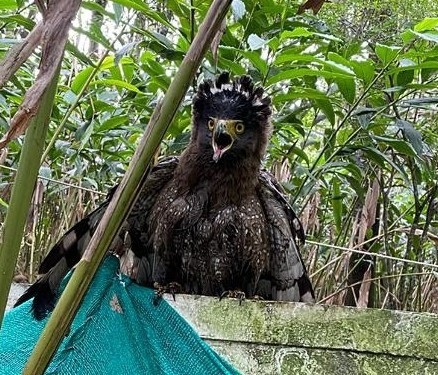 crested serpent-eagle
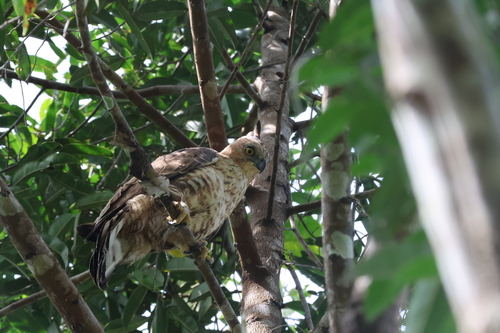 wallace's hawk-eagle
Em resumo
A marca de campo mais confiável para separar o crested serpent-eagle do wallace's hawk-eagle é a estrutura geral e a silhueta de voo: o crested serpent-eagle é robusto e de asas largas, com uma cauda curta e arredondada e um pescoço grosso coroado por uma crista curta em forma de leque, enquanto o wallace's hawk-eagle é muito mais esbelto, com asas mais estreitas e uma cauda mais longa e graduada. Em voo, o crested serpent-eagle exibe asas largas em forma de pá, mantidas em um V raso, e uma cauda e penas de voo com listras pretas e brancas; o wallace's hawk-eagle é mais ágil e semelhante a um accipiter, com uma cauda mais longa e um padrão de parte inferior menos contrastante. Os juvenis de crested serpent-eagle são mais claros na cabeça e mostram mais branco na parte inferior, mas ainda mantêm a silhueta robusta. O tamanho também é uma pista forte: o crested serpent-eagle é muito maior e mais robusto que o wallace's hawk-eagle. Ambas as espécies ocorrem em florestas do Sudeste Asiático, mas o wallace's hawk-eagle está mais estritamente ligado a florestas de planície.
Dicas de identificação
- A estrutura é fundamental: O crested serpent-eagle é robusto, com um pescoço grosso, asas largas em forma de pá e uma cauda curta e arredondada. O wallace's hawk-eagle é muito mais esbelto, com asas mais estreitas e pontiagudas e uma cauda mais longa e graduada. Essa diferença é óbvia tanto empoleirado quanto em voo.
- Cresta e forma da cabeça: O crested serpent-eagle tem uma crista nuchal curta, em forma de leque, preta e branca, que lhe confere uma aparência de pescoço grosso e cabeça grande. O wallace's hawk-eagle não possui esse pescoço grosso e tem um perfil de cabeça mais esbelto.
- Silhueta de voo: Em voo planado, o crested serpent-eagle mantém suas asas largas em um V raso, com uma cauda curta e corpo robusto. O wallace's hawk-eagle voa com mais agilidade semelhante a um accipiter, com cauda mais longa e asas mais estreitas.
- Padrão da cauda: O crested serpent-eagle exibe listras pretas e brancas na cauda, visíveis tanto empoleirado quanto em voo. A cauda do wallace's hawk-eagle é menos listrada e mais longa em proporção ao corpo.
- Padrão da parte inferior das asas e penas de voo: O crested serpent-eagle tem listras brancas largas na parte inferior das penas de voo e da cauda, criando uma aparência de alto contraste. A parte inferior das asas do wallace's hawk-eagle é menos contrastante e mais uniformemente marcada.
- Plumagem juvenil: Os jovens crested serpent-eagles têm muito branco na cabeça e partes inferiores, mas ainda mostram as largas listras brancas da cauda e das asas da espécie. O juvenil do wallace's hawk-eagle não apresenta tanto branco na cabeça, nem a mesma marcação ousada.
- Postura empoleirada: Quando empoleirado, as pontas das asas do crested serpent-eagle não alcançam a ponta da cauda, e a ave parece robusta. O wallace's hawk-eagle parece mais esbelto e de cauda longa.
- Partes nuas: O crested serpent-eagle tem pele facial nua amarela e pés, que podem ser visíveis a curta distância. As partes nuas do wallace's hawk-eagle não são descritas aqui, então use com cautela.
- Comportamento: O crested serpent-eagle passa muito do dia empoleirado em folhagem densa ou planando alto, frequentemente chamando. O wallace's hawk-eagle é mais propenso a ser visto voando ativamente pela copa das árvores ou ao longo das bordas da floresta.
- Habitat: Se visto em campo aberto, borda ou florestas de maior elevação, é mais provável que seja o crested serpent-eagle. O wallace's hawk-eagle está ligado a florestas úmidas de planície.
- Impressão de tamanho: Mesmo sem comparação direta, o crested serpent-eagle é muito maior e mais robusto que o wallace's hawk-eagle. Se a ave parecer pequena e ágil para um rapinante, suspeite do wallace's hawk-eagle.
- Vocalização: Se você ouvir um 'kluee-wip-wip' alto e ascendente, é diagnóstico para o crested serpent-eagle.
- Armadilhas: Ambas as espécies são marrons escuras por cima e podem parecer semelhantes à distância, mas a combinação de estrutura, padrão da cauda e das asas, e habitat deve separá-las na maioria das vistas.
- Sexo e estação: Nenhum dimorfismo sexual forte ou diferenças sazonais de plumagem são notados para qualquer uma das espécies, então todas essas marcas se aplicam durante todo o ano e a ambos os sexos.
- Se em dúvida: Foque na forma geral da ave, comprimento da cauda e padrão das asas em voo, e procure o pescoço grosso e a crista curta do crested serpent-eagle em comparação ao perfil esbelto e de cauda longa do wallace's hawk-eagle.
Tamanho
O crested serpent-eagle é significativamente maior e mais robusto que o wallace's hawk-eagle. Os adultos de crested serpent-eagle variam muito em tamanho em sua distribuição, mas mesmo as menores subespécies são mais pesadas e maiores que o wallace's hawk-eagle, cuja massa corporal média é de cerca de 555 g [wikidata]. Algumas raças de crested serpent-eagle podem exceder 1.500 g, com até mesmo aves pequenas do continente pesando cerca de 900 g. No campo, o crested serpent-eagle parece largo e robusto, enquanto o wallace's hawk-eagle é visivelmente menor, mais esbelto e mais leve.
Plumagem
Os juvenis e imaturos de crested serpent-eagle mostram muito branco na cabeça e partes inferiores, mas mantêm as largas listras brancas típicas da espécie na cauda e penas de voo, visíveis tanto empoleirados quanto em voo. Os adultos são marrons escuros por cima, com um pescoço grosso, crista curta em forma de leque e listras pretas e brancas ousadas na cauda e penas de voo abaixo. Em voo, a parte inferior das asas é escura com largas faixas claras, e as asas são largas e em forma de pá. O wallace's hawk-eagle, em contraste, não possui o pescoço grosso e a crista curta, e é mais uniformemente marcado abaixo, com menos contraste na parte inferior das asas e na cauda. Sua cauda é mais longa e mais graduada, e as asas são mais estreitas e pontiagudas. O juvenil do wallace's hawk-eagle não apresenta o extenso branco na cabeça ou as largas listras brancas do crested serpent-eagle. Ambas as espécies são marrons escuras por cima, mas a estrutura da águia e o padrão das asas/cauda são fundamentais.
Comportamento
O crested serpent-eagle passa a maior parte do dia empoleirado em folhagem densa, frequentemente chamando de um poleiro exposto e planando em térmicas com as asas mantidas em um V raso. É um predador de espera, frequentemente visto escaneando em busca de cobras e répteis. O wallace's hawk-eagle é mais ativo e ágil, frequentemente visto voando pela copa da floresta ou ao longo das bordas, e é menos provável de ser visto planando alto acima da floresta. O voo da águia é mais semelhante ao de um accipiter, com movimentos rápidos e ágeis e menos tempo gasto empoleirado em áreas abertas.
Habitat
Ambas as espécies habitam florestas do Sudeste Asiático, mas o crested serpent-eagle é mais adaptável, encontrado em uma variedade de habitats florestais, desde planícies até colinas e até mesmo perto de gramados úmidos. O wallace's hawk-eagle é mais restrito a florestas úmidas de planície subtropicais ou tropicais, especialmente na Península Malaia, Sumatra e Bornéu. Ver um rapinante em habitats abertos ou de borda, ou em elevações mais altas, é mais provável que indique o crested serpent-eagle.
Voz
O crested serpent-eagle tem um chamado distintivo e de longa distância descrito como 'kluee-wip-wip', com a primeira nota alta e ascendente, frequentemente repetida de um poleiro ou em voo. As vocalizações do wallace's hawk-eagle não são descritas nas notas fornecidas, então a voz é apenas diagnóstica se o chamado do crested serpent-eagle for ouvido.
crested serpent-eagle · wallace's hawk-eagle · Minhas aves difíceis